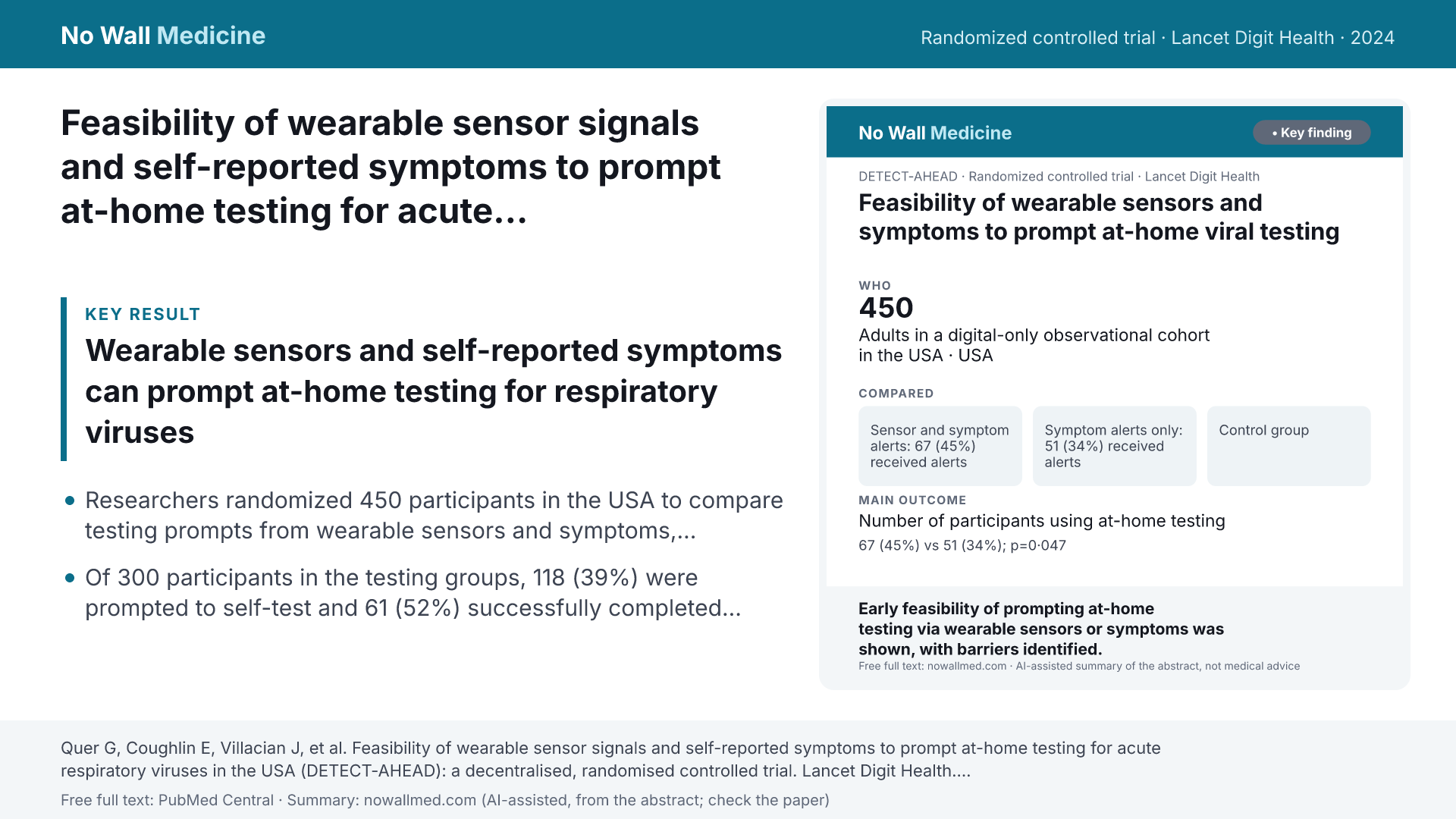
Wearable sensors and self-reported symptoms can prompt at-home testing for respiratory viruses
Feasibility of wearable sensor signals and self-reported symptoms to prompt at-home testing for acute respiratory viruses in the USA (DETECT-AHEAD): a decentralised, randomised controlled trial
Key points
- Researchers randomized 450 participants in the USA to compare testing prompts from wearable sensors and symptoms, symptoms alone, or no testing capability.
- Of 300 participants in the testing groups, 118 (39%) were prompted to self-test and 61 (52%) successfully completed the process.
- Among the 61 people who completed testing, 19 (31%) tested positive for a viral pathogen, all of which were SARS-CoV-2.
Headline and key points written with AI from the paper’s abstract, with every number checked against it. Read the paper before relying on them.
Was this summary helpful?
Abstract
Background
Early identification of an acute respiratory infection is important for reducing transmission and enabling earlier therapeutic intervention. We aimed to prospectively evaluate the feasibility of home-based diagnostic self-testing of viral pathogens in individuals prompted to do so on the basis of self-reported symptoms or individual changes in physiological parameters detected via a wearable sensor. Methods
DETECT-AHEAD was a prospective, decentralised, randomised controlled trial carried out in a subpopulation of an existing cohort (DETECT) of individuals enrolled in a digital-only observational study in the USA. Participants aged 18 years or older were randomly assigned (1:1:1) with a block randomisation scheme stratified by under-represented in biomedical research status. All participants were offered a wearable sensor (Fitbit Sense smartwatch). Participants in groups 1 and 2 received an at-home self-test kit (Alveo be.well) for two acute respiratory viral pathogens: SARS-CoV-2 and respiratory syncytial virus. Participants in group 1 could be alerted through the DETECT study app to take the at-home test on the basis of changes in their physiological data (as detected by our algorithm) or due to self-reported symptoms; those in group 2 were prompted via the app to self-test only due to symptoms. Group 3 served as the control group, without alerts or home testing capability. The primary endpoints, assessed on an intention-to-treat basis, were the number of acute respiratory infections presented (self-reported) and diagnosed (electronic health record), and the number of participants using at-home testing in groups 1 and 2. This trial is registered with ClinicalTrials.gov, NCT04336020. Findings
Between Sept 28 and Dec 30, 2021, 450 participants were recruited and randomly assigned to group 1 (n=149), group 2 (n=151), or group 3 (n=150). 179 (40%) participants were male, 264 (59%) were female, and seven (2%) identified as other. 232 (52%) were from populations historically under-represented in biomedical research. 118 (39%) of the 300 participants in groups 1 and 2 were prompted to self-test, with 61 (52%) successfully completing self-testing. Participants were prompted to home-test more frequently due to symptoms (41 [28%] in group 1 and 51 [34%] in group 2) than due to detected physiological changes (26 [17%] in group 1). Significantly more participants in group 1 received alerts to test than did those in group 2 (67 [45%] vs 51 [34%]; p=0·047). Of the 61 individuals who were prompted to test and successfully did so, 19 (31%) tested positive for a viral pathogen-all for SARS-CoV-2. The individuals diagnosed as positive for SARS-CoV-2 in the electronic health record were eight (5%) in group 1, four (3%) in group 2, and two (1%) in group 3, but it was difficult to confirm if they were tied to symptomatic episodes documented in the trial. There were no adverse events. Interpretation
In this direct-to-participant trial, we showed early feasibility of a decentralised programme to prompt individuals to use a viral pathogen diagnostic test based on symptoms tracked in the study app or physiological changes detected using a wearable sensor. Barriers to adequate participation and performance were also identified, which would need to be addressed before large-scale implementation. Funding
Janssen Pharmaceuticals.
Abstract reproduced under the article’s CC BY NC ND licence.
Subject terms
Headline, design, result, key points, caveat and citation as plain text.
Cite this article
Quer G, Coughlin E, Villacian J, et al. Feasibility of wearable sensor signals and self-reported symptoms to prompt at-home testing for acute respiratory viruses in the USA (DETECT-AHEAD): a decentralised, randomised controlled trial. Lancet Digit Health. 2024;6(8):e546-e554. doi:10.1016/S2589-7500(24)00096-7
Spotted a mistake? Suggest a correction