Federated learning models performed similarly to centralized machine learning for predicting mortality in clinical settings
Federated Learning-Based Model for Predicting Mortality: Systematic Review and Meta-Analysis
Systematic review and meta-analysisNo clear difference
How does federated learning compare to centralized machine learning for mortality prediction?
Who
1,412,973
Participants in cohort datasets across various clinical settings · Intensive care units, emergency departments, and trauma centers
Compared
0.81Federated learning (95% CI 0.76-0.85)
0.82Centralized machine learning (95% CI 0.77-0.86)
Main outcome
Area under the receiver operating curve
Result: no difference
Bottom line: Federated learning achieves similar mortality prediction performance to centralized machine learning while addressing privacy risks.
Limitation: Small number of studies and moderate proportion of high risk of bias.
J Med Internet Res · 2025-07-21Download image
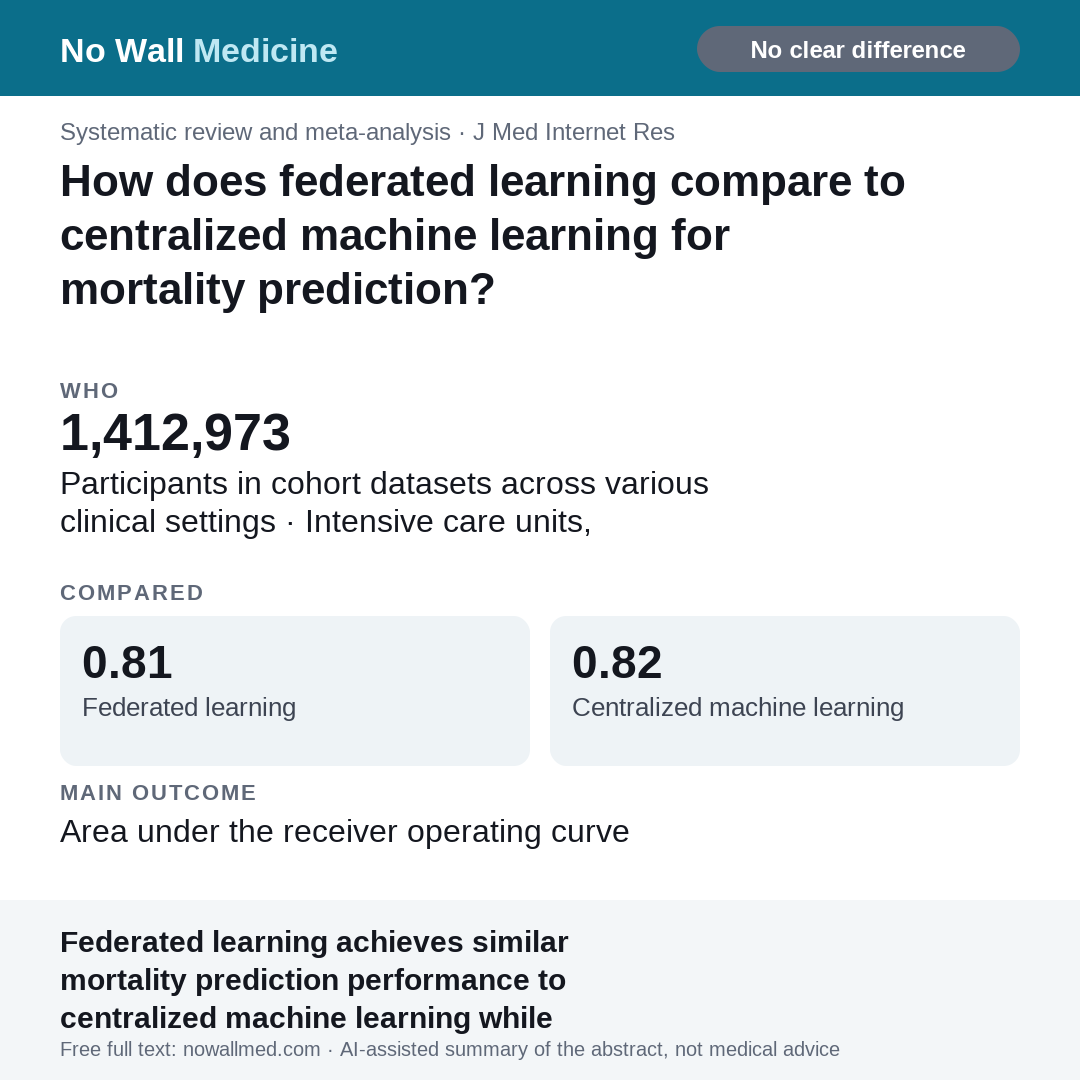
Clinical question: How does federated learning compare to centralized machine learning for mortality prediction?
Why it matters: There is a scarcity of clear and comprehensive evidence comparing the performance of federated learning with established centralized machine learning for mortality prediction in clinical domains.
Key points
- Researchers analyzed nine studies involving 1,412,973 participants to compare federated learning, a privacy-preserving decentralized technology, with centralized machine learning.
- The pooled area under the receiver operating curve, a measure of predictive accuracy, was 0.81 for federated learning and 0.82 for centralized machine learning.
- High heterogeneity was observed between studies, and 44% of the developed models were identified as having a high risk of bias.
Limitation the authors note: The authors state that the small number of studies and a moderate proportion of high risk of bias might make effect estimates imprecise.
Headline and key points written with AI from the paper’s abstract, with every number checked against it. Read the paper before relying on them.
Topics
Cite this article
Tahir N, Jung CR, Lee SD, Azizah N, Ho WC, Li TC. Federated Learning-Based Model for Predicting Mortality: Systematic Review and Meta-Analysis. J Med Internet Res. 2025. doi:10.2196/65708
Spotted a mistake? Suggest a correction
Top studies every Monday
The week’s key trials and guidelines in your specialties, plus any topics you follow. By email, free.
Get the weekly digest