Feno differentiates epithelial gene expression clusters: Exploratory analysis from the MESOS randomized controlled trial
Post hoc exploratory analysis of a phase II trialBenefit found
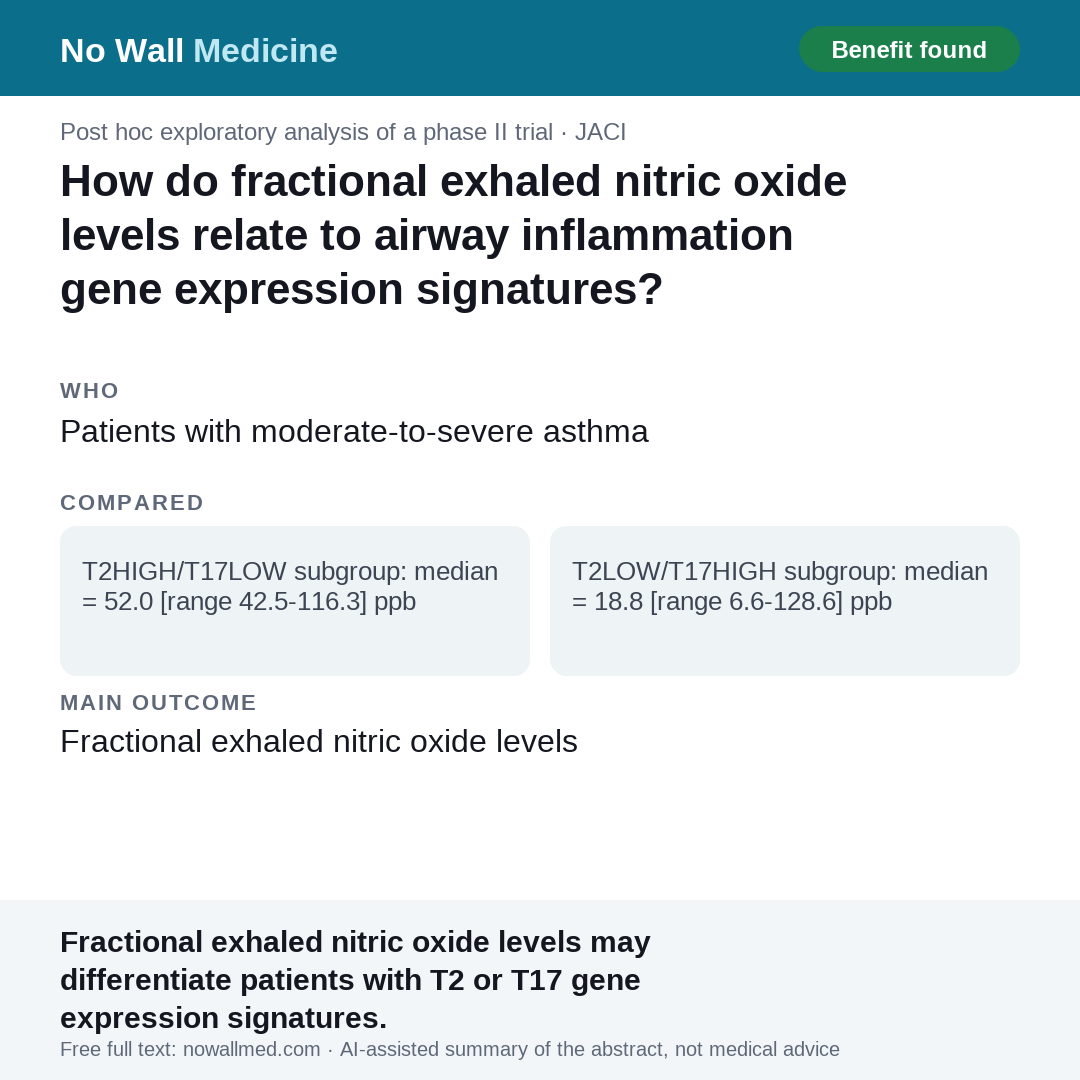
How do fractional exhaled nitric oxide levels relate to airway inflammation gene expression signatures?
Who
Patients with moderate-to-severe asthma
Compared
T2HIGH/T17LOW subgroup: median = 52.0 [range 42.5-116.3] ppb
T2LOW/T17HIGH subgroup: median = 18.8 [range 6.6-128.6] ppb
Main outcome
Fractional exhaled nitric oxide levels
Bottom line: Fractional exhaled nitric oxide levels may differentiate patients with T2 or T17 gene expression signatures.
JACI · 2022-05-07Download image
Clinical question: How do fractional exhaled nitric oxide levels relate to airway inflammation gene expression signatures?
Abstract
Background
Understanding how asthma biomarkers relate to gene expression signatures could help identify drivers of pathogenesis. Objective
This post hoc exploratory analysis of the phase II tralokinumab trial MESOS (ClinicalTrials.gov identifier NCT02449473) aimed to profile baseline airway inflammation in patients with moderate-to-severe asthma. Methods
The T2 and T17 gene expression signatures, 3-gene mean and 5-gene mean, were calculated through transcriptomic analysis of baseline bronchial brushing samples. Clustering analysis using these signatures identified 3 distinct inflammatory subgroups: T2LOW/T17HIGH (n = 33), T2HIGH/T17LOW (n = 10), and T2LOW/T17LOW (n = 27). Results
Fractional exhaled nitric oxide (Feno) levels were highest for T2HIGH/T17LOW and lowest for T2LOW/T17HIGH (median = 52.0 [range 42.5-116.3] and median = 18.8 [range 6.6-128.6] ppb, respectively; P = .003). High Feno levels were strongly correlated with high T2 gene expression (Spearman ρ = 0.5537; P < .001). Individual genes differentially expressed in patients with elevated levels of Feno, blood and bronchial submucosal eosinophil counts, and IgE level were explored, with cystatin SN (CST1) being the most upregulated gene in all subgroups (4.49- to 34.42-fold upregulation across clinically defined subgroups with high biomarker expression). Conclusion
Feno level may be useful to differentiate patients with T2 or T17 gene expression. Elevated Feno levels are associated with high CST1 expression.
Subject terms
Cite this article
Diver S, Sridhar S, Khalfaoui LC, Russell RJ, Emson C, Griffiths JM. Feno differentiates epithelial gene expression clusters: Exploratory analysis from the MESOS randomized controlled trial. JACI. 2022. doi:10.1016/j.jaci.2022.04.024
Spotted a mistake? Suggest a correction
Top studies every Monday
The week’s key trials and guidelines in your specialties, plus any topics you follow. By email, free.
Get the weekly digest