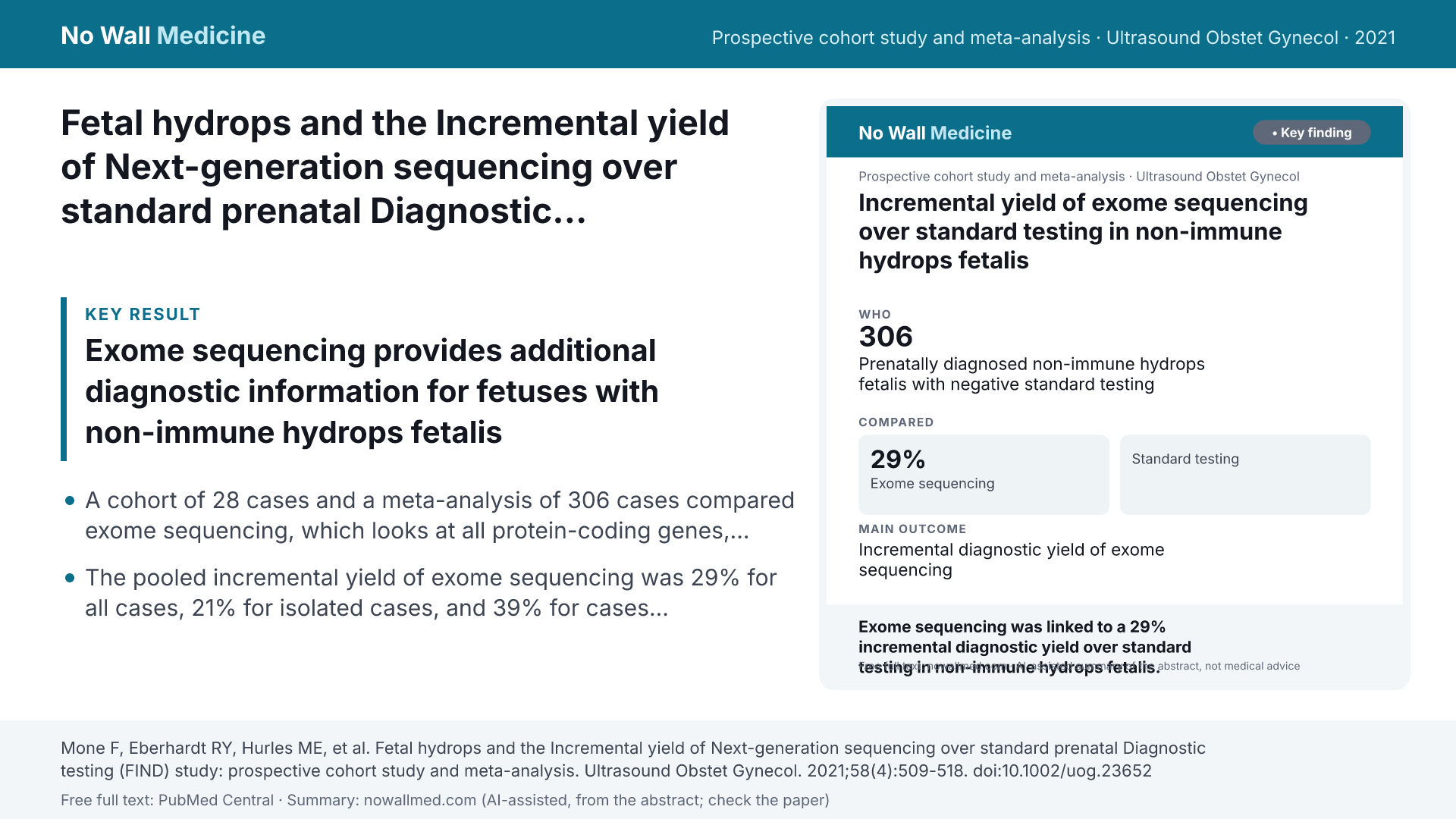
Exome sequencing provides additional diagnostic information for fetuses with non-immune hydrops fetalis
Fetal hydrops and the Incremental yield of Next-generation sequencing over standard prenatal Diagnostic testing (FIND) study: prospective cohort study and meta-analysis
Prospective cohort study and meta-analysisKey finding
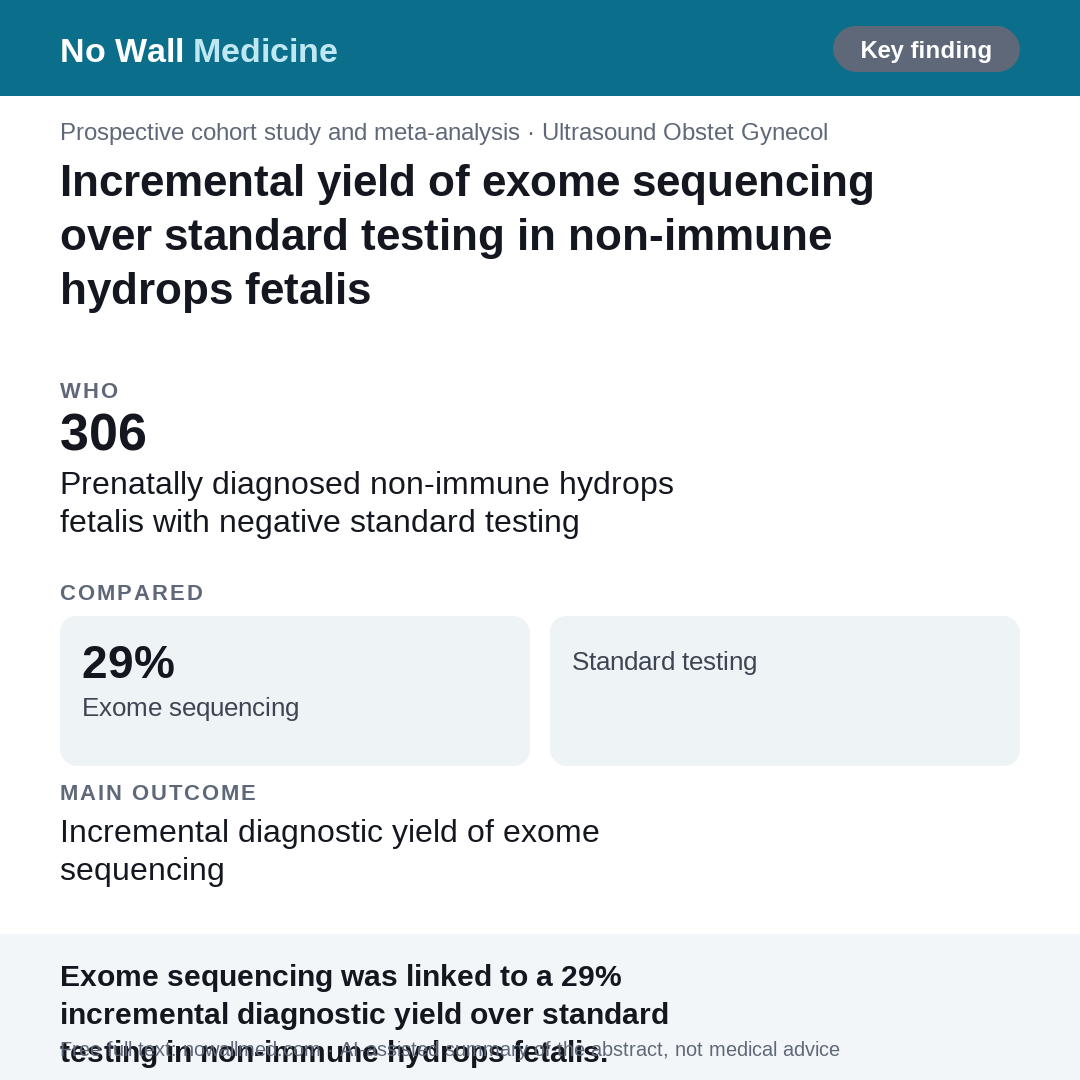
Incremental yield of exome sequencing over standard testing in non-immune hydrops fetalis
Who
306
Prenatally diagnosed non-immune hydrops fetalis with negative standard testing
Compared
29%Exome sequencing (95% CI, 24-34%)
Standard testing
Main outcome
Incremental diagnostic yield of exome sequencing
Result: 29% (95% CI, 24-34%)
Bottom line: Exome sequencing was linked to a 29% incremental diagnostic yield over standard testing in non-immune hydrops fetalis.
Ultrasound Obstet Gynecol · 2021-04-14Download image
Key points
- A cohort of 28 cases and a meta-analysis of 306 cases compared exome sequencing, which looks at all protein-coding genes, to standard chromosomal microarray or karyotyping.
- The pooled incremental yield of exome sequencing was 29% for all cases, 21% for isolated cases, and 39% for cases with additional structural anomalies.
- In cases where a genetic cause was found, RASopathies were the most common disorder at 30.3%, and 86.3% of monoallelic disease genes followed a de novo inheritance pattern.
Headline and key points written with AI from the paper’s abstract, with every number checked against it. Read the paper before relying on them.
Was this summary helpful?
Subject terms
Headline, design, result, key points, caveat and citation as plain text.
Cite this article
Mone F, Eberhardt RY, Hurles ME, et al. Fetal hydrops and the Incremental yield of Next-generation sequencing over standard prenatal Diagnostic testing (FIND) study: prospective cohort study and meta-analysis. Ultrasound Obstet Gynecol. 2021. doi:10.1002/uog.23652
Spotted a mistake? Suggest a correction