FFR-Guided Percutaneous Coronary Intervention vs Coronary Artery Bypass Grafting in Patients With Diabetes
Randomized clinical trial subgroup analysisNo clear difference
Is FFR-guided PCI or CABG better for patients with diabetes?
Who
428
Patients with 3-vessel coronary artery disease · 48 centers worldwide
Compared
FFR-guided PCI
CABG
Main outcome
Major adverse cardiac and cerebrovascular events at 3 years
Result: hazard ratio 1.44 (95% CI, 0.91-2.28)
Bottom line: In patients with diabetes, the relative benefit of CABG compared with FFR-guided PCI was similar to those without diabetes.
JAMA Cardiol · 2025-03-12Download image
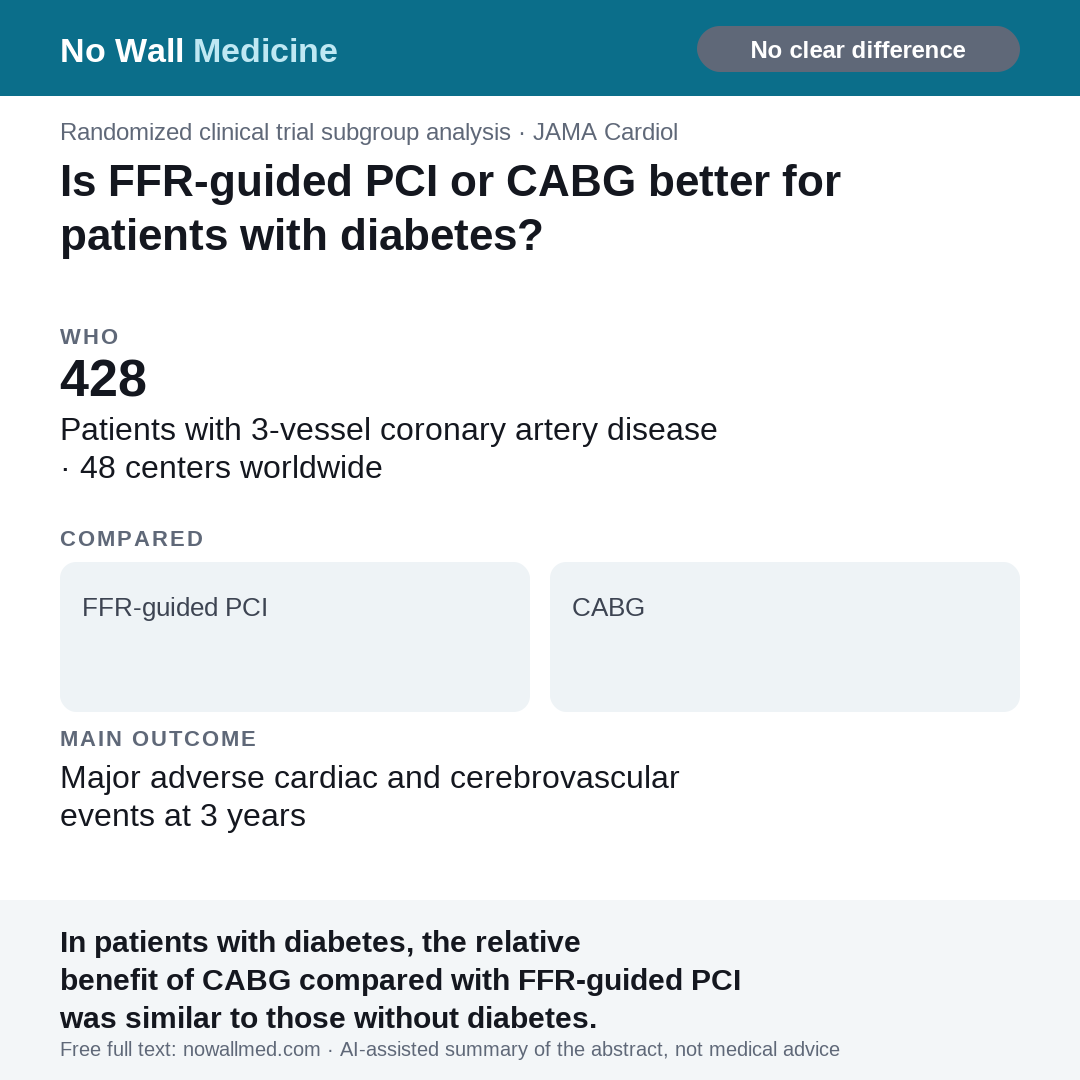
Clinical question: Is FFR-guided PCI or CABG better for patients with diabetes?
Abstract
Importance
Outcomes in patients with diabetes after fractional flow reserve (FFR)-guided percutaneous coronary intervention (PCI) using current-generation drug-eluting stents (DES) compared with coronary artery bypass grafting (CABG) are unknown. Objectives
To investigate the relative treatment effect of PCI vs CABG according to diabetes status with respect to major adverse cardiac and cerebrovascular events (MACCE) at 3 years and to evaluate the impact of the SYNTAX score. Design, setting, and participants
This is a prespecified subgroup analysis of the FAME (Fractional Flow Reserve vs Angiography for Multivessel Evaluation) 3 trial, an investigator-initiated, randomized clinical trial conducted at 48 centers worldwide. The FAME 3 trial enrolled patients with 3-vessel coronary artery disease not involving the left main undergoing coronary revascularization between August 2014 and December 2019. Data analysis was conducted in August 2023. Clinical follow-up was performed at hospital discharge and at 1 month, 6 months, 1 year, 2 years, and 3 years after randomization. Intervention
Either FFR-guided PCI with current-generation DES or CABG. Main outcomes and measures
The primary end point was MACCE, defined as the composite of all-cause death, myocardial infarction, stroke, or repeat revascularization at 3 years. Results
Of 1500 total patients enrolled, mean (SD) patient age was 65.1 (8.4) years, and 265 patients (17.7%) were female. The FAME 3 trial included 428 patients with diabetes (28.5%). Patients with diabetes, especially those receiving insulin, had a higher risk of MACCE at 3 years compared with those without diabetes. Regarding relative treatment effect, the risk of MACCE was higher after FFR-guided PCI compared with CABG in both patients with diabetes (hazard ratio [HR], 1.44; 95% CI, 0.91-2.28; P = .12) and those without diabetes (HR, 1.50; 95% CI, 1.08-2.07; P = .02), with no significant interaction (P for interaction = .94). In patients with a low SYNTAX score (<23), there was no significant difference in MACCE between PCI and CABG, while in patients with an intermediate to high SYNTAX score (≥23), PCI had a higher risk of MACCE than CABG, regardless of diabetes status. Conclusions and relevance
In this subgroup analysis of the FAME 3 randomized clinical trial, the relative benefit of CABG compared with FFR-guided PCI was similar among patients with and without diabetes. Trial registration
ClinicalTrials.gov Identifier: NCT02100722.
Topics
Cite this article
Takahashi K, Otsuki H, Zimmermann FM, Ding VY, Engstrøm T, Hørsted Thyregod HG. FFR-Guided Percutaneous Coronary Intervention vs Coronary Artery Bypass Grafting in Patients With Diabetes. JAMA Cardiol. 2025. doi:10.1001/jamacardio.2025.0095
Spotted a mistake? Suggest a correction
Top studies every Monday
The week’s key trials and guidelines in your specialties, plus any topics you follow. By email, free.
Get the weekly digest