FHL5 gene expression was linked to vascular calcification and smooth muscle cell contraction regulation
FHL5 Controls Vascular Disease-Associated Gene Programs in Smooth Muscle Cells
Multimodal approach with ex vivo and in vitro analysisMixed results
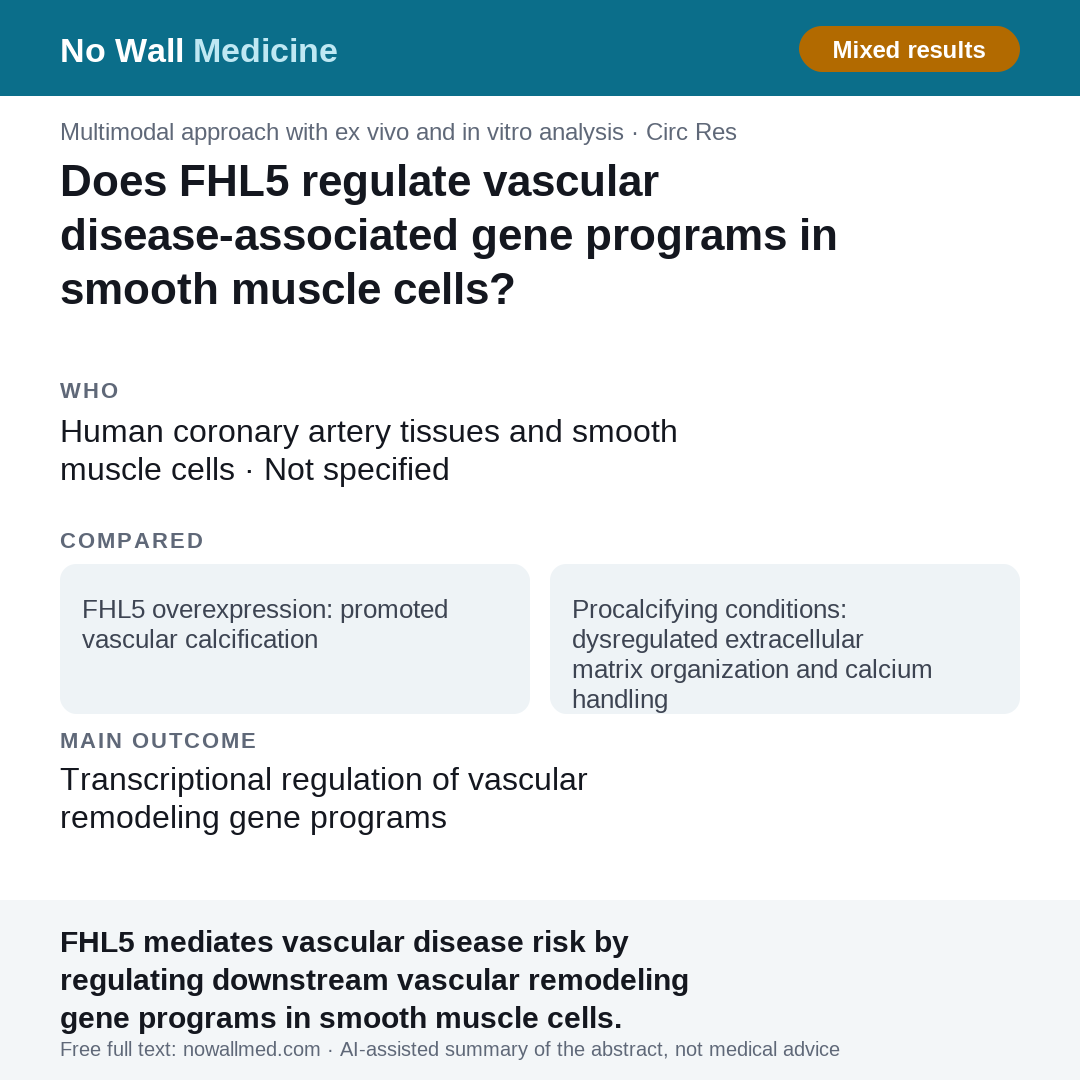
Does FHL5 regulate vascular disease-associated gene programs in smooth muscle cells?
Who
Human coronary artery tissues and smooth muscle cells · Not specified
Compared
FHL5 overexpression: promoted vascular calcification
Procalcifying conditions: dysregulated extracellular matrix organization and calcium handling
Main outcome
Transcriptional regulation of vascular remodeling gene programs
Bottom line: FHL5 mediates vascular disease risk by regulating downstream vascular remodeling gene programs in smooth muscle cells.
Circ Res · 2023-04-05Download image
Clinical question: Does FHL5 regulate vascular disease-associated gene programs in smooth muscle cells?
Why it matters: The specific molecular mechanisms for many genetic loci associated with coronary artery disease and myocardial infarction remain unknown.
Key points
- Researchers used statistical fine-mapping and human coronary artery tissue analysis to identify FHL5 as a candidate causal gene for vascular diseases.
- FHL5 expression was enriched in smooth muscle cells and pericytes, and its overexpression was linked to vascular calcification and dysregulated calcium handling.
- FHL5 was linked to regulatory interactions with downstream genes like FOXL1 and FN1, which play roles in vascular remodeling.
Headline and key points written with AI from the paper’s abstract, with every number checked against it. Read the paper before relying on them.
Topics
Cite this article
Wong D, Auguste G, Lino Cardenas CL, Turner AW, Chen Y, Song Y. FHL5 Controls Vascular Disease-Associated Gene Programs in Smooth Muscle Cells. Circ Res. 2023. doi:10.1161/CIRCRESAHA.122.321692
Spotted a mistake? Suggest a correction
Top studies every Monday
The week’s key trials and guidelines in your specialties, plus any topics you follow. By email, free.
Get the weekly digest