Fibrin-based scaffolds may improve healing and function after meniscal repair surgery
Fibrin-Based Scaffold Augmentation During Meniscal Repair May Enhance Healing and Functional Outcomes: A Systematic Review
Systematic reviewBenefit found
Does fibrin-based scaffold augmentation enhance healing and functional outcomes after meniscal repair?
Who
438
Patients with meniscal tears, mostly in avascular zones
Compared
Fibrin-based augmentation: superior outcomes
Nonaugmented repair
Main outcome
Healing rate, complication rate, and patient-reported outcome scores
Bottom line: Fibrin-based scaffolds achieved better healing and function compared to nonaugmented meniscal repair.
Am J Sports Med · 2026-06-03Download image
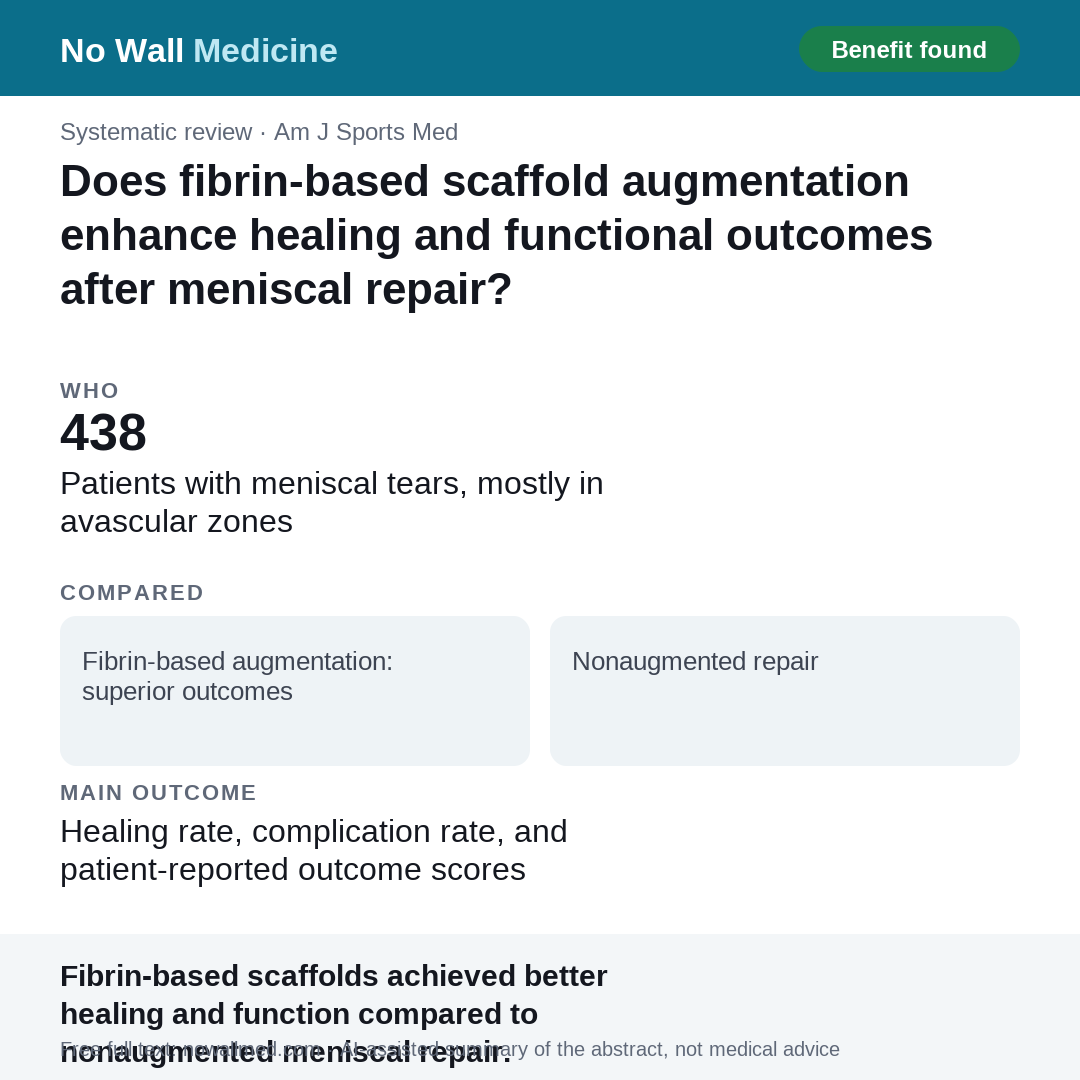
Clinical question: Does fibrin-based scaffold augmentation enhance healing and functional outcomes after meniscal repair?
Why it matters: Clinical outcomes for using biological scaffolds to help heal meniscal tears, especially in areas without blood supply, have been reported inconsistently.
Key points
- Researchers reviewed 15 studies involving 438 patients to compare meniscal repair with and without fibrin-based scaffolds, which are biological structures used to support tissue growth.
- Among 252 patients using fibrin clot from peripheral venous blood, 77.5% achieved complete healing, 12.2% had partial healing, and 10.3% experienced failure.
- Fibrin-based augmentation yielded superior outcomes compared to nonaugmented repair, though improvements in Tegner activity scores were not seen in all fibrin clot groups.
Headline and key points written with AI from the paper’s abstract, with every number checked against it. Read the paper before relying on them.
Topics
Spotted a mistake? Suggest a correction