Higher fibroblast activity biomarkers were associated with death in patients with severe COVID-19
Fibroblast activity biomarkers are associated with mortality in severe COVID-19: a post-hoc analysis of a phase 2 clinical trial
Post-hoc analysisHarm found
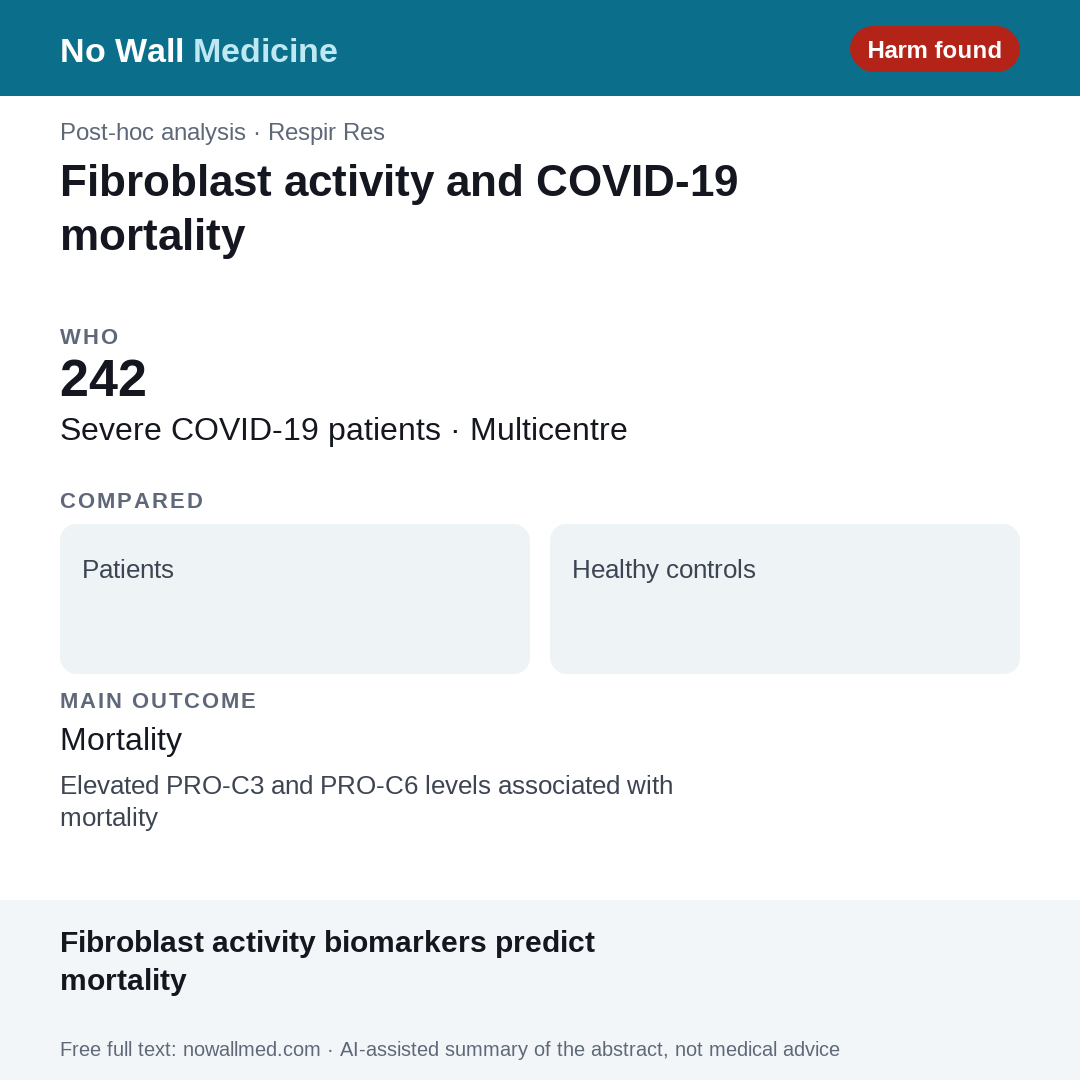
Fibroblast activity and COVID-19 mortality
Who
242
Severe COVID-19 patients · Multicentre
Compared
Patients
Healthy controls
Main outcome
Mortality
Result: Elevated PRO-C3 and PRO-C6 levels associated with mortality
Bottom line: Fibroblast activity biomarkers predict mortality
Respir Res · 2026-06-25Download image
Why it matters: It was unclear whether fibroblast activity, which increases in response to lung tissue damage, is associated with mortality in severe COVID-19.
Key points
- Researchers analyzed serum samples from 242 placebo-treated patients with severe COVID-19 and 20 healthy controls.
- Patients who died or experienced respiratory failure had higher levels of PRO-C3 and PRO-C6 biomarkers on day 1 compared to healthy controls.
- Elevated levels of these two biomarkers and their increase shortly before death were strongly associated with mortality.
Headline and key points written with AI from the paper’s abstract, with every number checked against it. Read the paper before relying on them.
Topics
Spotted a mistake? Suggest a correction