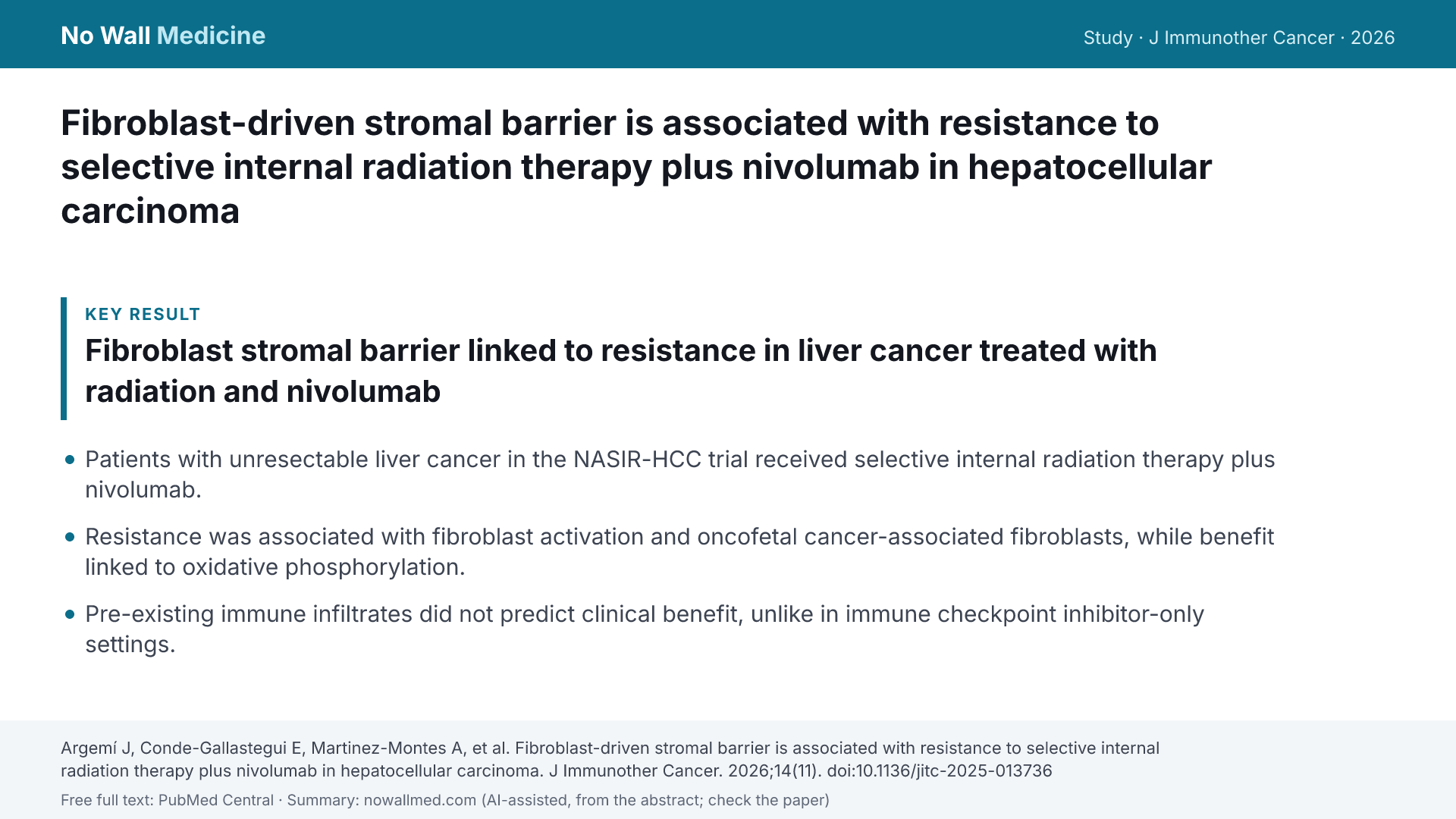
Fibroblast-driven stromal barrier is associated with resistance to selective internal radiation therapy plus nivolumab in hepatocellular carcinoma
Key result: Fibroblast stromal barrier linked to resistance in liver cancer treated with radiation and nivolumab
Key points
- Patients with unresectable liver cancer in the NASIR-HCC trial received selective internal radiation therapy plus nivolumab.
- Resistance was associated with fibroblast activation and oncofetal cancer-associated fibroblasts, while benefit linked to oxidative phosphorylation.
- Pre-existing immune infiltrates did not predict clinical benefit, unlike in immune checkpoint inhibitor-only settings.
Why it matters: Prediction of clinical benefit and mechanisms of resistance for selective internal radiation therapy plus nivolumab in liver cancer remain elusive.
Discussion prompts
- Would these patients look like yours? Who was left out?
- Is the main outcome one that matters to patients?
- Is the difference large enough to change what you do?
Cite: Argemí J, Conde-Gallastegui E, Martinez-Montes A, et al. Fibroblast-driven stromal barrier is associated with resistance to selective internal radiation therapy plus nivolumab in hepatocellular carcinoma. J Immunother Cancer. 2026. doi:10.1136/jitc-2025-013736
Free full text: PubMed Central · Summary and visual abstract: nowallmed.com/a/fibroblast-driven-stromal-barrier-is-associated-with-resistance-to-12kogkt/ (AI-assisted from the abstract; check the paper before relying on it).