Final Overall Survival Analysis of S1500: A Randomized, Phase II Study Comparing Sunitinib With Cabozantinib, Crizotinib, and Savolitinib in Advanced Papillary Renal Cell Carcinoma
Multicenter, randomized, phase II, open-label trialNo clear difference
Does cabozantinib, crizotinib, or savolitinib improve overall survival compared to sunitinib in advanced papillary renal cell carcinoma?
Who
147
Patients with advanced papillary renal cell carcinoma receiving up to one previous therapy · Multicenter
Compared
21.5 monthsCabozantinib (95% CI, 12.0 to 28.1)
17.3 monthsSunitinib (95% CI, 12.8 to 21.8)
Main outcome
Overall survival
Result: hazard ratio 0.83 (95% CI 0.51 to 1.36)
Bottom line: Cabozantinib showed no significant difference in overall survival compared to sunitinib in advanced papillary renal cell carcinoma.
J Clin Oncol · 2024-09-10Download image
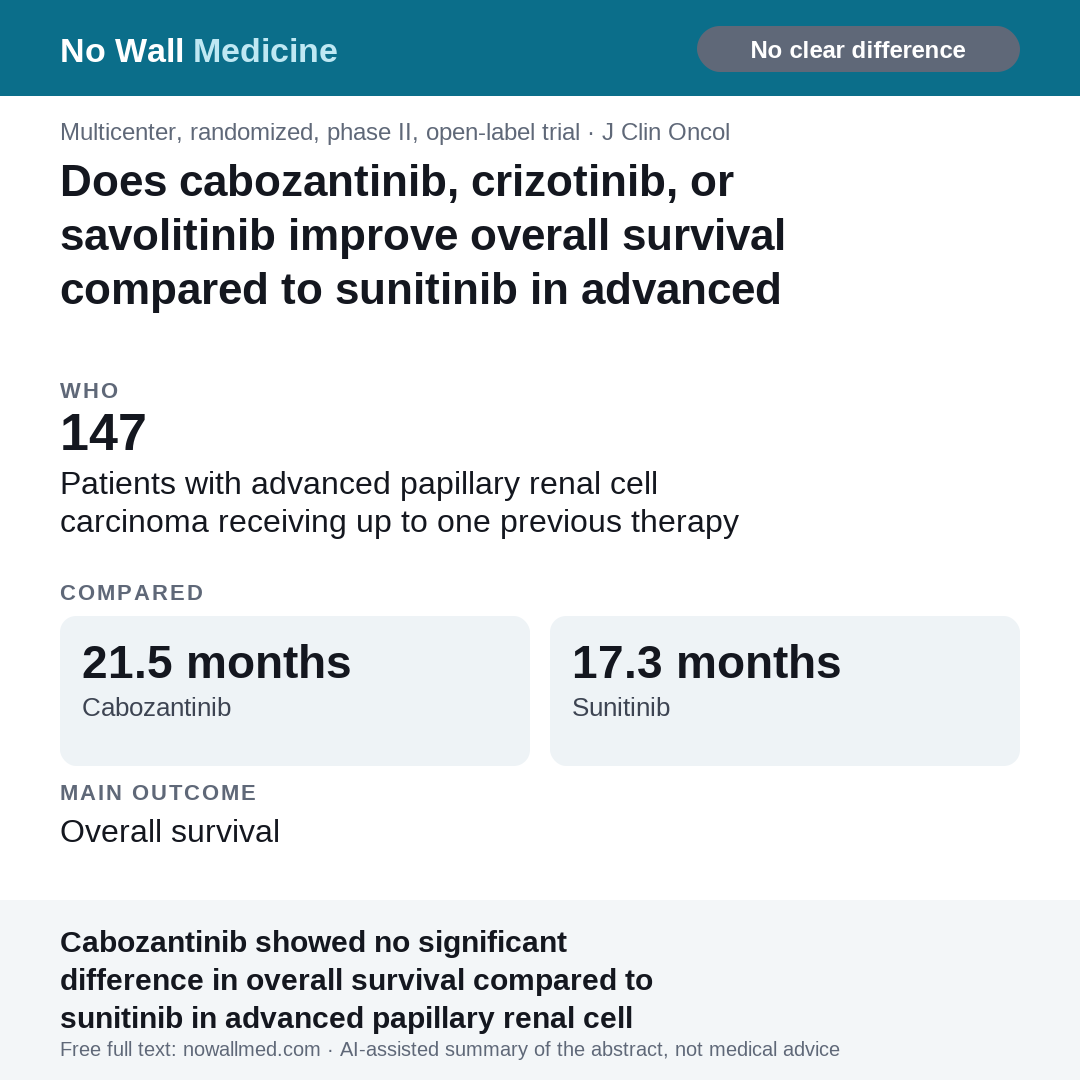
Clinical question: Does cabozantinib, crizotinib, or savolitinib improve overall survival compared to sunitinib in advanced papillary renal cell carcinoma?
Abstract
Clinical trials frequently include multiple end points that mature at different times. The initial report, typically based on the primary end point, may be published when key planned co-primary or secondary analyses are not yet available. Clinical Trial Updates provide an opportunity to disseminate additional results from studies, published in JCO or elsewhere, for which the primary end point has already been reported.Mesenchymal-epithelial transition (MET) signaling pathway plays a role in the pathogenesis of selected patients with papillary renal cell carcinoma (PRCC). In the phase II PAPMET trial (ClinicalTrials.gov identifier: NCT02761057), cabozantinib significantly prolonged progression-free survival and improved objective response rate compared with sunitinib in patients with advanced PRCC. Here, we present the final overall survival (OS) analysis. In this multicenter, randomized phase II, open-label trial, 147 patients with advanced PRCC who have received up to one previous therapy (excluding vascular endothelial growth factor-directed agents) were assigned to sunitinib, cabozantinib, crizotinib, or savolitinib. Ultimately, savolitinib and crizotinib arms were closed because of futility. With a median follow-up of 17.5 months, the median OS was 21.5 months (95% CI, 12.0 to 28.1) with cabozantinib and 17.3 months (95% CI, 12.8 to 21.8) with sunitinib (hazard ratio, 0.83; 95% CI, 0.51 to 1.36; P = .46). The OS landmark estimates for cabozantinib and sunitinib were 50% versus 39% at 24 months and 32% versus 28% at 36 months. In conclusion, we observed no significant difference in OS across treatment arms. Although cabozantinib represents a well-supported option for advanced PRCC, the lack of survival benefit underscores the need to develop novel therapies for this disease.
Subject terms
Cite this article
Barata P, Tangen C, Plets M, Thompson IM, Narayan V, George DJ. Final Overall Survival Analysis of S1500: A Randomized, Phase II Study Comparing Sunitinib With Cabozantinib, Crizotinib, and Savolitinib in Advanced Papillary Renal Cell Carcinoma. J Clin Oncol. 2024. doi:10.1200/JCO.24.00767
Spotted a mistake? Suggest a correction
Top studies every Monday
The week’s key trials and guidelines in your specialties, plus any topics you follow. By email, free.
Get the weekly digest