First-Attempt Success in Ultrasound-Guided vs Standard Peripheral Intravenous Catheter Insertion: The EPIC Superiority Randomized Clinical Trial
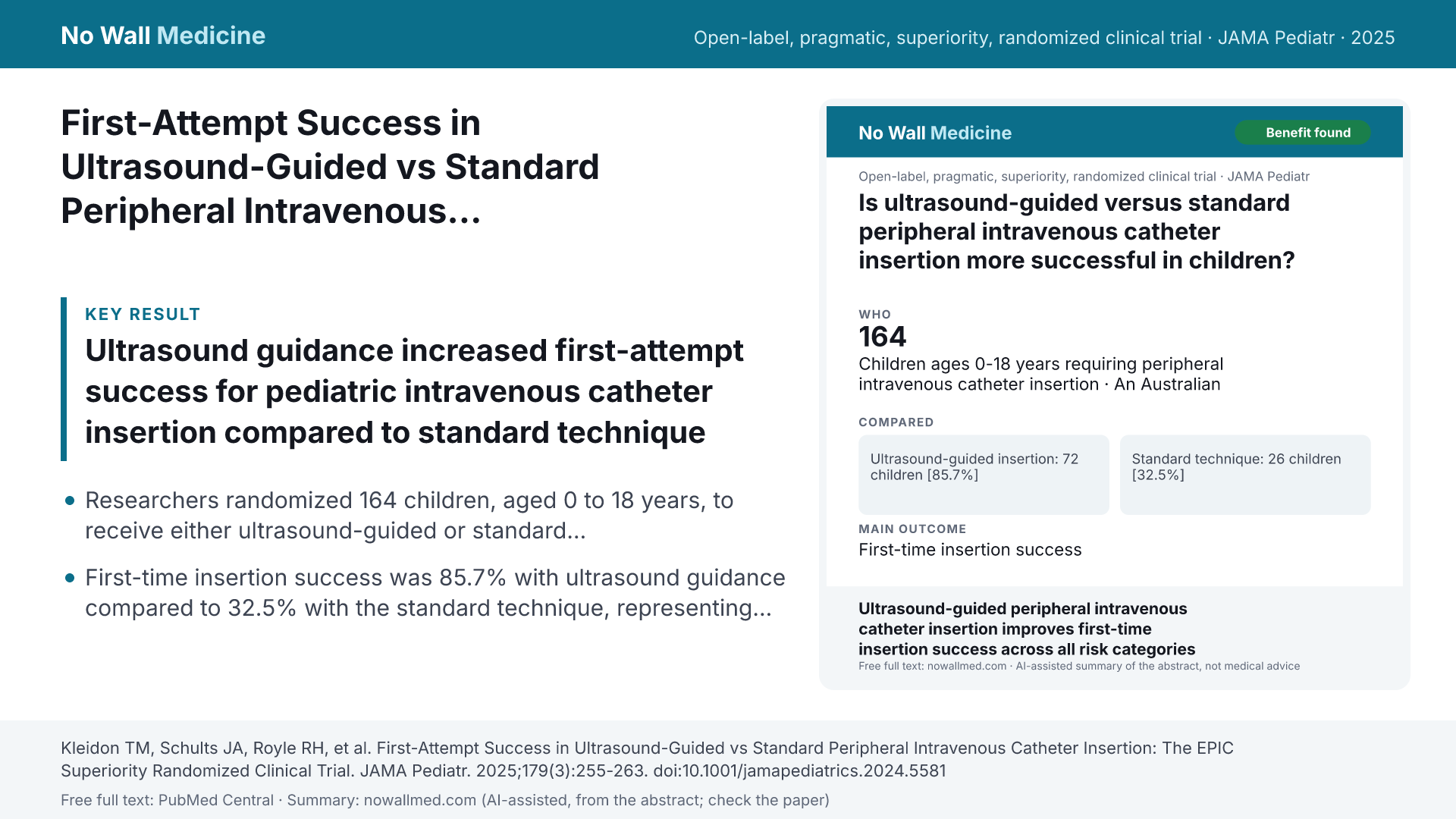
Key result: Ultrasound guidance increased first-attempt success for pediatric intravenous catheter insertion compared to standard technique
Open-label, pragmatic, superiority, randomized clinical trialBenefit found
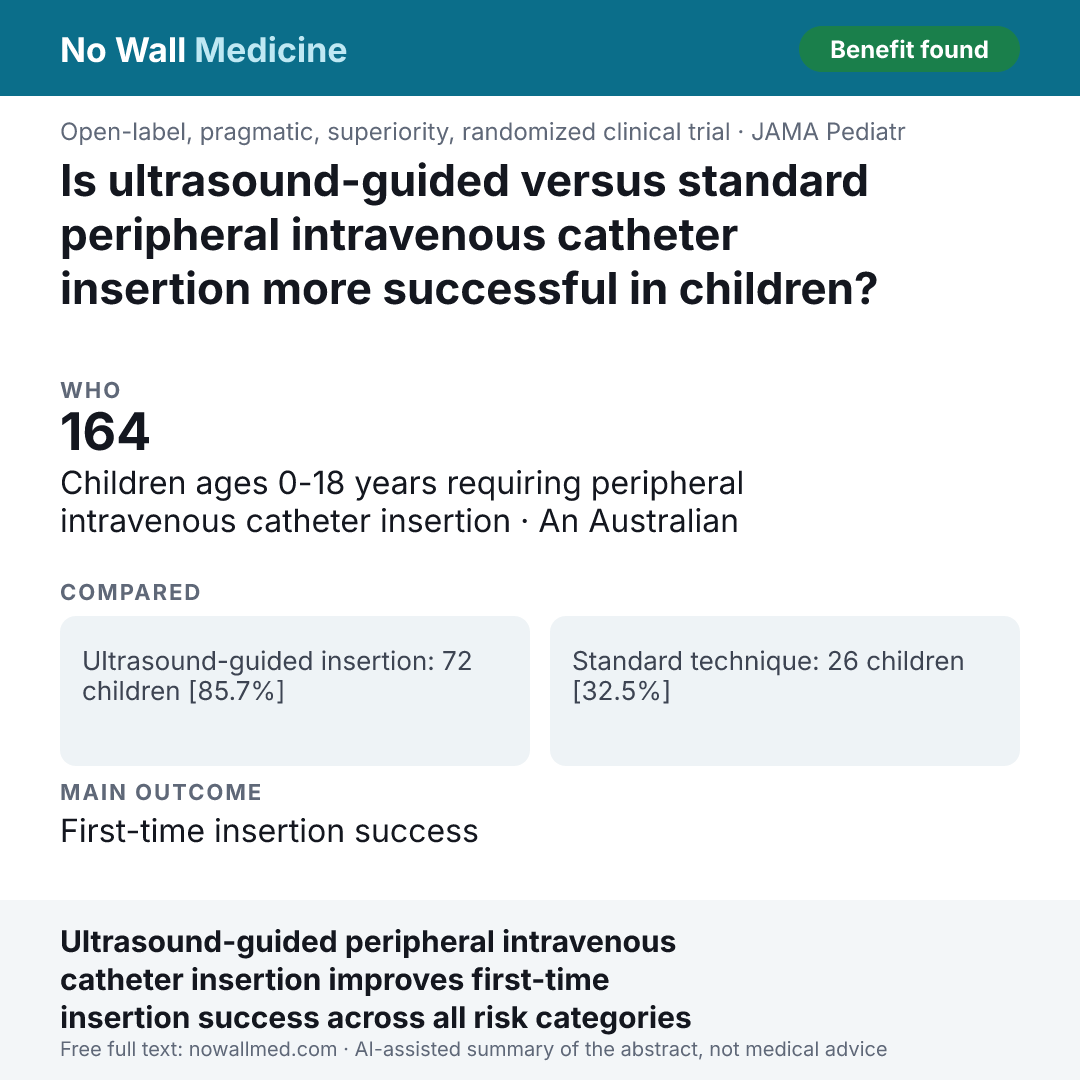
Is ultrasound-guided versus standard peripheral intravenous catheter insertion more successful in children?
Who
164
Children ages 0-18 years requiring peripheral intravenous catheter insertion · An Australian quaternary pediatric hospital
Compared
Ultrasound-guided insertion: 72 children [85.7%]
Standard technique: 26 children [32.5%]
Main outcome
First-time insertion success
Result: risk difference 53.6% (95% CI, 41.7%-65.4%)
Bottom line: Ultrasound-guided peripheral intravenous catheter insertion improves first-time insertion success across all risk categories in children.
JAMA Pediatr · 2025-01-27 · Save PNG
Key points
- Researchers randomized 164 children, aged 0 to 18 years, to receive either ultrasound-guided or standard peripheral intravenous catheter insertion using palpation and visualization.
- First-time insertion success was 85.7% with ultrasound guidance compared to 32.5% with the standard technique, representing a risk difference of 53.6%.
- Ultrasound-guided insertion was associated with higher immediate health care costs, with a mean difference of A$9.33 per person.
Discussion prompts
- Would these patients look like yours? Who was left out?
- Is the main outcome one that matters to patients?
- Is the difference large enough to change what you do?
Cite: Kleidon TM, Schults JA, Royle RH, et al. First-Attempt Success in Ultrasound-Guided vs Standard Peripheral Intravenous Catheter Insertion: The EPIC Superiority Randomized Clinical Trial. JAMA Pediatr. 2025;179(3):255-263. doi:10.1001/jamapediatrics.2024.5581
Free full text: PubMed Central · Summary and visual abstract: nowallmed.com/a/first-attempt-success-in-ultrasound-guided-vs-standard-peripheral-1xqrlhl/ (AI-assisted from the abstract; check the paper before relying on it).