High dose gene therapy was found to be safe in a small study of children with CLN7 disease
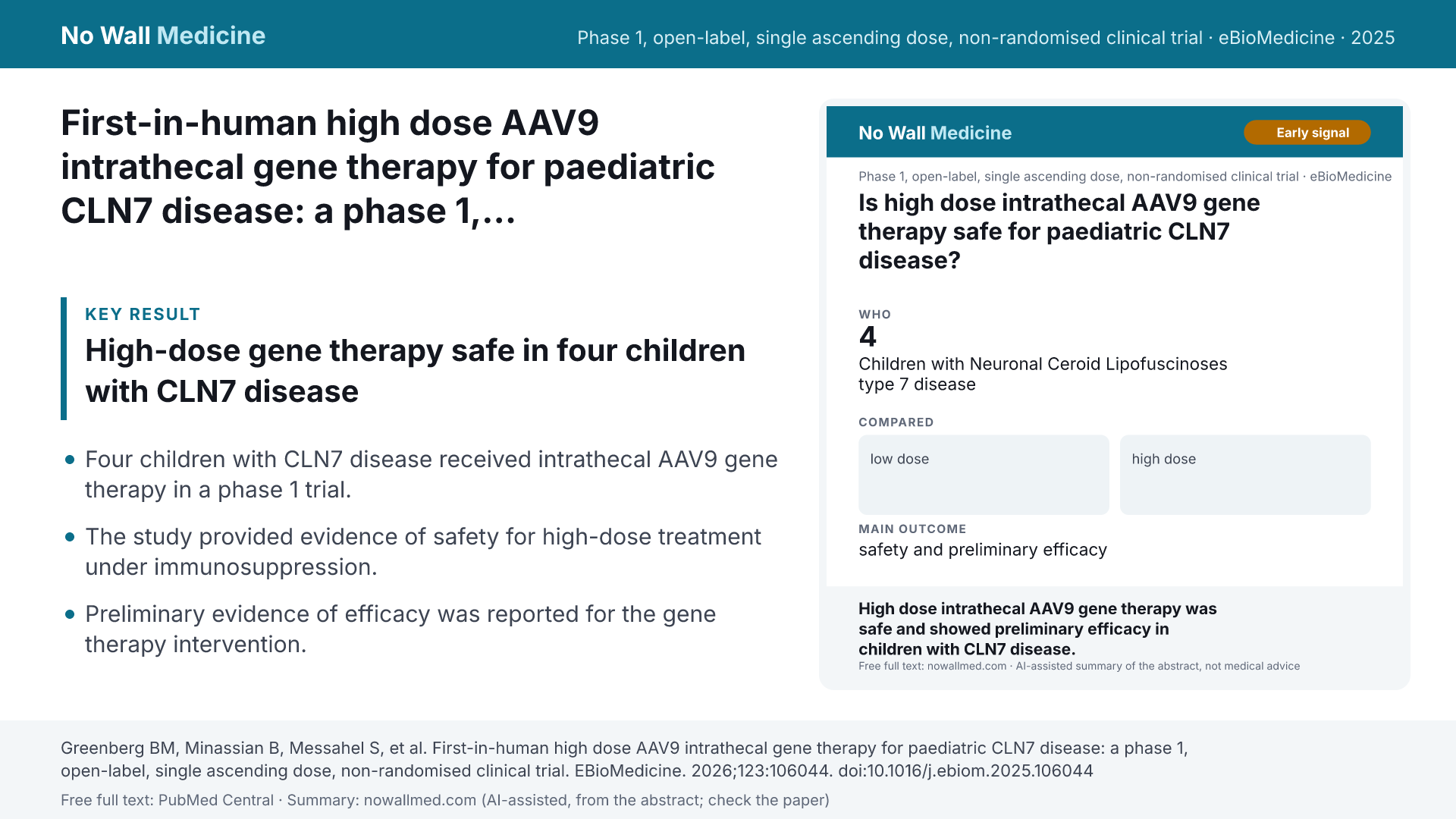
First-in-human high dose AAV9 intrathecal gene therapy for paediatric CLN7 disease: a phase 1, open-label, single ascending dose, non-randomised clinical trial
Phase 1, open-label, single ascending dose, non-randomised clinical trialEarly signal
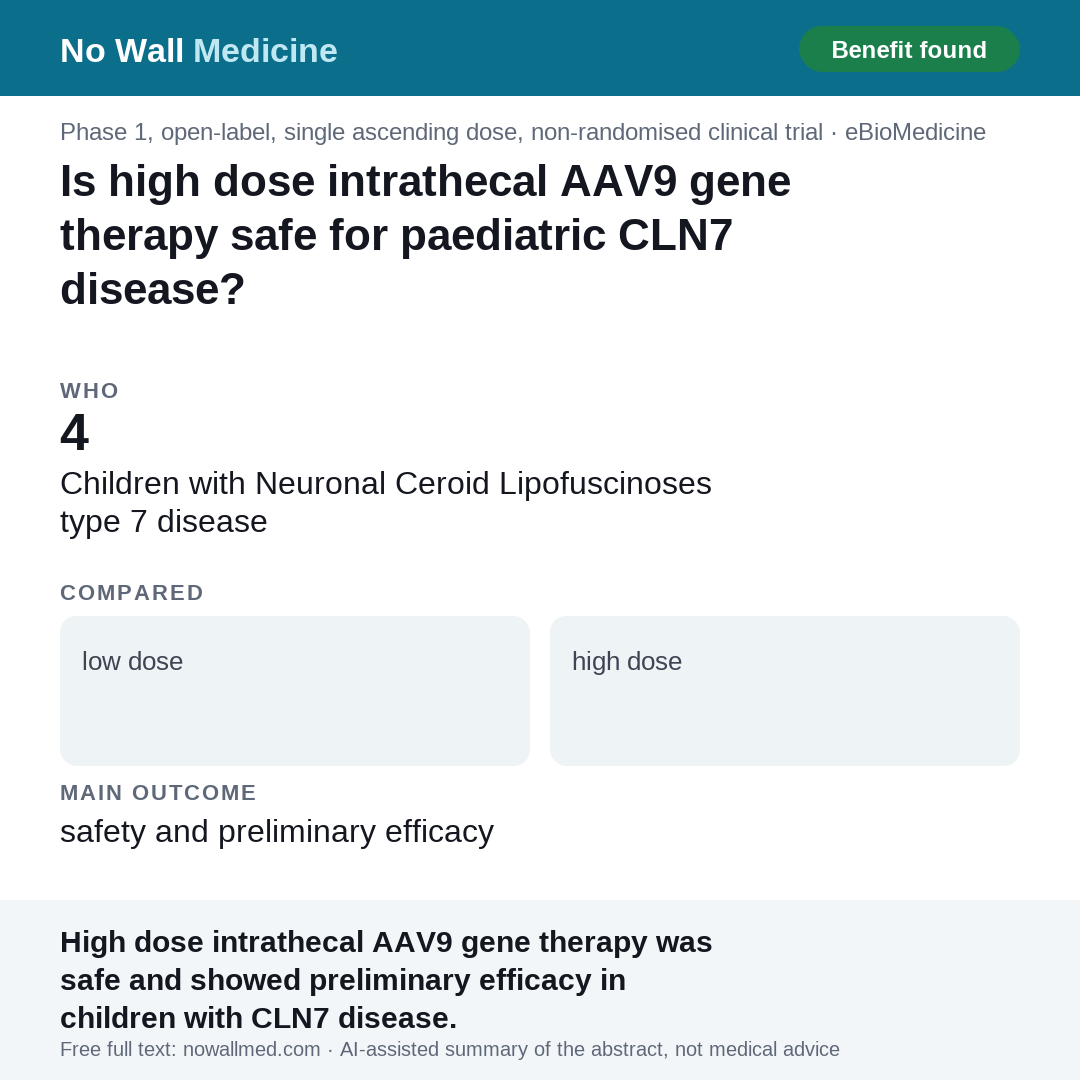
Is high dose intrathecal AAV9 gene therapy safe for paediatric CLN7 disease?
Who
4
Children with Neuronal Ceroid Lipofuscinoses type 7 disease
Compared
low dose
high dose
Main outcome
safety and preliminary efficacy
Bottom line: High dose intrathecal AAV9 gene therapy was safe and showed preliminary efficacy in children with CLN7 disease.
Limitation: Additional long-term monitoring of the immune system is needed during immunosuppression tapering.
Funded by: The Batten's Hope Foundation, Mila's Miracle Foundation, Children's Health Dallas
eBioMedicine · 2025-11-27Download image
Clinical question: Is high dose intrathecal AAV9 gene therapy safe for paediatric CLN7 disease?
Why it matters: There are currently no effective therapies for CLN7 disease, a condition caused by mutations of the MFSD8 gene that leads to progressive decline and death.
Key points
- The study followed 4 participants, including 1 receiving a low dose and 3 receiving a high dose, of adeno-associated virus serotype 9 (AAV9) gene therapy.
- High dose intrathecal gene therapy, which is delivered into the spinal fluid, was found to be safe under a specific immunosuppression regimen.
- The researchers also noted that the study provided preliminary evidence of efficacy for this gene therapy.
Limitation the authors note: The study was a phase 1, open-label, non-randomised clinical trial with only 4 participants.
Headline and key points written with AI from the paper’s abstract, with every number checked against it. Read the paper before relying on them.
Was this summary helpful?
Subject terms
Cite this article
Greenberg BM, Minassian B, Messahel S, et al. First-in-human high dose AAV9 intrathecal gene therapy for paediatric CLN7 disease: a phase 1, open-label, single ascending dose, non-randomised clinical trial. eBioMedicine. 2025. doi:10.1016/j.ebiom.2025.106044
Spotted a mistake? Suggest a correction