Mite allergoids given under the skin or under the tongue showed clinical improvement in allergy symptoms
First-in-human phase 2 trial with mite allergoids coupled to mannan in subcutaneous and sublingual immunotherapy
Randomized, double-blind, placebo-controlled trialBenefit found
Is house dust mite polymerized allergoid safe and effective via subcutaneous or sublingual administration?
Who
196
Subjects with house dust mite allergy
Compared
Active subcutaneous or sublingual groups: 45% to 62% (subcutaneous) and 44% to 61% (sublingual)
16%Placebo group
Main outcome
Improvement of titrated nasal provocation tests
Bottom line: House dust mite polymerized allergoid was safe and improved clinical outcomes via subcutaneous or sublingual administration.
Allergy · 2022-05-27Download image
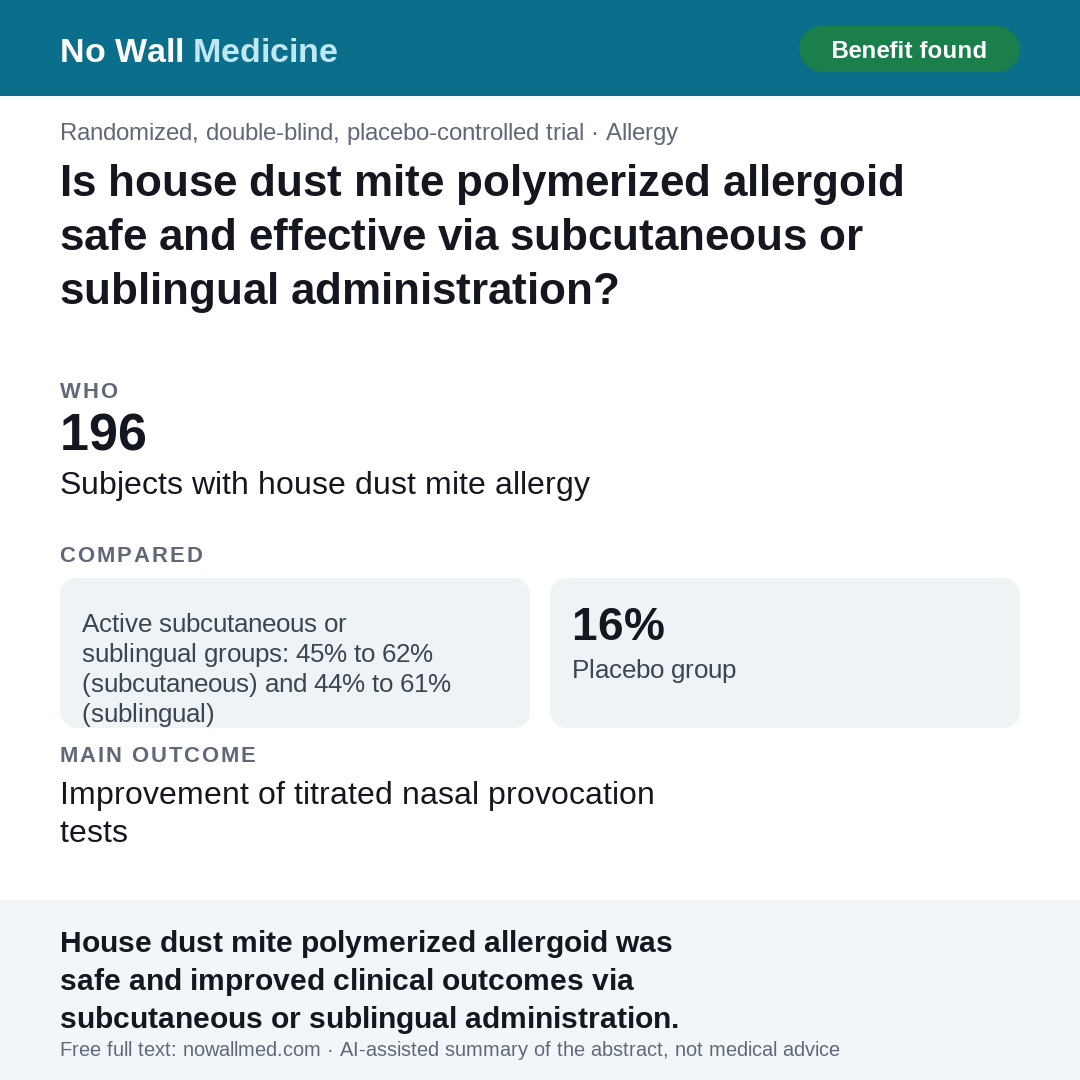
Clinical question: Is house dust mite polymerized allergoid safe and effective via subcutaneous or sublingual administration?
Why it matters: It was unknown if polymerized allergens conjugated to mannan are safe and effective when administered via subcutaneous or sublingual routes in humans.
In absolute numbers
Active subcutaneous or sublingual groups: 45% · Placebo group: 16% → a difference of 29 percentage points, so about 4 people would need the treatment for 1 more to benefit (number needed to treat) over the trial’s follow-up.
Worked out by us from the two group results above, not reported by the authors. Check the paper for the exact outcome and timing.
Key points
- In this randomized trial, 196 subjects received either a placebo or house dust mite allergoids at doses of 500, 1000, 3000, or 5000 mannan-conjugated therapeutic units per milliliter.
- Improvement in nasal provocation tests, a test measuring allergic reactions, was seen in 45% to 62% of subcutaneous groups and 44% to 61% of sublingual groups compared to 16% for placebo.
- No moderate or severe adverse reactions were reported during the 4 month study period.
Headline and key points written with AI from the paper’s abstract, with every number checked against it. Read the paper before relying on them.
Was this summary helpful?
Subject terms
Cite this article
Nieto A, Mazón Á, Nieto M, Ibáñez E, Jang DT, Calaforra S. First-in-human phase 2 trial with mite allergoids coupled to mannan in subcutaneous and sublingual immunotherapy. Allergy. 2022. doi:10.1111/all.15374
Spotted a mistake? Suggest a correction
Top studies every Monday
The week’s key trials and guidelines in your specialties, plus any topics you follow. By email, free.
Get the weekly digest