Sutureless drain securement device was faster to apply than traditional suture methods in a clinical trial
First-in-human Testing of a Novel Sutureless Drain Securement Device: A Randomized Clinical Trial
Randomized clinical trialBenefit found
Is the K-LOCK sutureless device effective and well-tolerated compared to suture-based securement?
Who
21
Patients 18 years or older undergoing surgery with bilateral drains
Compared
K-LOCK sutureless device: significantly faster (P = 0.0008)
Traditional suture
Main outcome
Time to secure drains, adverse outcomes, and patient satisfaction
Bottom line: The K-LOCK sutureless device is faster to secure and overwhelmingly favored by patients compared to traditional sutures.
Plast Reconstr Surg Glob Open · 2025-06-23Download image
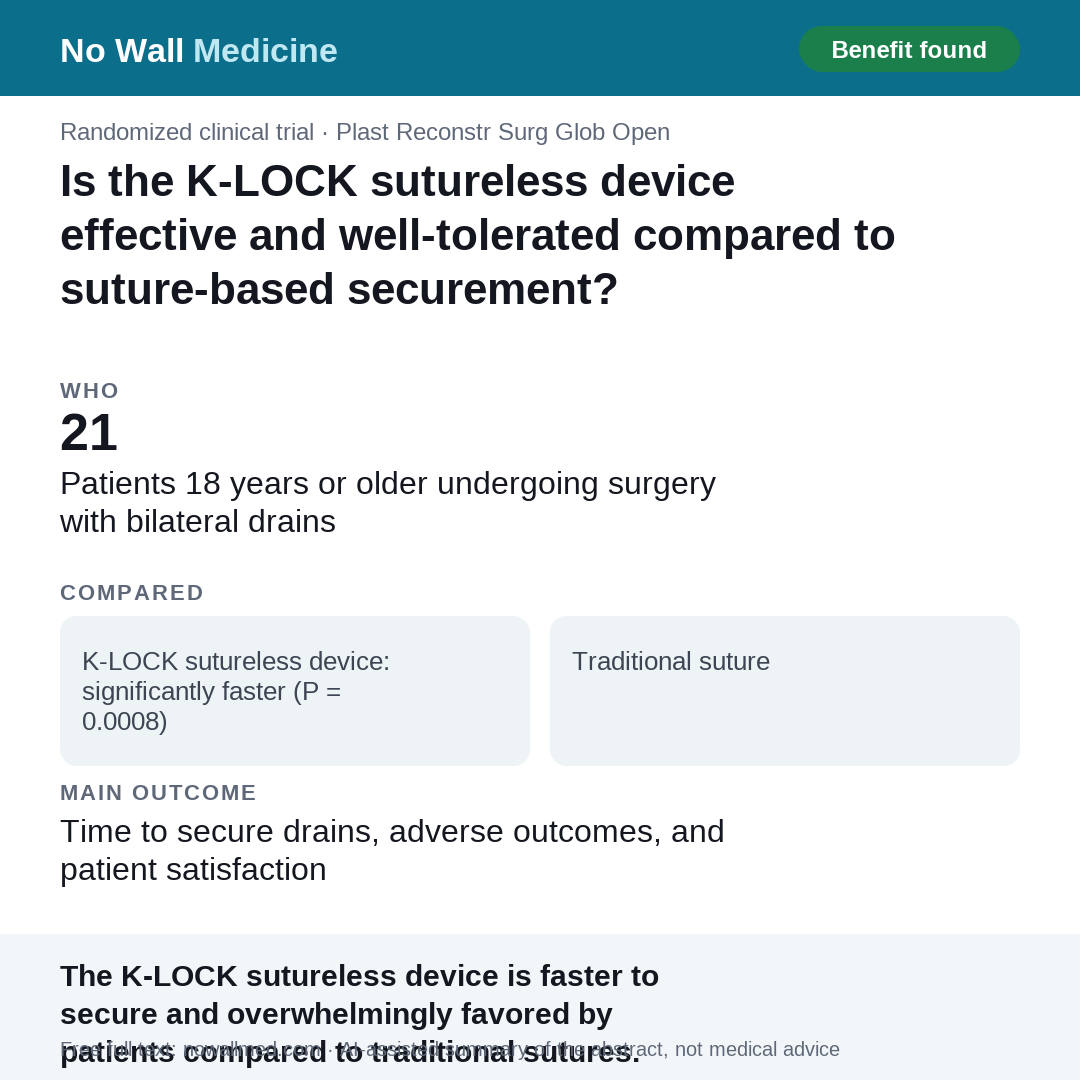
Clinical question: Is the K-LOCK sutureless device effective and well-tolerated compared to suture-based securement?
Why it matters: Standard suture-based methods for securing surgical drains are nonstandardized and can cause patient discomfort, skin irritation, or unintended loss of the drain.
Key points
- Researchers conducted a randomized trial with 21 patients undergoing surgery that required the placement of bilateral surgical drains.
- The K-LOCK sutureless device was significantly faster to secure than traditional sutures (P = 0.0008) with no drain securement failures.
- Blinded evaluations showed no significant difference between the two methods regarding skin redness (P = 0.9384) or blistering (P = 0.6058).
Headline and key points written with AI from the paper’s abstract, with every number checked against it. Read the paper before relying on them.
Cite this article
Duet ML, Zeng E, Boyajian MK, Browne DT, Peoples A, Tapp M. First-in-human Testing of a Novel Sutureless Drain Securement Device: A Randomized Clinical Trial. Plast Reconstr Surg Glob Open. 2025. doi:10.1097/GOX.0000000000006888
Spotted a mistake? Suggest a correction
Top studies every Monday
The week’s key trials and guidelines in your specialties, by email. Free.
Get the weekly digest