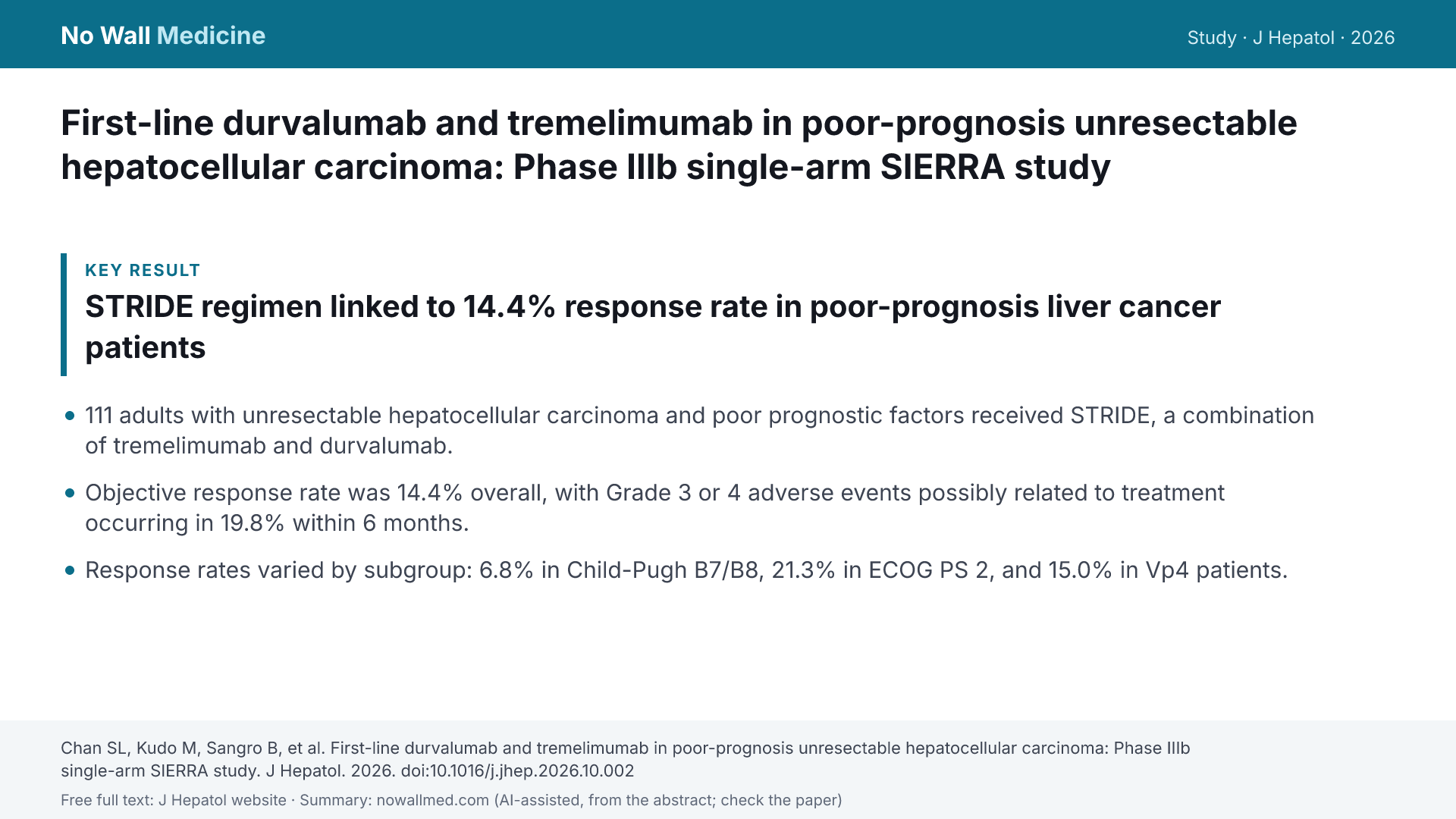
STRIDE regimen linked to 14.4% response rate in poor-prognosis liver cancer patients
First-line durvalumab and tremelimumab in poor-prognosis unresectable hepatocellular carcinoma: Phase IIIb single-arm SIERRA study
Why it matters: Patients with poor prognostic factors like impaired liver function are often excluded from major liver cancer trials despite comprising up to 65% of clinical cases.
Key points
- 111 adults with unresectable hepatocellular carcinoma and poor prognostic factors received STRIDE, a combination of tremelimumab and durvalumab.
- Objective response rate was 14.4% overall, with Grade 3 or 4 adverse events possibly related to treatment occurring in 19.8% within 6 months.
- Response rates varied by subgroup: 6.8% in Child-Pugh B7/B8, 21.3% in ECOG PS 2, and 15.0% in Vp4 patients.
Study type: Observational study: it can show a link, but not prove that one thing causes another.
Headline and key points written with AI from the paper’s abstract, with every number checked against it. Read the paper before relying on them.
Was this summary helpful?
Headline, design, result, key points, caveat and citation as plain text.
Cite this article
Chan SL, Kudo M, Sangro B, et al. First-line durvalumab and tremelimumab in poor-prognosis unresectable hepatocellular carcinoma: Phase IIIb single-arm SIERRA study. J Hepatol. 2026. doi:10.1016/j.jhep.2026.10.002
Spotted a mistake? Suggest a correction