First SARS-CoV-2 Omicron infection as an effective immune booster among mRNA vaccinated individuals: final results from the first phase of the PRIBIVAC randomised clinical trial
Randomised, controlled trialBenefit found
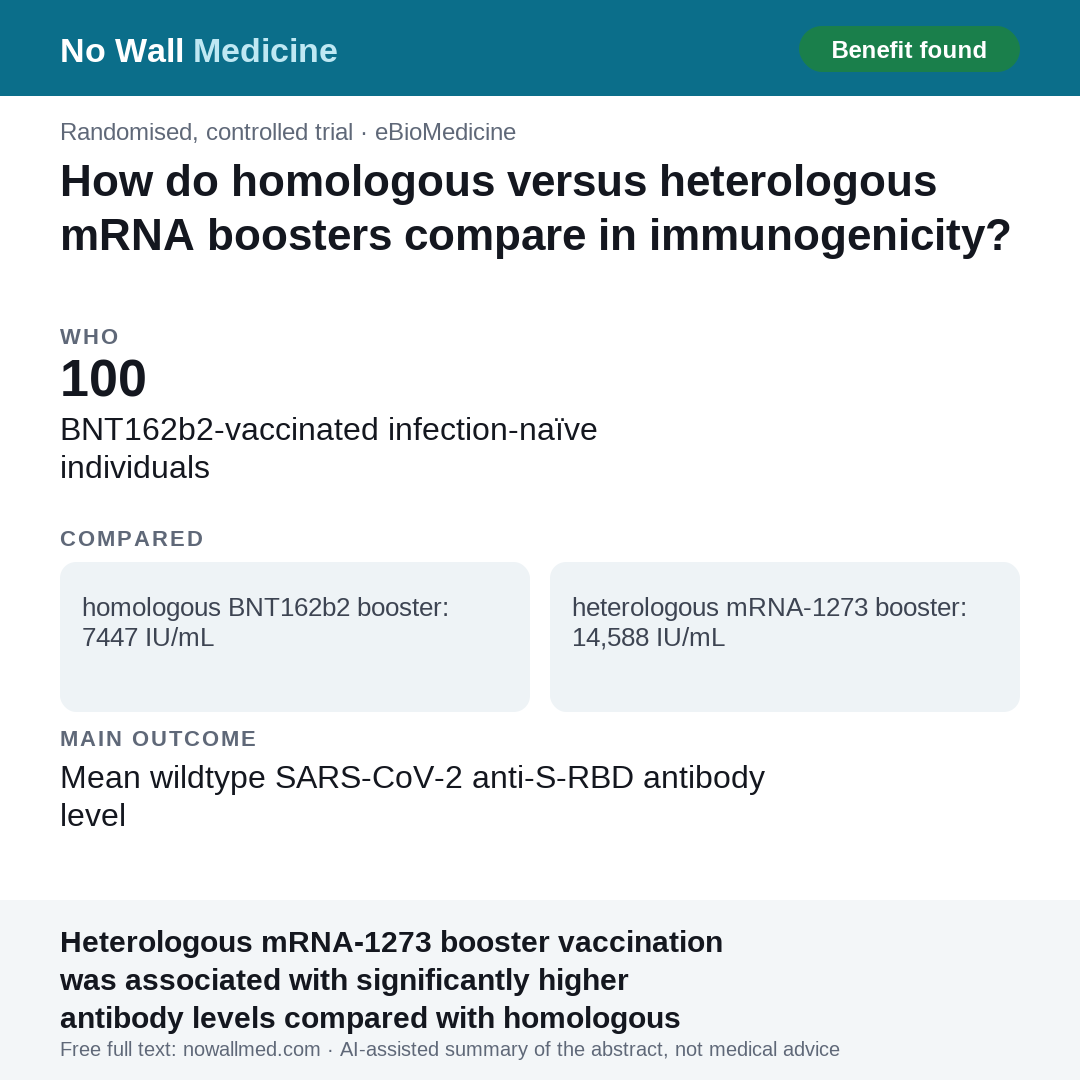
How do homologous versus heterologous mRNA boosters compare in immunogenicity?
Who
100
BNT162b2-vaccinated infection-naïve individuals
Compared
homologous BNT162b2 booster: 7447 IU/mL
heterologous mRNA-1273 booster: 14,588 IU/mL
Main outcome
Mean wildtype SARS-CoV-2 anti-S-RBD antibody level
Result: 14,588 IU/mL; 95% CI, 10,186-20,893 vs 7447 IU/mL; 4646-11,912; p = 0.025
Bottom line: Heterologous mRNA-1273 booster vaccination was associated with significantly higher antibody levels compared with homologous BNT162b2 booster vaccination.
Funded by: Singapore NMRC, USFDA, MRC
eBioMedicine · 2024-08-12Download image
Clinical question: How do homologous versus heterologous mRNA boosters compare in immunogenicity?
Abstract
Background
Understanding how SARS-CoV-2 breakthrough infections impacts the breadth of immune responses against existing and pre-emergent SARS-CoV-2 strains is needed to develop an evidence-based long-term immunisation strategy. Methods
We performed a randomised, controlled trial to assess the immunogenicity of homologous (BNT162b2) versus heterologous (mRNA-1273) booster vaccination in 100 BNT162b2-vaccinated infection-naïve individuals enrolled from October 2021. Post hoc analysis was performed to assess the impact of SARS-CoV-2 infection on humoral and cellular immune responses against wild-type SARS-CoV-2 and/or Omicron subvariants. Findings
93 participants completed the study at day 360. 71% (66/93) of participants reported first SARS-CoV-2 Omicron infection by the end of the study with similar proportions of infections between homologous and heterologous booster groups (72.3% [34/47] vs 69.6% [32/46]; p = 0.82). Mean wildtype SARS-CoV-2 anti-S-RBD antibody level was significantly higher in heterologous booster group compared with homologous group at day 180 (14,588 IU/mL; 95% CI, 10,186-20,893 vs 7447 IU/mL; 4646-11,912; p = 0.025). Participants who experienced breakthrough infections during the Omicron BA.1/2 wave had significantly higher anti-S-RBD antibody levels against wildtype SARS-CoV-2 and antibody neutralisation against BA.1 and pre-emergent BA.5 compared with infection-naïve participants. Regardless of hybrid immunity status, wildtype SARS-CoV-2 anti-S-RBD antibody level declined significantly after six months post-booster or post-SARS-CoV-2 infection. Interpretation
Booster vaccination with mRNA-1273 was associated with significantly higher antibody levels compared with BNT162b2. Antibody responses are narrower and decline faster among uninfected, vaccinated individuals. Boosters may be more effective if administered shortly before infection outbreaks and at least six months after last infection or booster. Funding
Singapore NMRC, USFDA, MRC.
Subject terms
Cite this article
Poh XY, Lee IR, Tan CW, Chavatte JM, Fong SW, Goh YS. First SARS-CoV-2 Omicron infection as an effective immune booster among mRNA vaccinated individuals: final results from the first phase of the PRIBIVAC randomised clinical trial. eBioMedicine. 2024. doi:10.1016/j.ebiom.2024.105275
Spotted a mistake? Suggest a correction
Top studies every Monday
The week’s key trials and guidelines in your specialties, plus any topics you follow. By email, free.
Get the weekly digest