First and second generation BTK inhibitors have similar efficacy in Waldenström's Macroglobulinemia
First- versus second-generation Bruton tyrosine kinase inhibitors in Waldenström's Macroglobulinemia: A systematic review and meta-analysis
Systematic review and meta-analysisMixed results
Are second-generation Bruton tyrosine kinase inhibitors better than first-generation for Waldenström's macroglobulinemia?
Who
730
Patients with Waldenström's macroglobulinemia
Compared
first-generation Bruton tyrosine kinase inhibitors: 94.2% overall response rate
second-generation Bruton tyrosine kinase inhibitors: 88.9% overall response rate
Main outcome
efficacy measured by response and survival data
Bottom line: Efficacy is comparable, but first-generation inhibitors have higher atrial fibrillation risk while second-generation have more infections and neutropenia.
Am J Hematol · 2022-04-08Download image
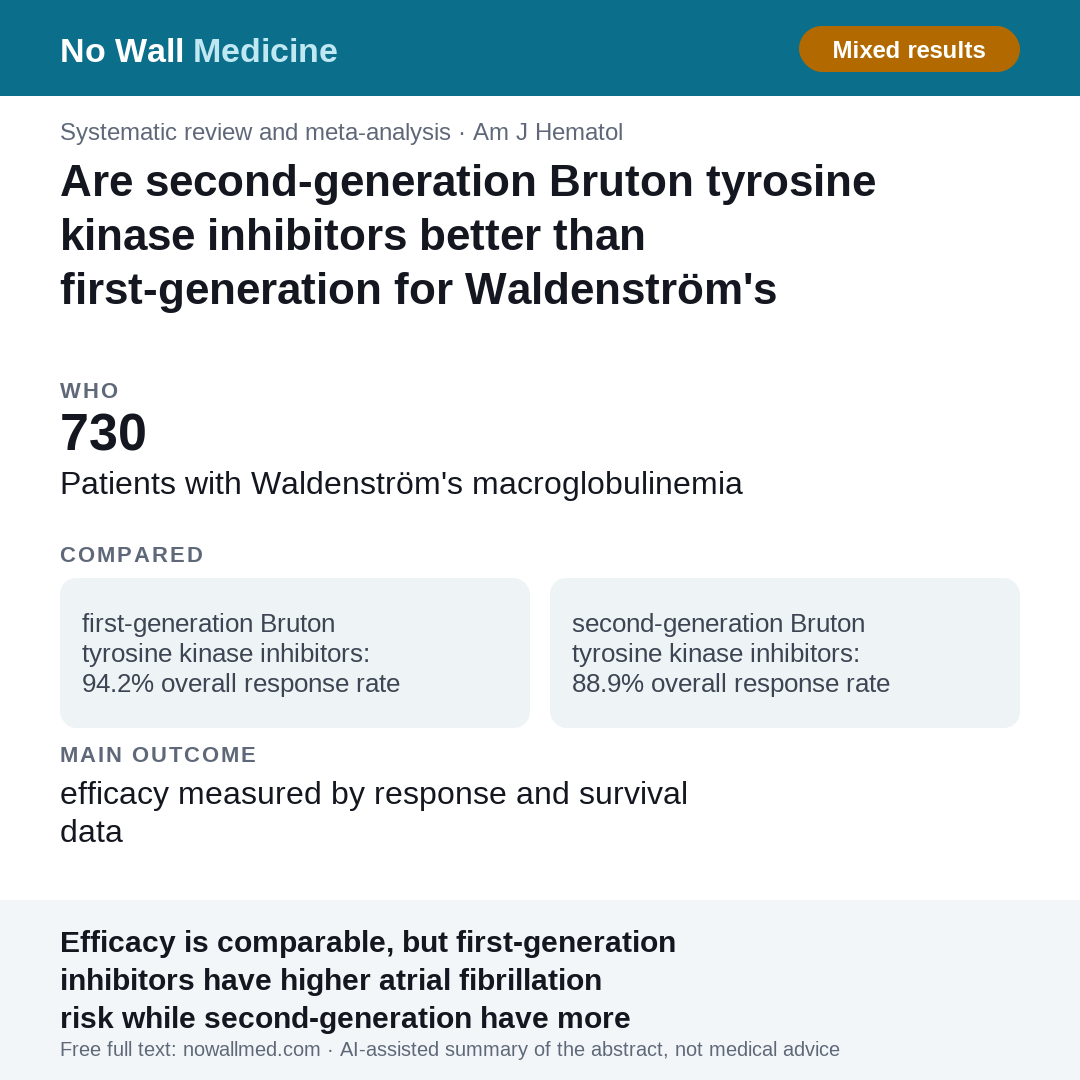
Clinical question: Are second-generation Bruton tyrosine kinase inhibitors better than first-generation for Waldenström's macroglobulinemia?
Why it matters: Whether second-generation BTK inhibitors improve outcomes or have a better safety profile than first-generation was unclear
Key points
- 730 patients with Waldenström's Macroglobulinemia received either 1st or 2nd generation BTK inhibitors.
- Overall response rate was 94.2% for 1st generation and 88.9% for 2nd generation.
- 1st generation BTK inhibitors had higher risk of atrial fibrillation, while 2nd generation had more infections and neutropenia.
Headline and key points written with AI from the paper’s abstract, with every number checked against it. Read the paper before relying on them.
Was this summary helpful?
Subject terms
Cite this article
Abushukair H, Syaj S, Ababneh O, Qarqash A, Schinke C, Thanendrarajan S. First- versus second-generation Bruton tyrosine kinase inhibitors in Waldenström's Macroglobulinemia: A systematic review and meta-analysis. Am J Hematol. 2022. doi:10.1002/ajh.26552
Spotted a mistake? Suggest a correction
Top studies every Monday
The week’s key trials and guidelines in your specialties, plus any topics you follow. By email, free.
Get the weekly digest