Transcatheter aortic valve implantation shows short-term benefits but higher long-term risks than surgery
Five-year outcomes in trials comparing transcatheter aortic valve implantation versus surgical aortic valve replacement: a pooled meta-analysis of reconstructed time-to-event data
Meta-analysis of seven randomized trialsMixed results
What are the five-year outcomes comparing transcatheter aortic valve implantation versus surgical aortic valve replacement?
Who
7770
Participants in trials comparing transcatheter aortic valve implantation and surgical aortic valve replacement
Compared
Transcatheter aortic valve implantation
Surgical aortic valve replacement
Main outcome
Composite of death or stroke, all-cause death, and rehospitalization
Result: hazard ratio 0.66 (95% CI 0.56-0.77) at 6 months; hazard ratio 1.25 (95% CI 1.08-1.46) after 24 months
Bottom line: Transcatheter aortic valve implantation shows short-term benefits but becomes a risk factor for mortality and rehospitalization after 24 months.
Eur J Cardiothorac Surg · 2021-12-18Download image
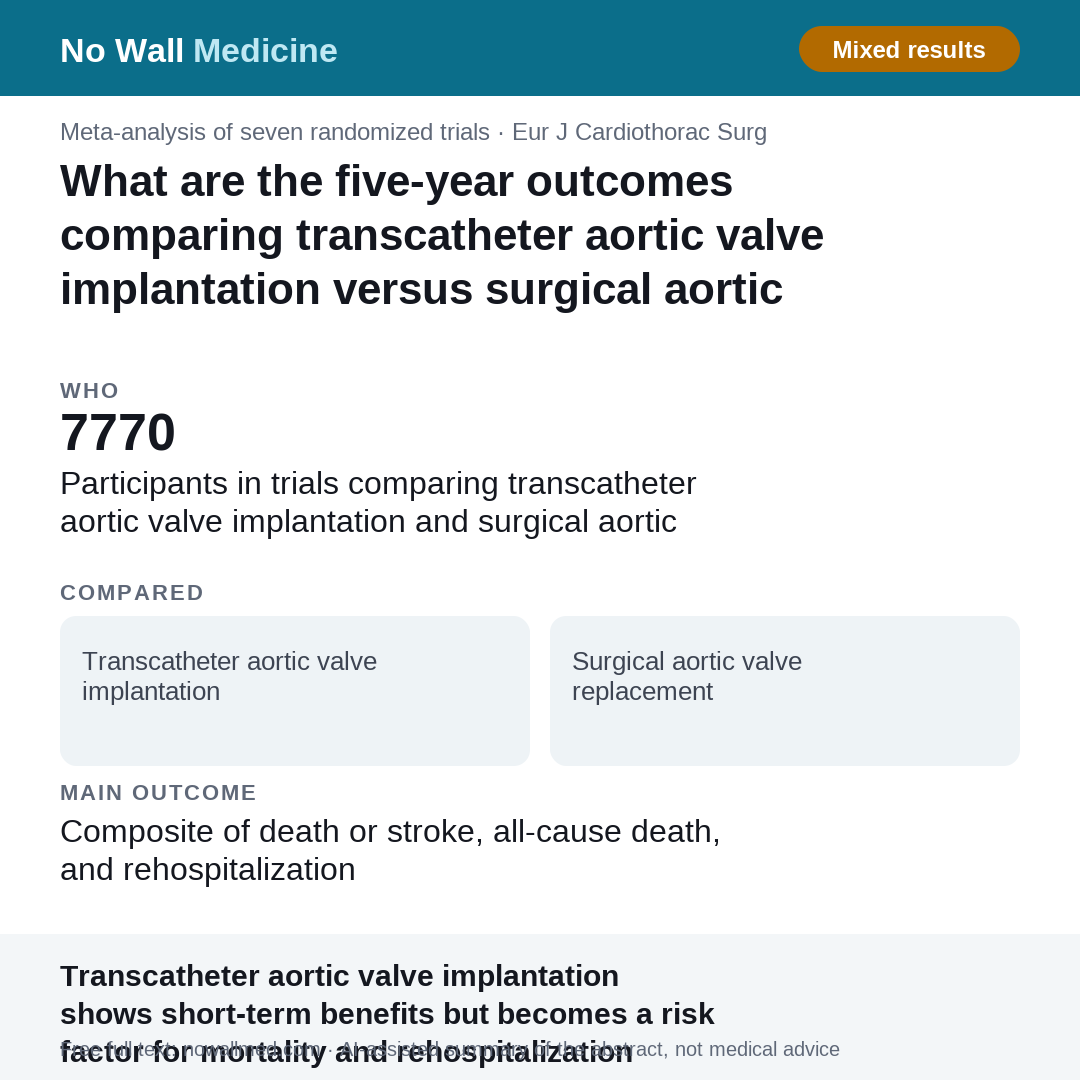
Clinical question: What are the five-year outcomes comparing transcatheter aortic valve implantation versus surgical aortic valve replacement?
Why it matters: The incidence of outcomes in trials comparing transcatheter aortic valve implantation and surgical aortic valve replacement is expected to be different in the short and long term.
Key points
- Researchers analyzed seven randomized trials involving 7770 participants comparing transcatheter aortic valve implantation (TAVI) to surgical aortic valve replacement (SAVR).
- TAVI was associated with a lower incidence of death or stroke in the first 6 months (hazard ratio 0.66), but SAVR was associated with better outcomes after 24 months (hazard ratio 1.25).
- TAVI was associated with an increased incidence of rehospitalization after 6 months (hazard ratio 1.42) and after 24 months (hazard ratio 1.67).
Headline and key points written with AI from the paper’s abstract, with every number checked against it. Read the paper before relying on them.
Was this summary helpful?
Subject terms
Cite this article
Barili F, Freemantle N, Musumeci F, Martin B, Anselmi A, Rinaldi M. Five-year outcomes in trials comparing transcatheter aortic valve implantation versus surgical aortic valve replacement: a pooled meta-analysis of reconstructed time-to-event data. Eur J Cardiothorac Surg. 2021. doi:10.1093/ejcts/ezab516
Spotted a mistake? Suggest a correction
Top studies every Monday
The week’s key trials and guidelines in your specialties, plus any topics you follow. By email, free.
Get the weekly digest