Five-year overall survival update from the HIMALAYA study of tremelimumab plus durvalumab in unresectable HCC
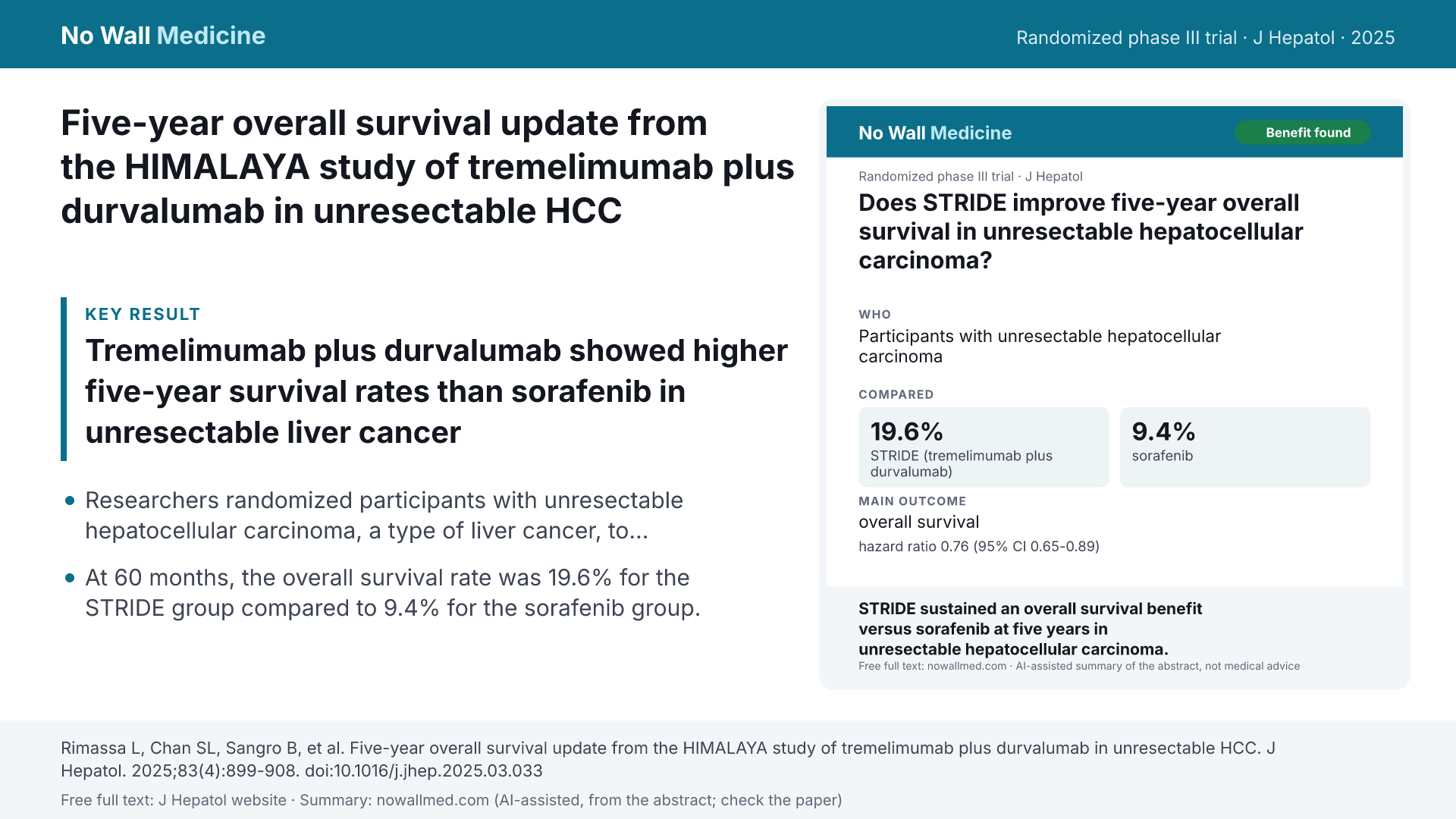
Key result: Tremelimumab plus durvalumab showed higher five-year survival rates than sorafenib in unresectable liver cancer
Secondary analysis of a trialBenefit found
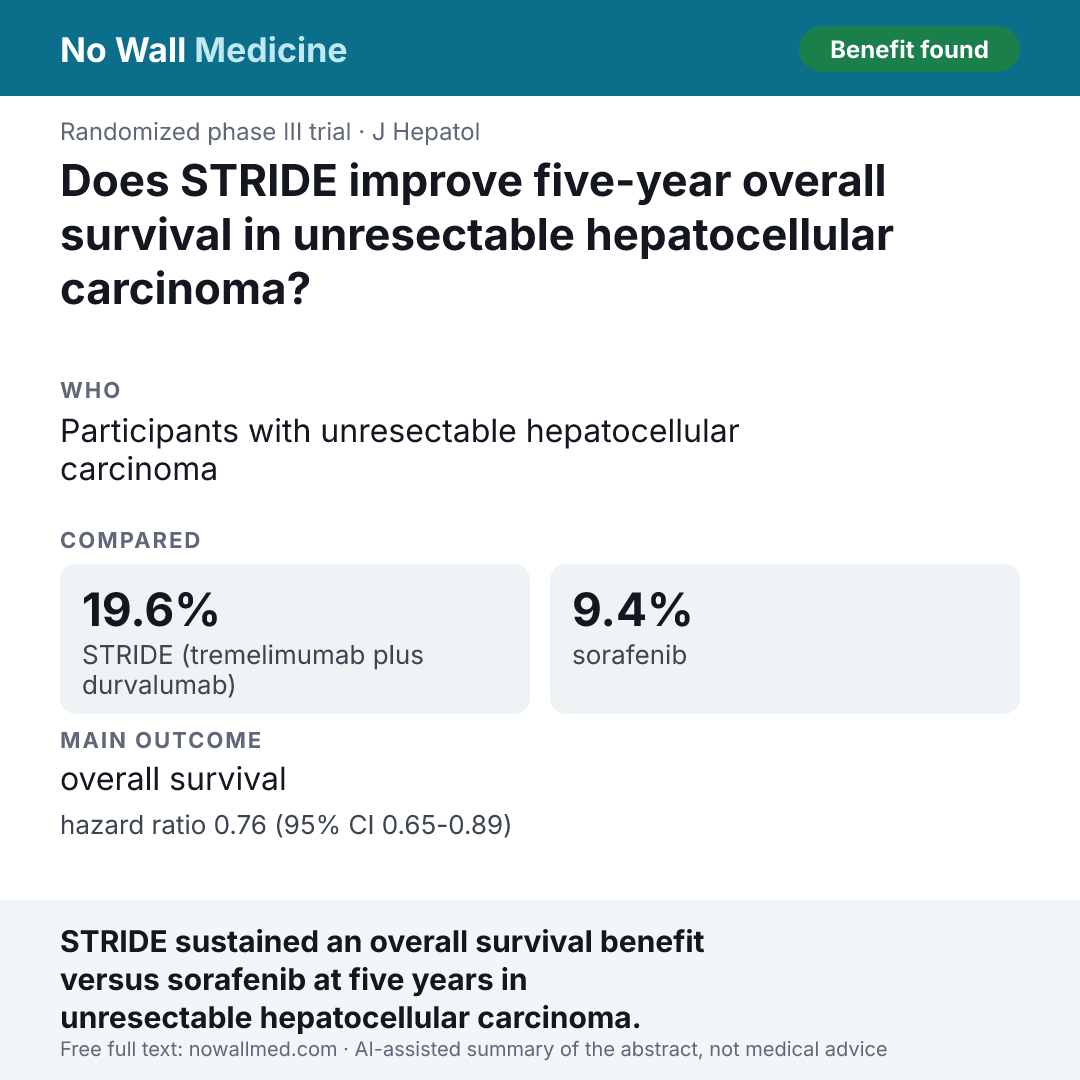
Does STRIDE improve five-year overall survival in unresectable hepatocellular carcinoma?
Who
Participants with unresectable hepatocellular carcinoma
Compared
19.6%STRIDE (tremelimumab plus durvalumab)
9.4%sorafenib
Main outcome
overall survival
Result: hazard ratio 0.76 (95% CI 0.65-0.89)
Bottom line: STRIDE sustained an overall survival benefit versus sorafenib at five years in unresectable hepatocellular carcinoma.
J Hepatol · 2025-04-11 · Save PNG
Key points
- Researchers randomized participants with unresectable hepatocellular carcinoma, a type of liver cancer, to receive STRIDE, durvalumab, or sorafenib.
- At 60 months, the overall survival rate was 19.6% for the STRIDE group compared to 9.4% for the sorafenib group.
- The STRIDE regimen was associated with 83/393 (21.1%) long-term survivors compared to 45/389 (11.6%) in the sorafenib group.
Why it matters: Long-term survival data and safety profiles for the STRIDE regimen in unresectable hepatocellular carcinoma were not previously known at the five-year mark.
Discussion prompts
- Would these patients look like yours? Who was left out?
- Is the main outcome one that matters to patients?
- Is the difference large enough to change what you do?
Cite: Rimassa L, Chan SL, Sangro B, et al. Five-year overall survival update from the HIMALAYA study of tremelimumab plus durvalumab in unresectable HCC. J Hepatol. 2025;83(4):899-908. doi:10.1016/j.jhep.2025.03.033
Free full text: J Hepatol website · Summary and visual abstract: nowallmed.com/a/five-year-overall-survival-update-from-the-himalaya-study-of-6uo0mi/ (AI-assisted from the abstract; check the paper before relying on it).