Tebentafusp increased five-year survival rates in patients with metastatic uveal melanoma
Five-year survival with tebentafusp in metastatic uveal melanoma
International, open-label, phase 3 trialBenefit found
Does tebentafusp improve five-year survival in metastatic uveal melanoma?
Who
Previously untreated HLA-A*02:01-positive patients with metastatic uveal melanoma · International
Compared
16%tebentafusp
8%investigator's choice
Main outcome
overall survival
Result: stratified hazard ratio 0.67 (95% confidence interval 0.54-0.85)
Bottom line: Tebentafusp provides long-term survival benefit in previously untreated HLA-A*02:01-positive metastatic uveal melanoma patients.
Ann Oncol · 2026-05-19Download image
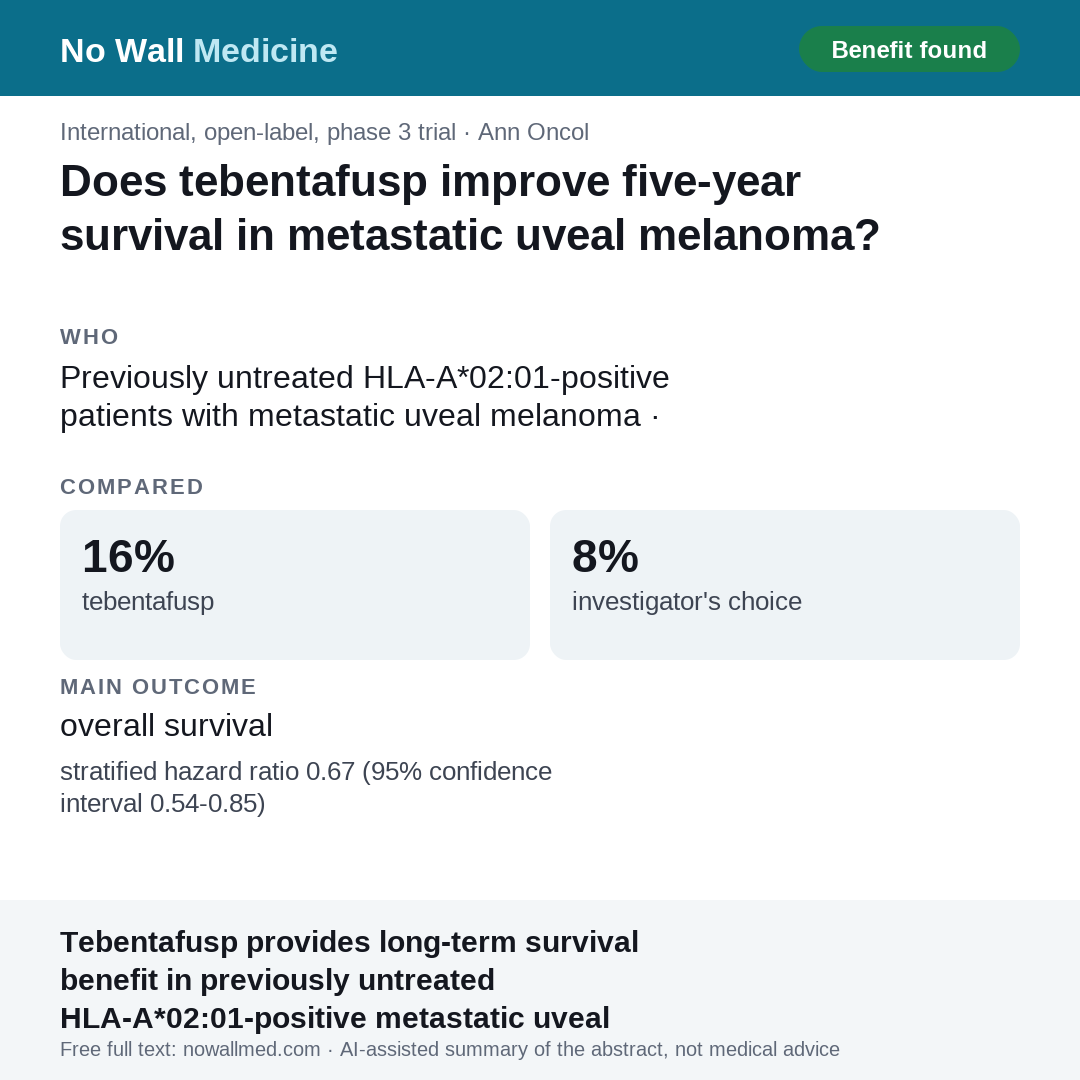
Clinical question: Does tebentafusp improve five-year survival in metastatic uveal melanoma?
Why it matters: Doctors needed long-term data on the survival benefits of tebentafusp for patients with this specific type of eye cancer.
Key points
- Researchers studied previously untreated patients with HLA-A*02:01-positive metastatic uveal melanoma who were randomized to receive tebentafusp or a choice of pembrolizumab, ipilimumab, or dacarbazine.
- The median overall survival was 21.6 months for the tebentafusp group compared to 16.9 months for the control group, with a 5-year survival rate of 16% versus 8%.
- Longer survival in the tebentafusp group was associated with undetectable circulating tumor DNA at baseline or reductions of 50% or more by week 9.
Headline and key points written with AI from the paper’s abstract, with every number checked against it. Read the paper before relying on them.
Topics
Cite this article
Piperno-Neumann S, Rutkowski P, Hassel JC, Butler MO, Schlaak M, Sullivan RJ. Five-year survival with tebentafusp in metastatic uveal melanoma. Ann Oncol. 2026. doi:10.1016/j.annonc.2026.05.695
Spotted a mistake? Suggest a correction