Low dose tacrolimus was non-inferior to standard dosing after kidney transplantation
Fixed low dose versus concentration-controlled initial tacrolimus dosing with reduced target levels in the course after kidney transplantation: results from a prospective randomized controlled non-inferiority trial (Slow & Low study)
Open-label, multicenter, randomized controlled, non-inferiority studyBenefit found
Is fixed low dose tacrolimus non-inferior to concentration-controlled dosing after kidney transplantation?
Who
432
Renal allograft recipients · Multicenter
Compared
20.7%Standard Care arm
22.1%Slow & Low arm
Main outcome
Combined incidence of biopsy-proven acute rejection, graft failure, or death
Result: difference: 1.4%, 90% CI -5.5% to 8.3%
Bottom line: Initial fixed low dose tacrolimus is non-inferior to standard therapy regarding rejection, graft failure, or death.
Funded by: Astellas Pharma GmbH
eClinicalMedicine · 2023-12-22Download image
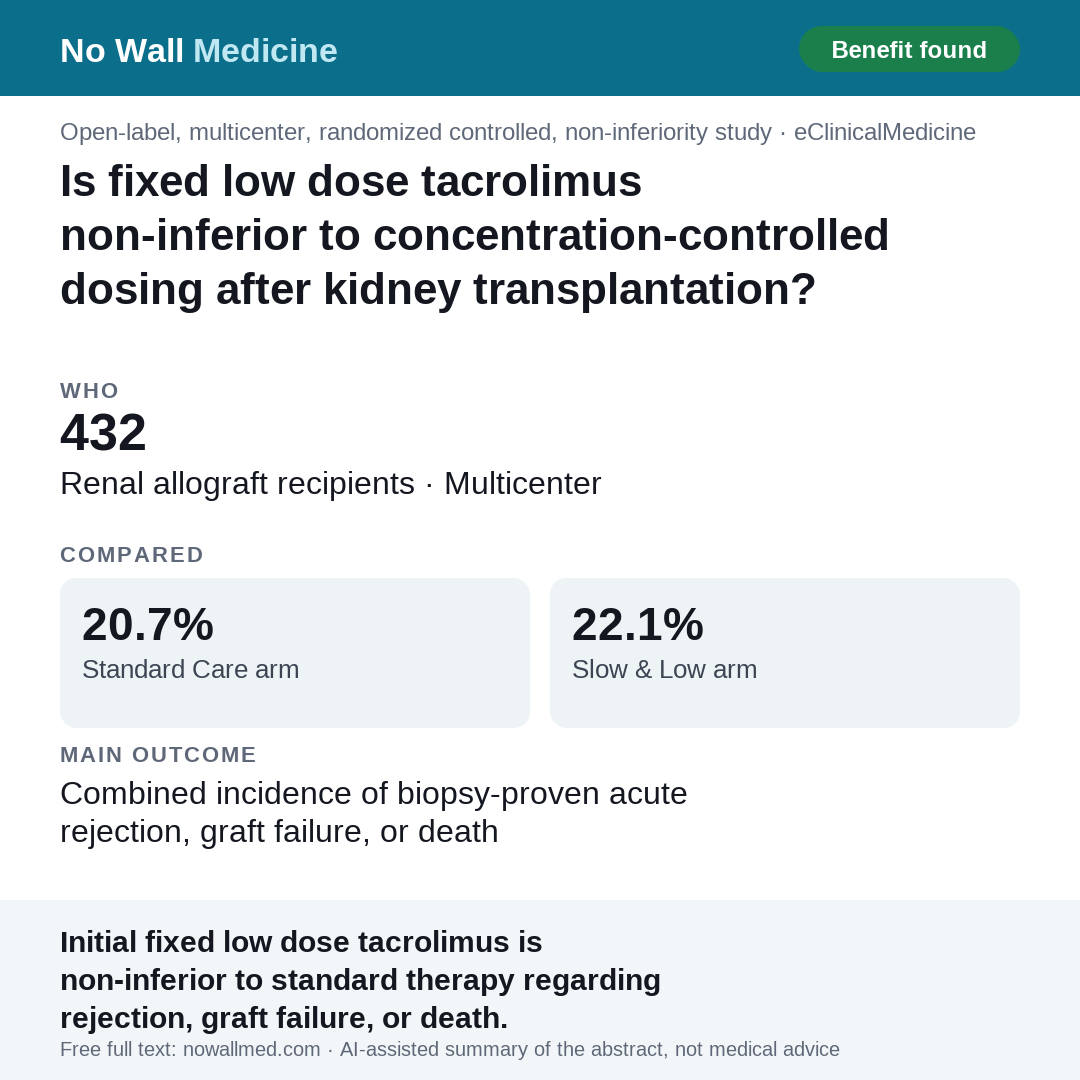
Clinical question: Is fixed low dose tacrolimus non-inferior to concentration-controlled dosing after kidney transplantation?
Why it matters: The optimal initial dosing and early exposure of tacrolimus after kidney transplantation is not well studied.
In absolute numbers
Standard Care arm: 20.7% · Slow & Low arm: 22.1% → a difference of 1.4 percentage points, so about 72 people would need the treatment for 1 more to benefit (number needed to treat) over the trial’s follow-up.
Worked out by us from the two group results above, not reported by the authors. Check the paper for the exact outcome and timing.
Key points
- Researchers randomized 432 kidney transplant recipients to receive either standard tacrolimus levels or a 7-day fixed 5 mg/day dose followed by lower target levels.
- The combined rate of organ rejection, graft failure, or death at 6 months was 22.1% in the low dose group compared to 20.7% in standard care.
- No differences were found between groups regarding kidney function, infections, or post-transplantation diabetes mellitus.
Headline and key points written with AI from the paper’s abstract, with every number checked against it. Read the paper before relying on them.
Cite this article
Stumpf J, Budde K, Witzke O, Sommerer C, Vogel T, Schenker P. Fixed low dose versus concentration-controlled initial tacrolimus dosing with reduced target levels in the course after kidney transplantation: results from a prospective randomized controlled non-inferiority trial (Slow & Low study). eClinicalMedicine. 2023. doi:10.1016/j.eclinm.2023.102381
Spotted a mistake? Suggest a correction
Top studies every Monday
The week’s key trials and guidelines in your specialties, plus any topics you follow. By email, free.
Get the weekly digest