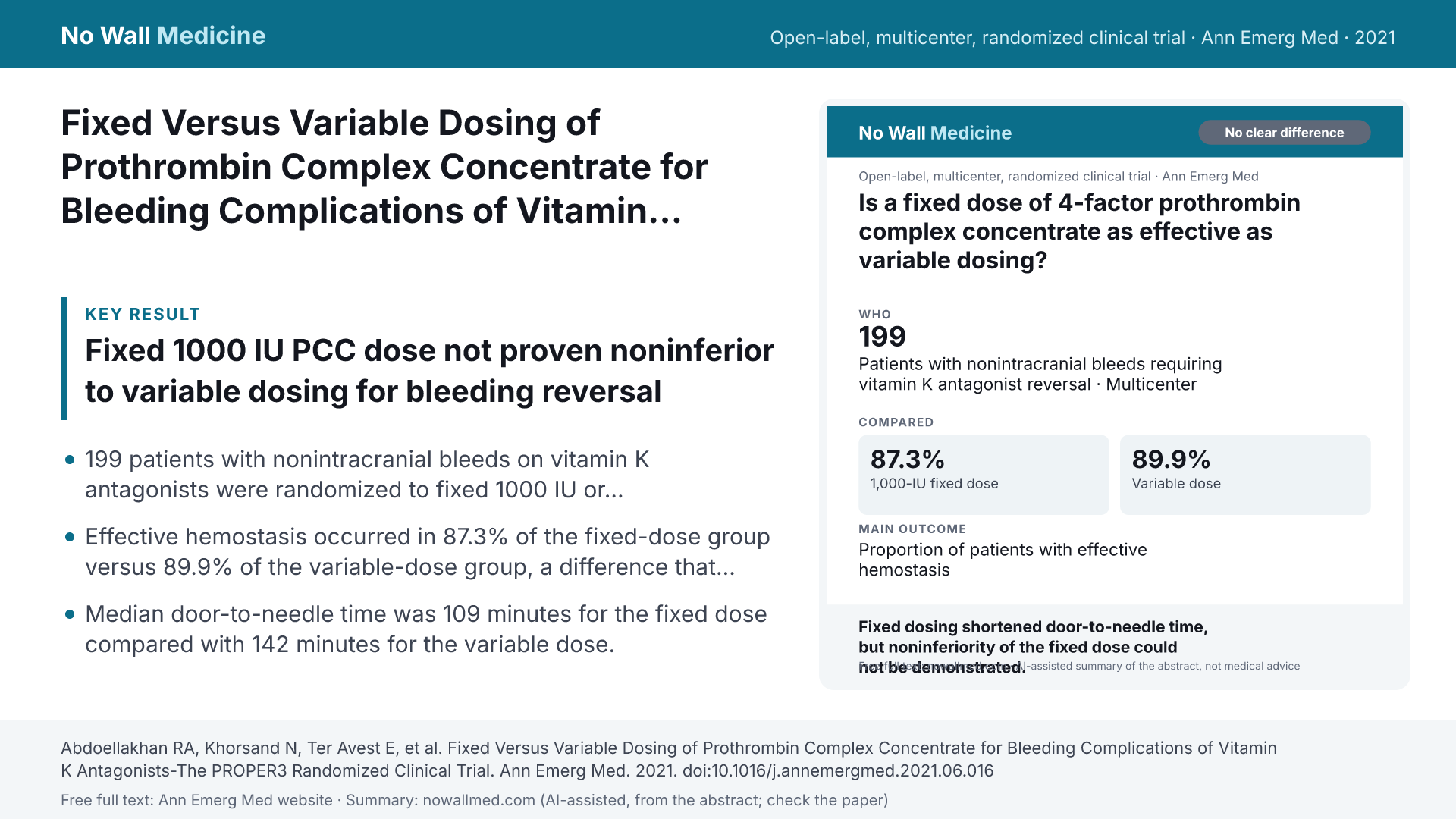
Fixed 1000 IU PCC dose not proven noninferior to variable dosing for bleeding reversal
Fixed Versus Variable Dosing of Prothrombin Complex Concentrate for Bleeding Complications of Vitamin K Antagonists-The PROPER3 Randomized Clinical Trial
Open-label, multicenter, randomized clinical trialNo clear difference
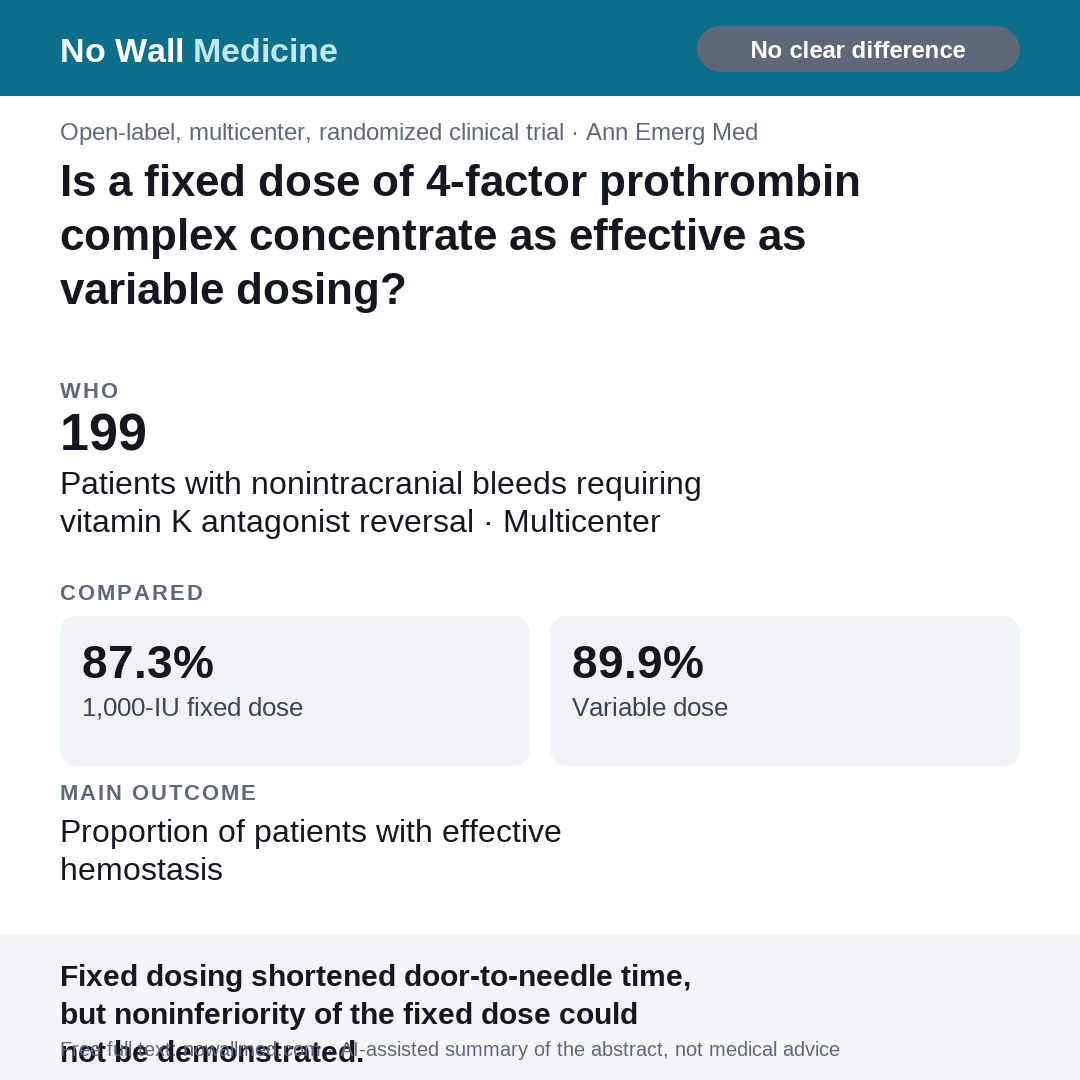
Is a fixed dose of 4-factor prothrombin complex concentrate as effective as variable dosing?
Who
199
Patients with nonintracranial bleeds requiring vitamin K antagonist reversal · Multicenter
Compared
87.3%1,000-IU fixed dose (n=69 of 79)
89.9%Variable dose (n=71 of 79)
Main outcome
Proportion of patients with effective hemostasis
Result: risk difference 2.5%, 95% confidence interval -13.3 to 7.9%
Bottom line: Fixed dosing shortened door-to-needle time, but noninferiority of the fixed dose could not be demonstrated.
Limitation: Noninferiority could not be demonstrated because the design assumed the fixed dose would be 4% superior.
Ann Emerg Med · 2021-09-15Download image
Clinical question: Is a fixed dose of 4-factor prothrombin complex concentrate as effective as variable dosing?
Key points
- 199 patients with nonintracranial bleeds on vitamin K antagonists were randomized to fixed 1000 IU or variable prothrombin complex concentrate dosing.
- Effective hemostasis occurred in 87.3% of the fixed-dose group versus 89.9% of the variable-dose group, a difference that was not statistically significant.
- Median door-to-needle time was 109 minutes for the fixed dose compared with 142 minutes for the variable dose.
Headline and key points written with AI from the paper’s abstract, with every number checked against it. Read the paper before relying on them.
Was this summary helpful?
Subject terms
Cite this article
Abdoellakhan RA, Khorsand N, Ter Avest E, et al. Fixed Versus Variable Dosing of Prothrombin Complex Concentrate for Bleeding Complications of Vitamin K Antagonists-The PROPER3 Randomized Clinical Trial. Ann Emerg Med. 2021. doi:10.1016/j.annemergmed.2021.06.016
Spotted a mistake? Suggest a correction