Fluid Balance After Tumescent Infiltration: A Practical Guideline to Avoid Dilution Anemia in Circumferential Liposuction Based on a Prospective Single-Center Study
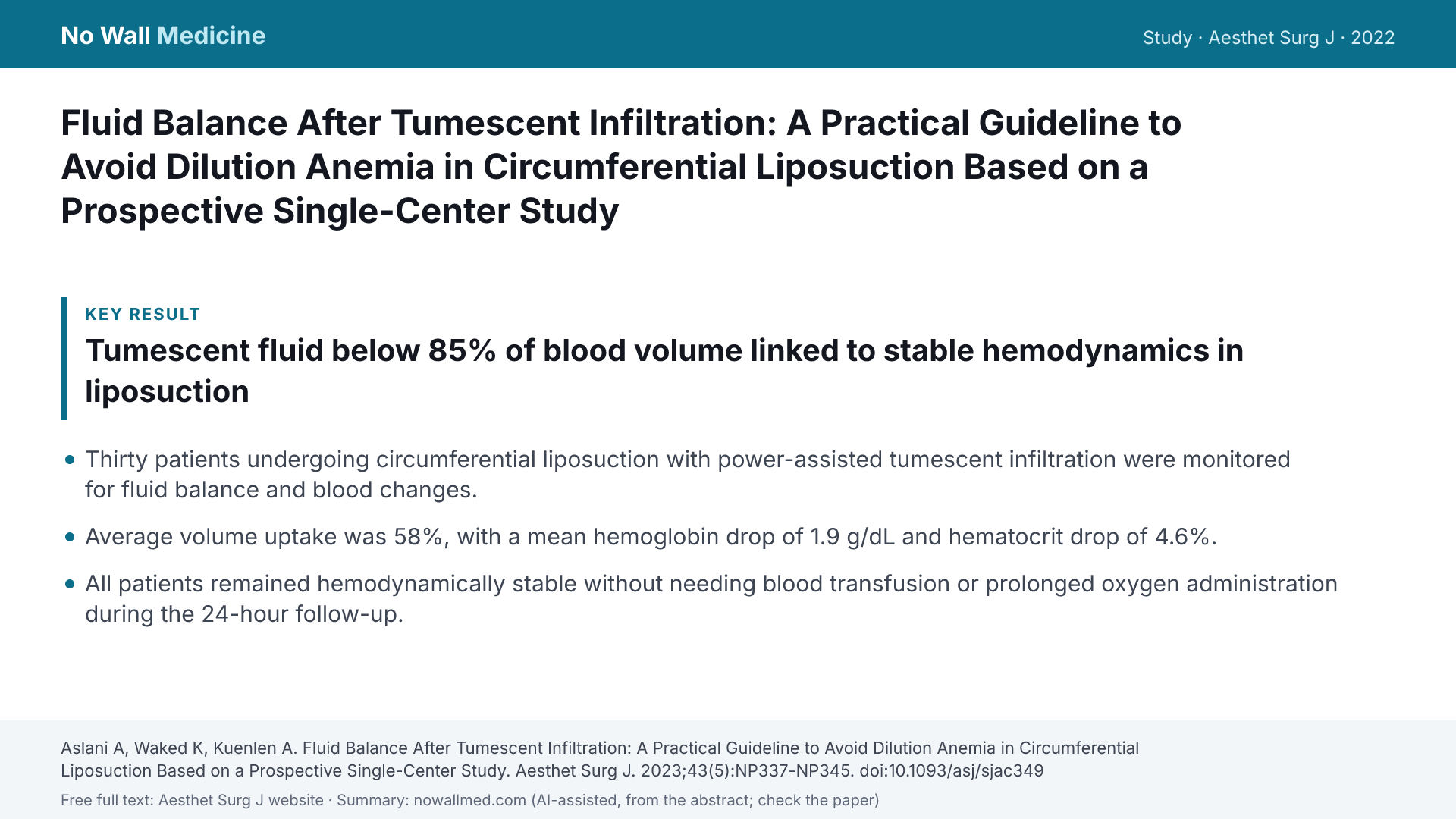
Key result: Tumescent fluid below 85% of blood volume linked to stable hemodynamics in liposuction
Key points
- Thirty patients undergoing circumferential liposuction with power-assisted tumescent infiltration were monitored for fluid balance and blood changes.
- Average volume uptake was 58%, with a mean hemoglobin drop of 1.9 g/dL and hematocrit drop of 4.6%.
- All patients remained hemodynamically stable without needing blood transfusion or prolonged oxygen administration during the 24-hour follow-up.
Why it matters: Studies analyzing the percentage of absorbed tumescent and the safe limit of tumescent infiltration are currently lacking.
Limitation the authors note: The study was a prospective single-center study with only 30 patients included.
Discussion prompts
- Would these patients look like yours? Who was left out?
- Is the main outcome one that matters to patients?
- Is the difference large enough to change what you do?
Cite: Aslani A, Waked K, Kuenlen A. Fluid Balance After Tumescent Infiltration: A Practical Guideline to Avoid Dilution Anemia in Circumferential Liposuction Based on a Prospective Single-Center Study. Aesthet Surg J. 2023;43(5):NP337-NP345. doi:10.1093/asj/sjac349
Free full text: Aesthet Surg J website · Summary and visual abstract: nowallmed.com/a/fluid-balance-after-tumescent-infiltration-a-practical-guideline-to-1p4fusg/ (AI-assisted from the abstract; check the paper before relying on it).