Fluocinolone acetonide implant showed similar vision results to aflibercept injections for diabetic macular edema
Fluocinolone Acetonide Implant as a Baseline Therapy for Diabetic Macular Edema: Results from the Randomized Phase 4 NEW DAY Study
Prospective, randomized, single-masked, phase 4 studyNo clear difference
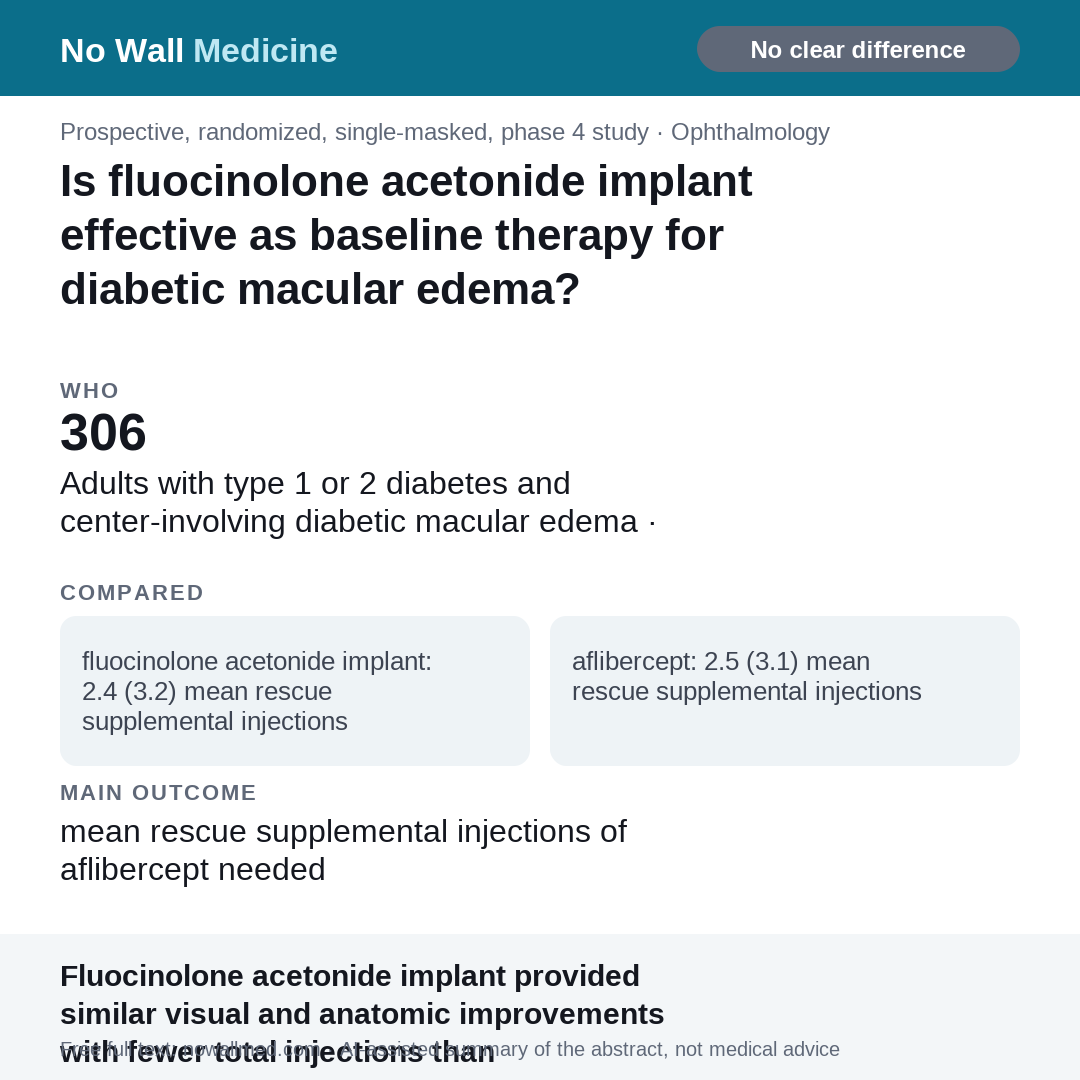
Is fluocinolone acetonide implant effective as baseline therapy for diabetic macular edema?
Who
306
Adults with type 1 or 2 diabetes and center-involving diabetic macular edema · multicenter
Compared
fluocinolone acetonide implant: 2.4 (3.2) mean rescue supplemental injections
aflibercept: 2.5 (3.1) mean rescue supplemental injections
Main outcome
mean rescue supplemental injections of aflibercept needed
Bottom line: Fluocinolone acetonide implant provided similar visual and anatomic improvements with fewer total injections than aflibercept.
Ophthalmology · 2026-03-25Download image
Clinical question: Is fluocinolone acetonide implant effective as baseline therapy for diabetic macular edema?
Why it matters: Doctors need to evaluate if a steroid implant can serve as an effective baseline therapy for diabetic macular edema compared to standard injection regimens.
Key points
- Researchers studied 306 adults with type 1 or 2 diabetes and diabetic macular edema, comparing a fluocinolone acetonide implant to aflibercept injections.
- The fluocinolone acetonide group required a mean of 2.4 rescue injections compared to 2.5 for the aflibercept group, which was not a statistically significant difference.
- The fluocinolone acetonide group received fewer total injections (3.4 versus 7.2) but had higher rates of cataract procedures (27.9% versus 6.6%) and increased eye pressure (15.6% versus 3.3%).
Headline and key points written with AI from the paper’s abstract, with every number checked against it. Read the paper before relying on them.
Topics
Cite this article
Singer MA, Wykoff CC, Riemann CD, Gonzalez VH, Weng CY, Alkhatib K. Fluocinolone Acetonide Implant as a Baseline Therapy for Diabetic Macular Edema: Results from the Randomized Phase 4 NEW DAY Study. Ophthalmology. 2026. doi:10.1016/j.ophtha.2026.03.019
Spotted a mistake? Suggest a correction