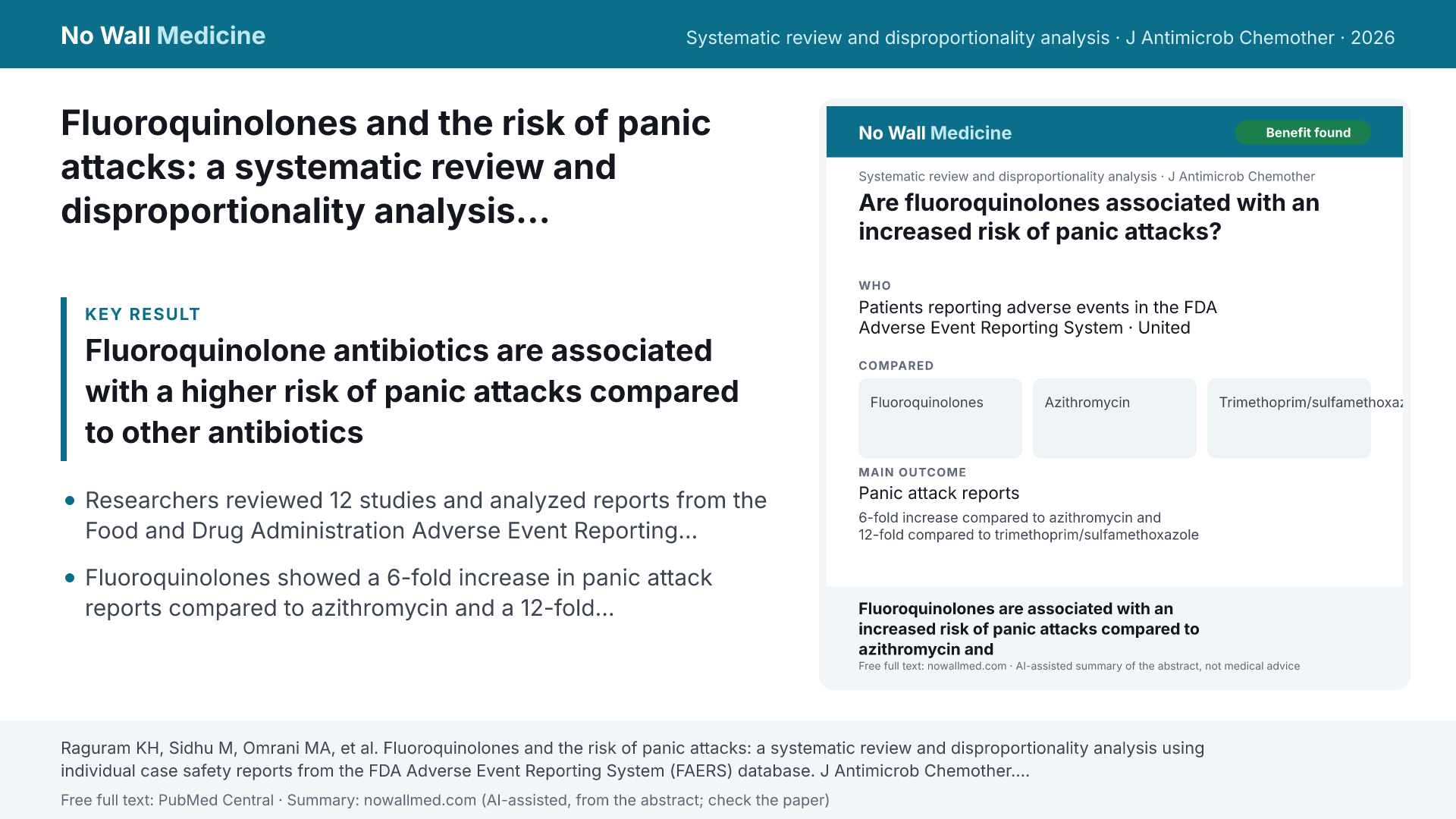
Fluoroquinolone antibiotics are associated with a higher risk of panic attacks compared to other antibiotics
Fluoroquinolones and the risk of panic attacks: a systematic review and disproportionality analysis using individual case safety reports from the FDA Adverse Event Reporting System (FAERS) database
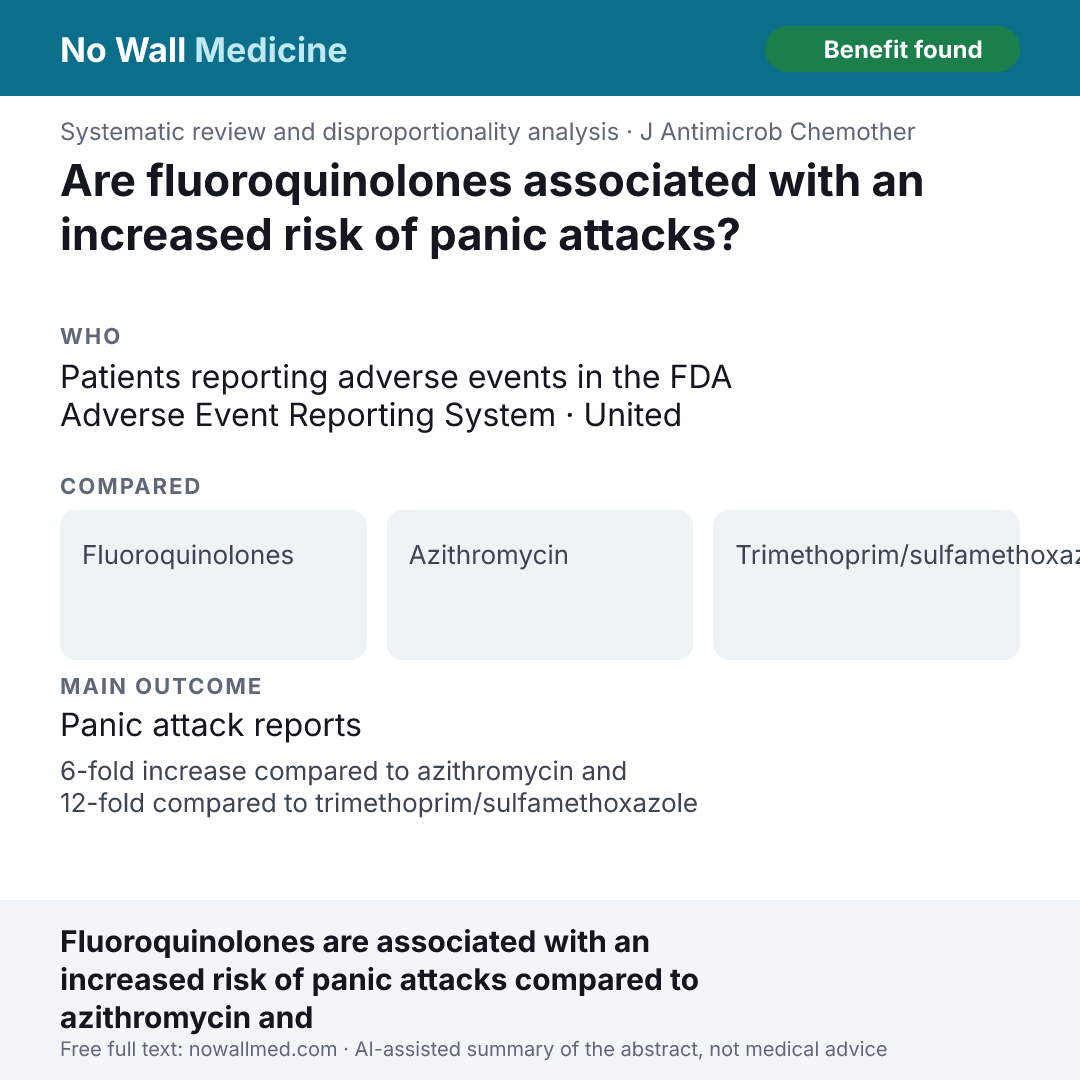
Systematic review and disproportionality analysisBenefit found
Are fluoroquinolones associated with an increased risk of panic attacks?
Who
Patients reporting adverse events in the FDA Adverse Event Reporting System · United States, FDA Adverse Event Reporting System database
Compared
Fluoroquinolones
Azithromycin
Trimethoprim/sulfamethoxazole
Main outcome
Panic attack reports
Result: 6-fold increase compared to azithromycin and 12-fold compared to trimethoprim/sulfamethoxazole
Bottom line: Fluoroquinolones are associated with an increased risk of panic attacks compared to azithromycin and trimethoprim/sulfamethoxazole.
Limitation: Reliance on spontaneous reports means causal relationships cannot be determined.
J Antimicrob Chemother · 2026-03-06
Why it matters: Current evidence exploring the link between fluoroquinolone use and panic attacks remains limited and requires investigation for safe use.
Headline and visual abstract written with AI from the paper’s abstract, with every number checked against it. Read the paper before relying on them.
Was this summary helpful?
Subject terms
Cite this article
Raguram KH, Sidhu M, Omrani MA, et al. Fluoroquinolones and the risk of panic attacks: a systematic review and disproportionality analysis using individual case safety reports from the FDA Adverse Event Reporting System (FAERS) database. J Antimicrob Chemother. 2026;81(4). doi:10.1093/jac/dkag083
Spotted a mistake? Suggest a correction