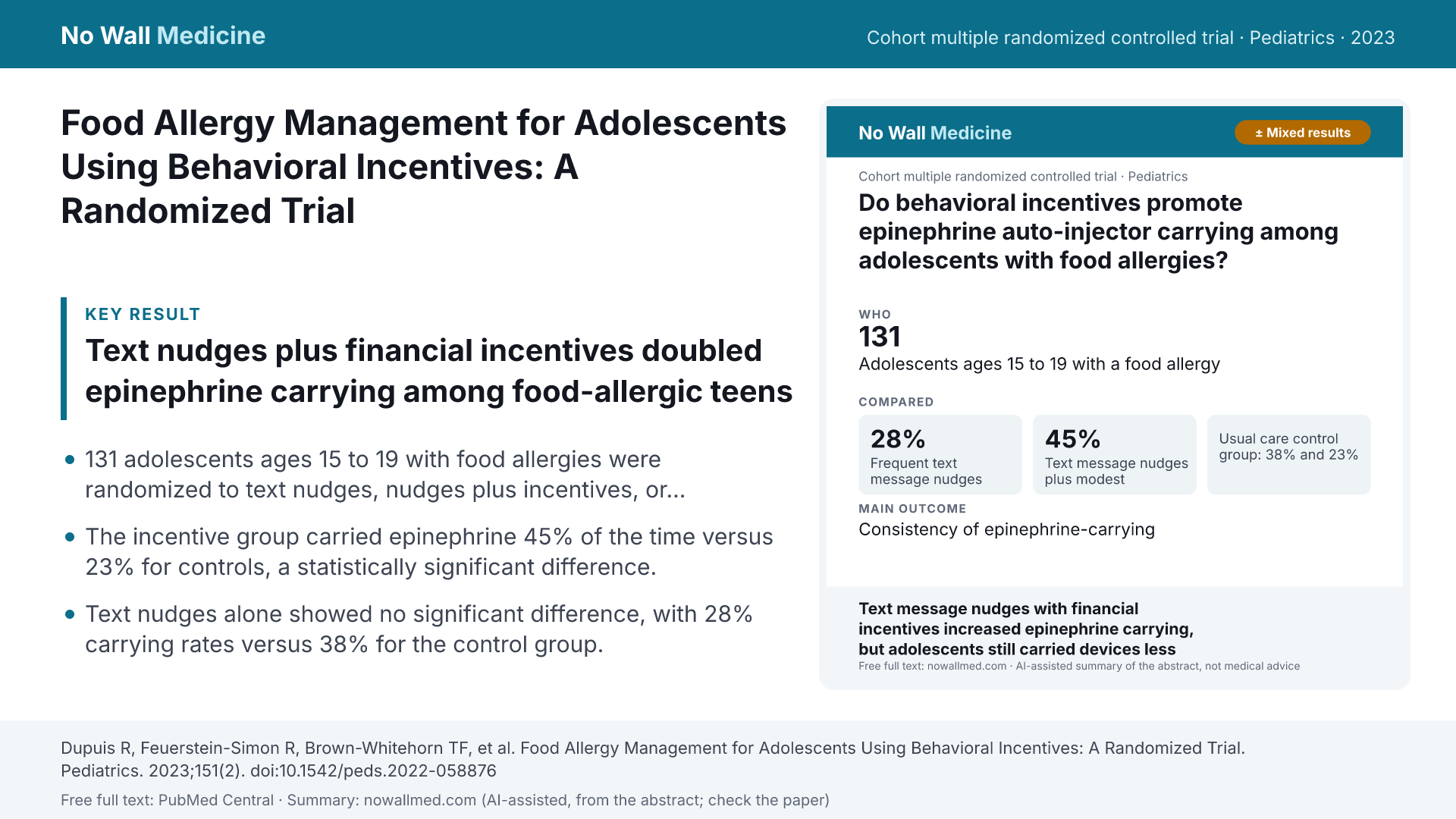
Text nudges plus financial incentives doubled epinephrine carrying among food-allergic teens
Food Allergy Management for Adolescents Using Behavioral Incentives: A Randomized Trial
Cohort multiple randomized controlled trialMixed results
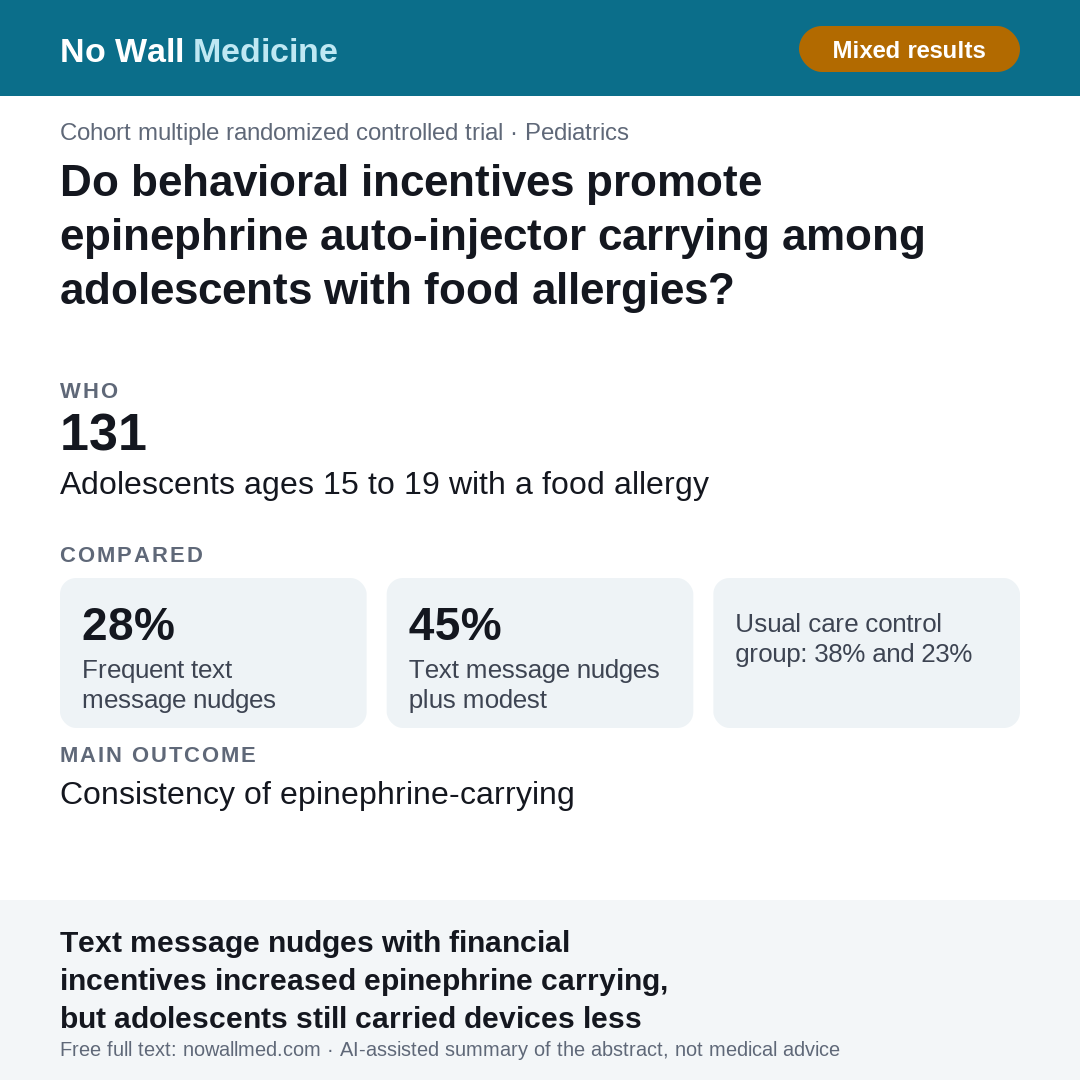
Do behavioral incentives promote epinephrine auto-injector carrying among adolescents with food allergies?
Who
131
Adolescents ages 15 to 19 with a food allergy
Compared
28%Frequent text message nudges
45%Text message nudges plus modest financial incentives
Usual care control group: 38% and 23%
Main outcome
Consistency of epinephrine-carrying
Bottom line: Text message nudges with financial incentives increased epinephrine carrying, but adolescents still carried devices less than 50% of the time.
Pediatrics · 2023-01-24Download image
Clinical question: Do behavioral incentives promote epinephrine auto-injector carrying among adolescents with food allergies?
Why it matters: Adolescents with food allergies often fail to carry prescribed epinephrine auto-injectors, creating a safety gap during allergic reactions.
Key points
- 131 adolescents ages 15 to 19 with food allergies were randomized to text nudges, nudges plus incentives, or usual care.
- The incentive group carried epinephrine 45% of the time versus 23% for controls, a statistically significant difference.
- Text nudges alone showed no significant difference, with 28% carrying rates versus 38% for the control group.
Headline and key points written with AI from the paper’s abstract, with every number checked against it. Read the paper before relying on them.
Was this summary helpful?
Subject terms
Cite this article
Dupuis R, Feuerstein-Simon R, Brown-Whitehorn TF, et al. Food Allergy Management for Adolescents Using Behavioral Incentives: A Randomized Trial. Pediatrics. 2023. doi:10.1542/peds.2022-058876
Spotted a mistake? Suggest a correction