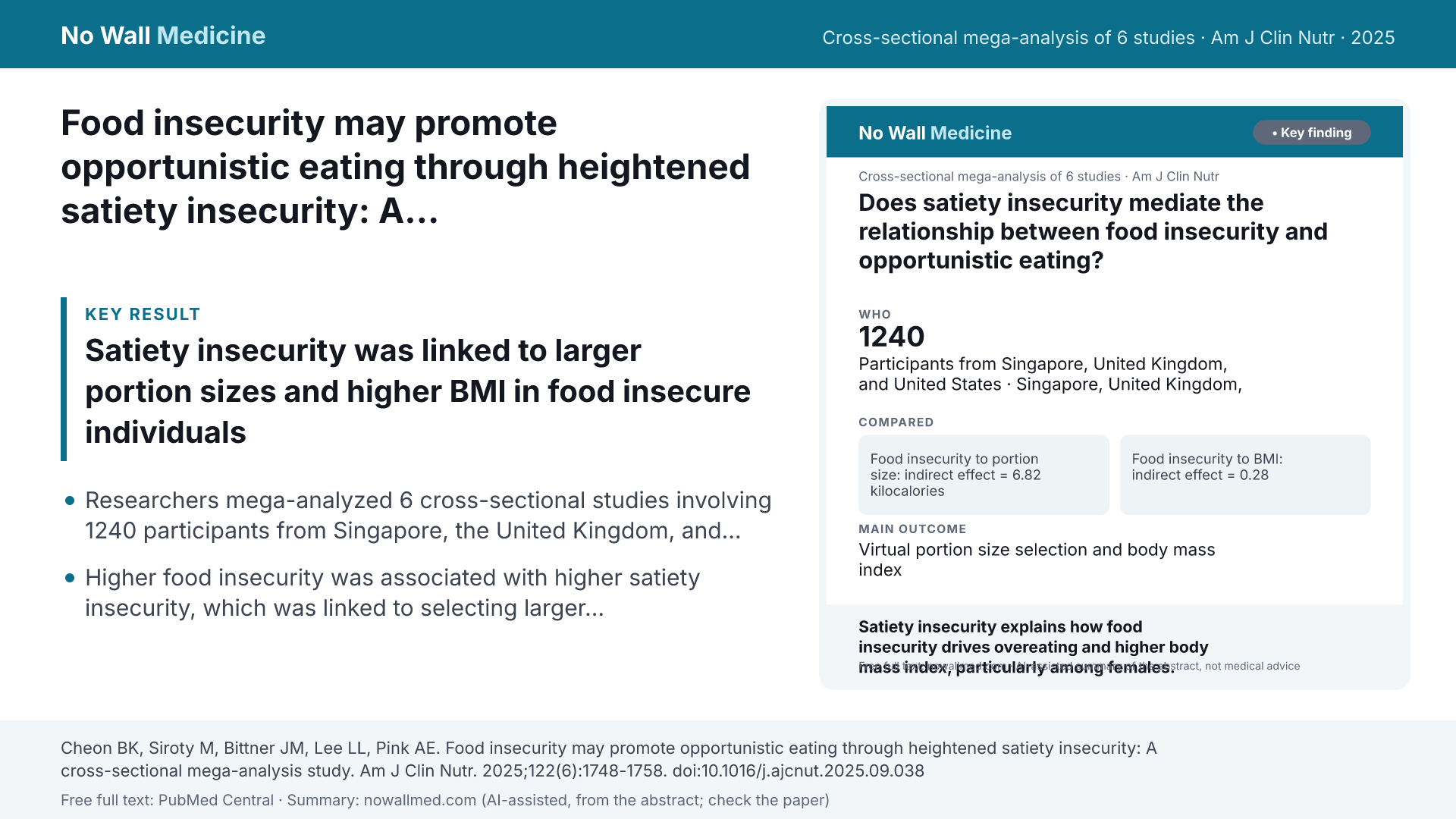
Satiety insecurity was linked to larger portion sizes and higher BMI in food insecure individuals
Food insecurity may promote opportunistic eating through heightened satiety insecurity: A cross-sectional mega-analysis study
Cross-sectional mega-analysis of 6 studiesBenefit found
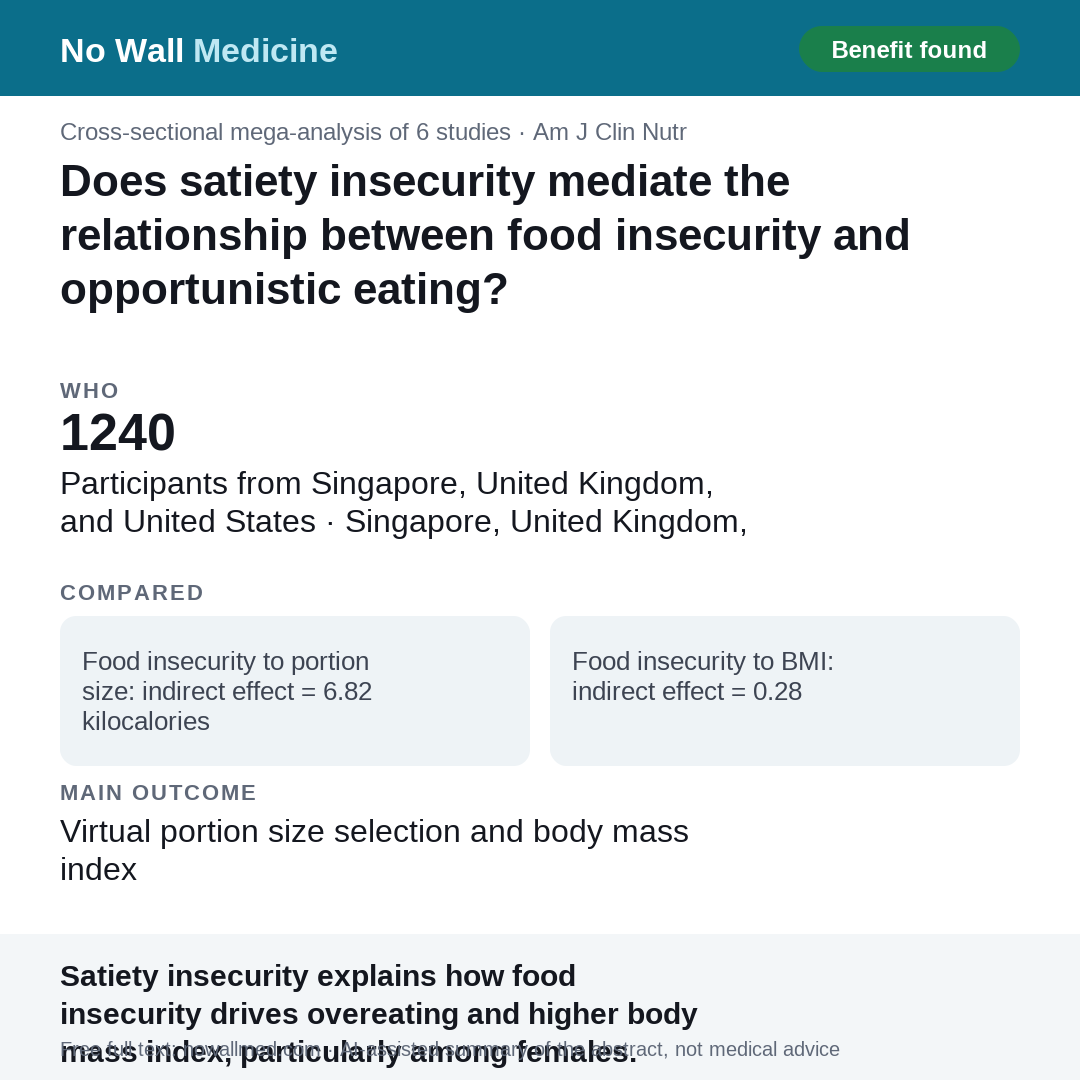
Does satiety insecurity mediate the relationship between food insecurity and opportunistic eating?
Who
1240
Participants from Singapore, United Kingdom, and United States · Singapore, United Kingdom, and United States
Compared
Food insecurity to portion size: indirect effect = 6.82 kilocalories
Food insecurity to BMI: indirect effect = 0.28
Main outcome
Virtual portion size selection and body mass index
Result: indirect effect 6.82 kilocalories (95% CI 4.15, 9.50); indirect effect 0.28 (95% CI 0.14, 0.42)
Bottom line: Satiety insecurity explains how food insecurity drives overeating and higher body mass index, particularly among females.
Am J Clin Nutr · 2025-09-27Download image
Clinical question: Does satiety insecurity mediate the relationship between food insecurity and opportunistic eating?
Why it matters: It is unclear why opportunistic eating, or overeating when food is available, may persist even after food security is restored.
Key points
- Researchers mega-analyzed 6 cross-sectional studies involving 1240 participants from Singapore, the United Kingdom, and the United States.
- Higher food insecurity was associated with higher satiety insecurity, which was linked to selecting larger virtual portion sizes by 6.82 kilocalories (95% CI: 4.15, 9.50).
- Satiety insecurity, or worries about maintaining fullness, was also associated with a higher body mass index (indirect effect = 0.28, 95% CI: 0.14, 0.42).
Headline and key points written with AI from the paper’s abstract, with every number checked against it. Read the paper before relying on them.
Was this summary helpful?
Subject terms
Cite this article
Cheon BK, Siroty M, Bittner JM, Lee LL, Pink AE. Food insecurity may promote opportunistic eating through heightened satiety insecurity: A cross-sectional mega-analysis study. Am J Clin Nutr. 2025. doi:10.1016/j.ajcnut.2025.09.038
Spotted a mistake? Suggest a correction