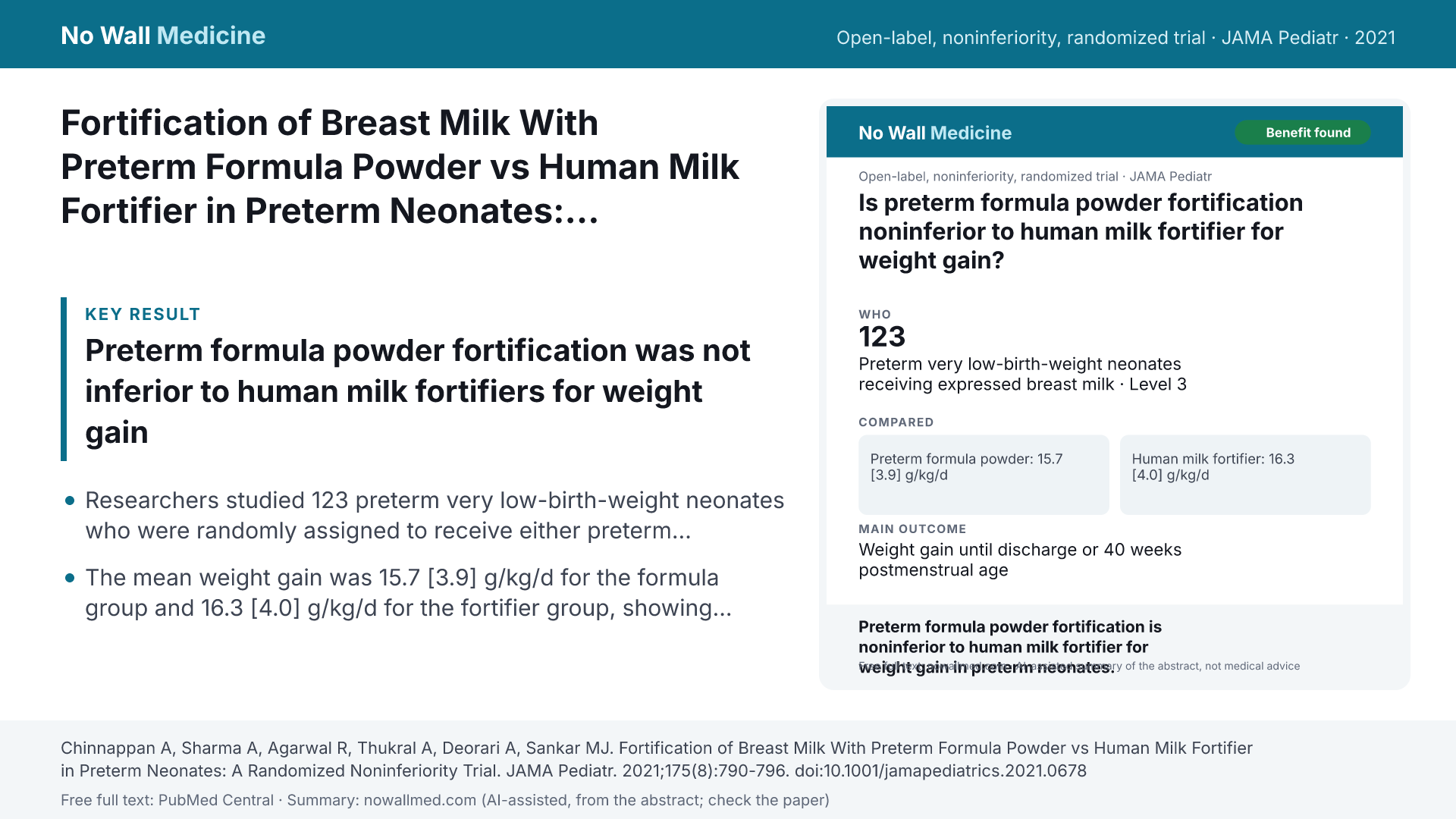
Preterm formula powder fortification was not inferior to human milk fortifiers for weight gain
Fortification of Breast Milk With Preterm Formula Powder vs Human Milk Fortifier in Preterm Neonates: A Randomized Noninferiority Trial
Open-label, noninferiority, randomized trialBenefit found
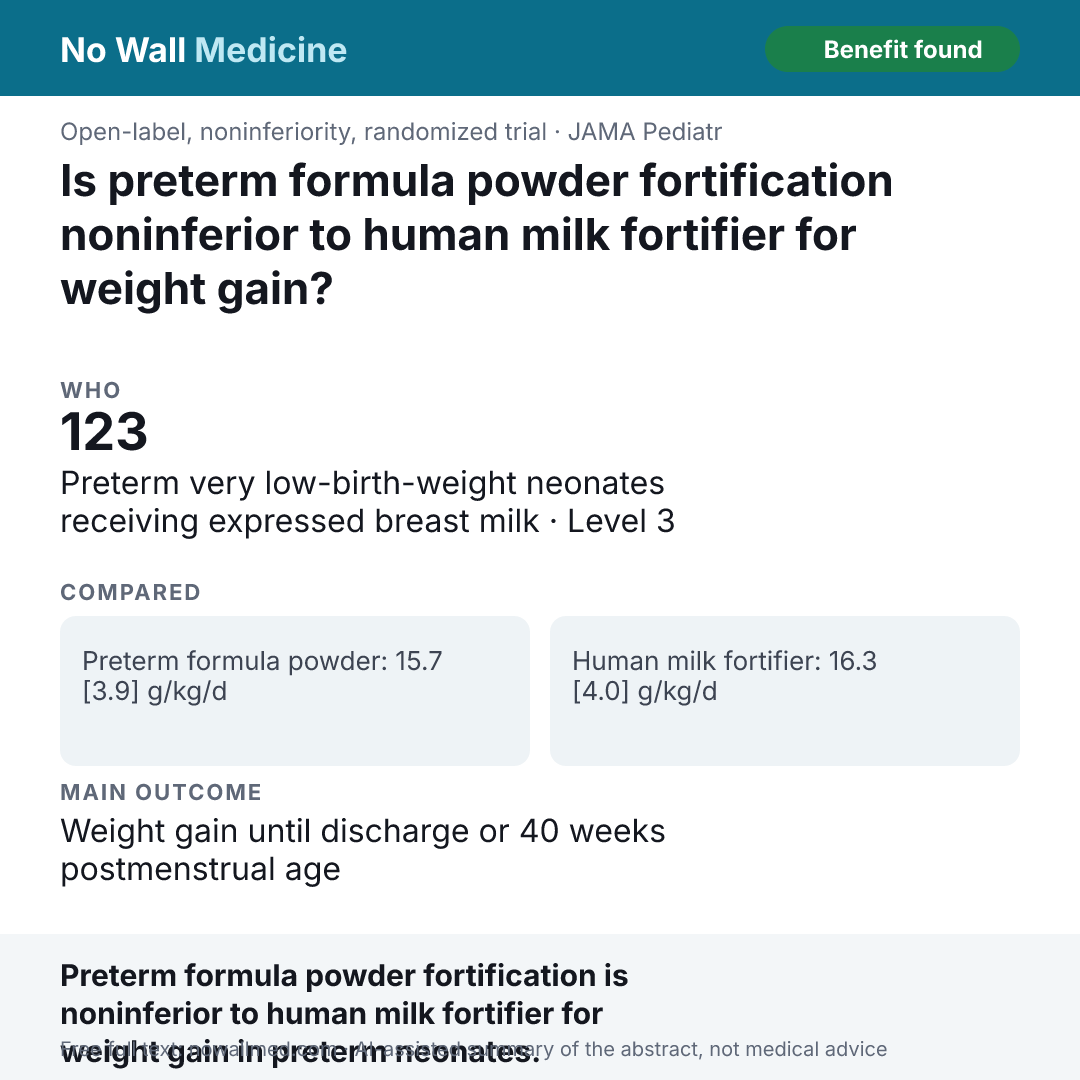
Is preterm formula powder fortification noninferior to human milk fortifier for weight gain?
Who
123
Preterm very low-birth-weight neonates receiving expressed breast milk · Level 3 neonatal unit in India
Compared
Preterm formula powder: 15.7 [3.9] g/kg/d
Human milk fortifier: 16.3 [4.0] g/kg/d
Main outcome
Weight gain until discharge or 40 weeks postmenstrual age
Result: mean difference, -0.5 g/kg/d; 95% CI, -1.9 to 0.7
Bottom line: Preterm formula powder fortification is noninferior to human milk fortifier for weight gain in preterm neonates.
JAMA Pediatr · 2021-05-11 · Save PNG
Clinical question: Is preterm formula powder fortification noninferior to human milk fortifier for weight gain?
Why it matters: Human milk fortifiers are expensive and linked to increased feed intolerance, making it unclear if preterm formula powder is a suitable alternative in resource-limited settings.
Key points
- Researchers studied 123 preterm very low-birth-weight neonates who were randomly assigned to receive either preterm formula powder or human milk fortifiers added to expressed breast milk.
- The mean weight gain was 15.7 [3.9] g/kg/d for the formula group and 16.3 [4.0] g/kg/d for the fortifier group, showing no significant difference.
- The preterm formula powder group had a lower incidence of feed intolerance at 1.4 vs 6.8 per 1000 patient-days and fewer neonates required withholding fortification for 24 hours or more (5% vs 22%).
Headline and key points written with AI from the paper’s abstract, with every number checked against it. Read the paper before relying on them.
Was this summary helpful?
Subject terms
Headline, design, result, key points, caveat and citation as plain text.
Cite this article
Chinnappan A, Sharma A, Agarwal R, Thukral A, Deorari A, Sankar MJ. Fortification of Breast Milk With Preterm Formula Powder vs Human Milk Fortifier in Preterm Neonates: A Randomized Noninferiority Trial. JAMA Pediatr. 2021;175(8):790-796. doi:10.1001/jamapediatrics.2021.0678
Spotted a mistake? Suggest a correction