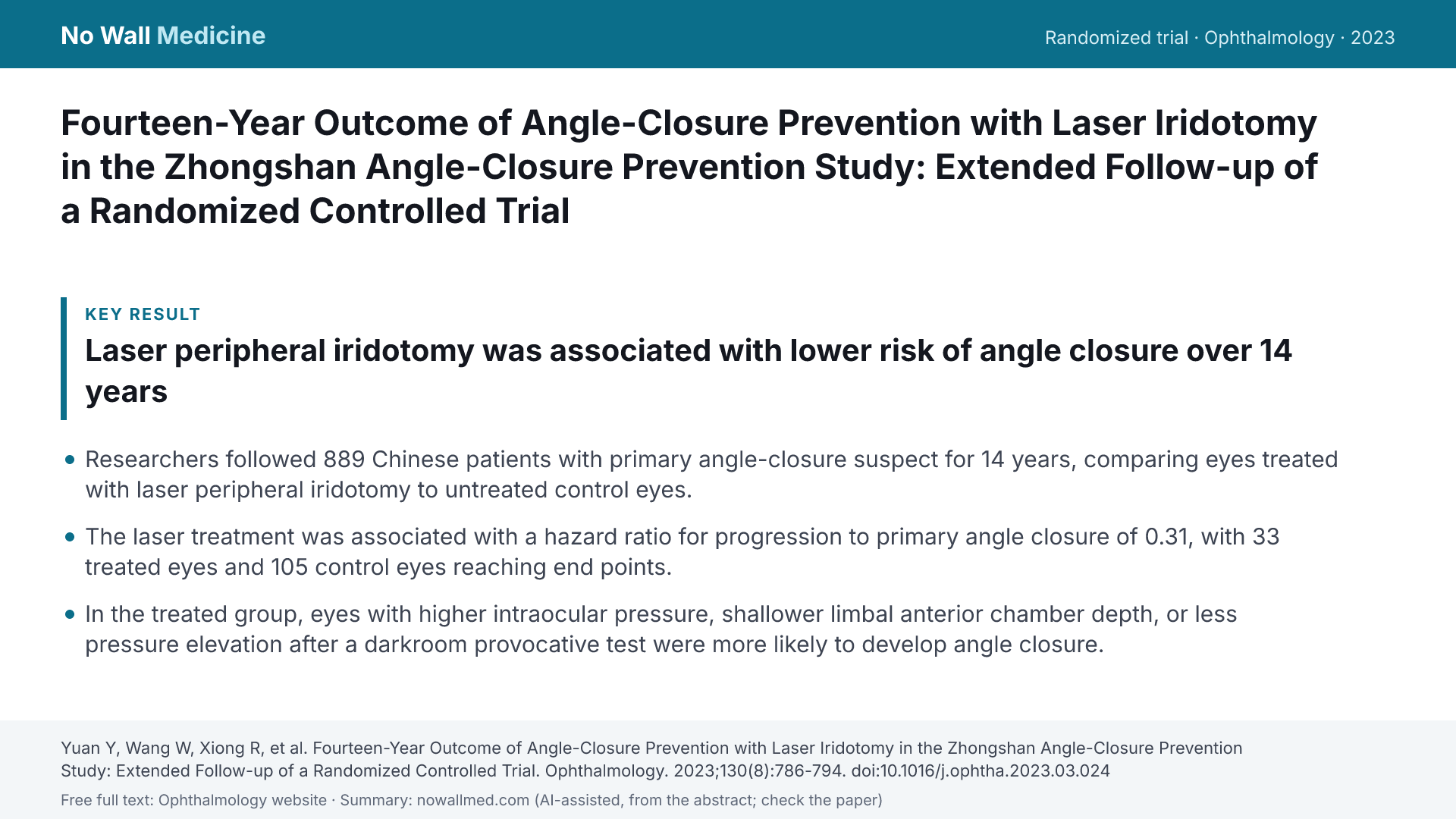
Laser peripheral iridotomy was associated with lower risk of angle closure over 14 years
Fourteen-Year Outcome of Angle-Closure Prevention with Laser Iridotomy in the Zhongshan Angle-Closure Prevention Study: Extended Follow-up of a Randomized Controlled Trial
Key points
- Researchers followed 889 Chinese patients with primary angle-closure suspect for 14 years, comparing eyes treated with laser peripheral iridotomy to untreated control eyes.
- The laser treatment was associated with a hazard ratio for progression to primary angle closure of 0.31, with 33 treated eyes and 105 control eyes reaching end points.
- In the treated group, eyes with higher intraocular pressure, shallower limbal anterior chamber depth, or less pressure elevation after a darkroom provocative test were more likely to develop angle closure.
Headline and key points written with AI from the paper’s abstract, with every number checked against it. Read the paper before relying on them.
Was this summary helpful?
Subject terms
Headline, design, result, key points, caveat and citation as plain text.
Cite this article
Yuan Y, Wang W, Xiong R, et al. Fourteen-Year Outcome of Angle-Closure Prevention with Laser Iridotomy in the Zhongshan Angle-Closure Prevention Study: Extended Follow-up of a Randomized Controlled Trial. Ophthalmology. 2023;130(8):786-794. doi:10.1016/j.ophtha.2023.03.024
Spotted a mistake? Suggest a correction