Using fractional flow reserve to guide renal artery stenting did not change blood pressure outcomes
Fractional flow reserve-guided renal artery stenting in atherosclerotic renovascular hypertension: the FAIR randomized trial
Randomized trialNo clear difference
Is fractional flow reserve-guided revascularization better than angiography-guided revascularization for atherosclerotic renal artery stenosis?
Who
101
Patients with atherosclerotic renal artery stenosis and hypertension
Compared
Fractional flow reserve-guided group: 4% [-2%, 11%] change in daytime mean systolic blood pressure
Angiography-guided group: 4% [-3%, 10%] change in daytime mean systolic blood pressure
Main outcome
Changes in daytime mean systolic blood pressure and antihypertensive medicines
Bottom line: Fractional flow reserve-guided revascularization reduced unnecessary stenting without improving blood pressure or medication reduction compared to angiography guidance.
Eur Heart J · 2025-10-07Download image
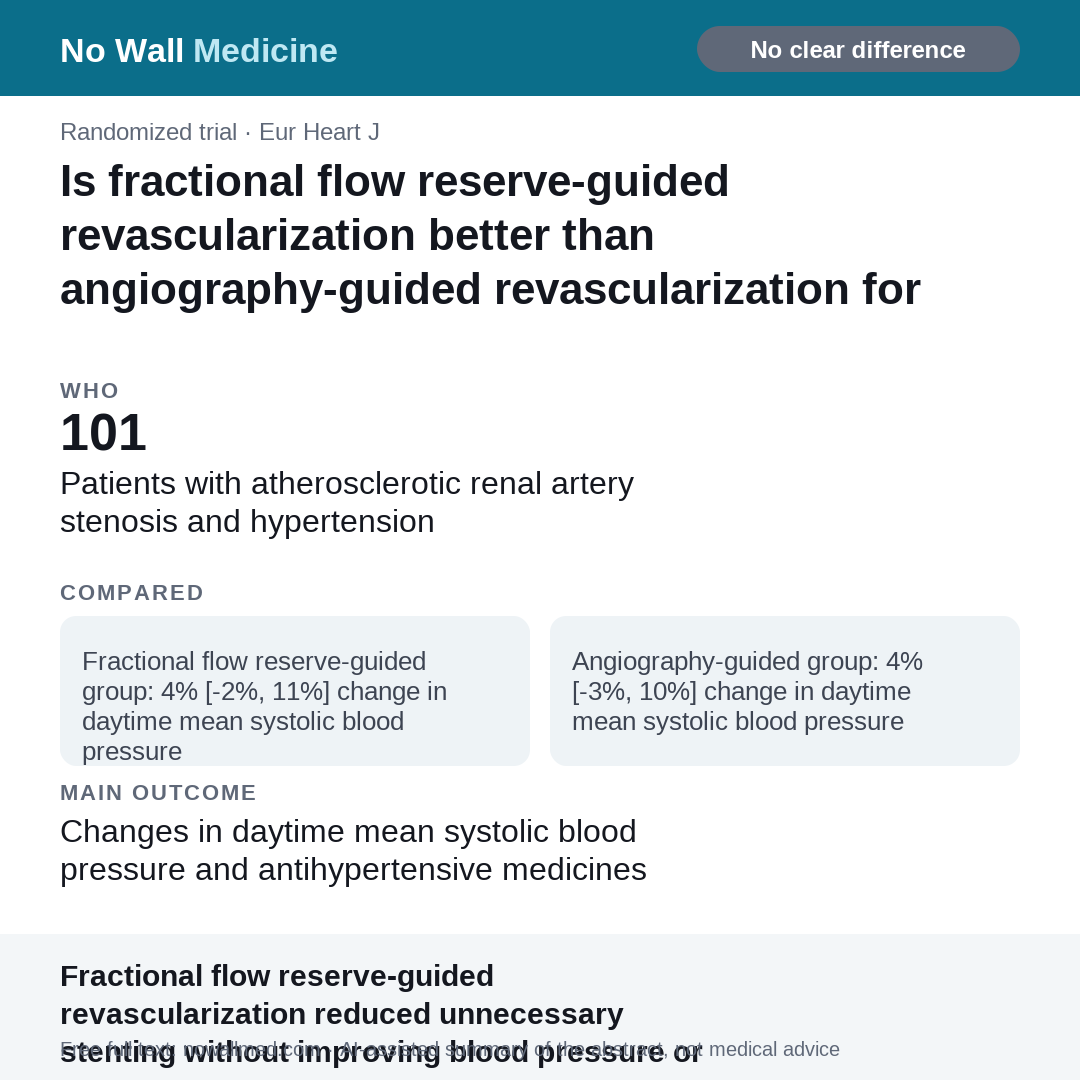
Clinical question: Is fractional flow reserve-guided revascularization better than angiography-guided revascularization for atherosclerotic renal artery stenosis?
Why it matters: The optimal therapy for patients with atherosclerotic renal artery stenosis and hypertension remains unresolved, specifically whether using fractional flow reserve to guide stenting improves clinical outcomes.
Key points
- Researchers randomly assigned 101 patients with atherosclerotic renal artery stenosis and hypertension to either fractional flow reserve-guided revascularization or traditional angiography-guided revascularization.
- The fractional flow reserve-guided group had a lower stenting rate of 46.0% compared to 100.0% in the angiography group, but blood pressure and medication changes did not differ.
- In patients with a fractional flow reserve below 0.80, stenting was associated with a 6.2 mmHg reduction in daytime mean systolic blood pressure and a 3.1 reduction in medication usage.
Headline and key points written with AI from the paper’s abstract, with every number checked against it. Read the paper before relying on them.
Was this summary helpful?
Subject terms
Cite this article
Li Y, Zheng J, Lu C, Fan F, Liu Z, Liu S. Fractional flow reserve-guided renal artery stenting in atherosclerotic renovascular hypertension: the FAIR randomized trial. Eur Heart J. 2025. doi:10.1093/eurheartj/ehaf746
Spotted a mistake? Suggest a correction
Top studies every Monday
The week’s key trials and guidelines in your specialties, plus any topics you follow. By email, free.
Get the weekly digest