Bone building drugs were more effective than bisphosphonates at reducing clinical and vertebral fractures
Fracture risk reduction and safety by osteoporosis treatment compared with placebo or active comparator in postmenopausal women: systematic review, network meta-analysis, and meta-regression analysis of randomised clinical trials
Meta-analysis of 69 trialsBenefit found
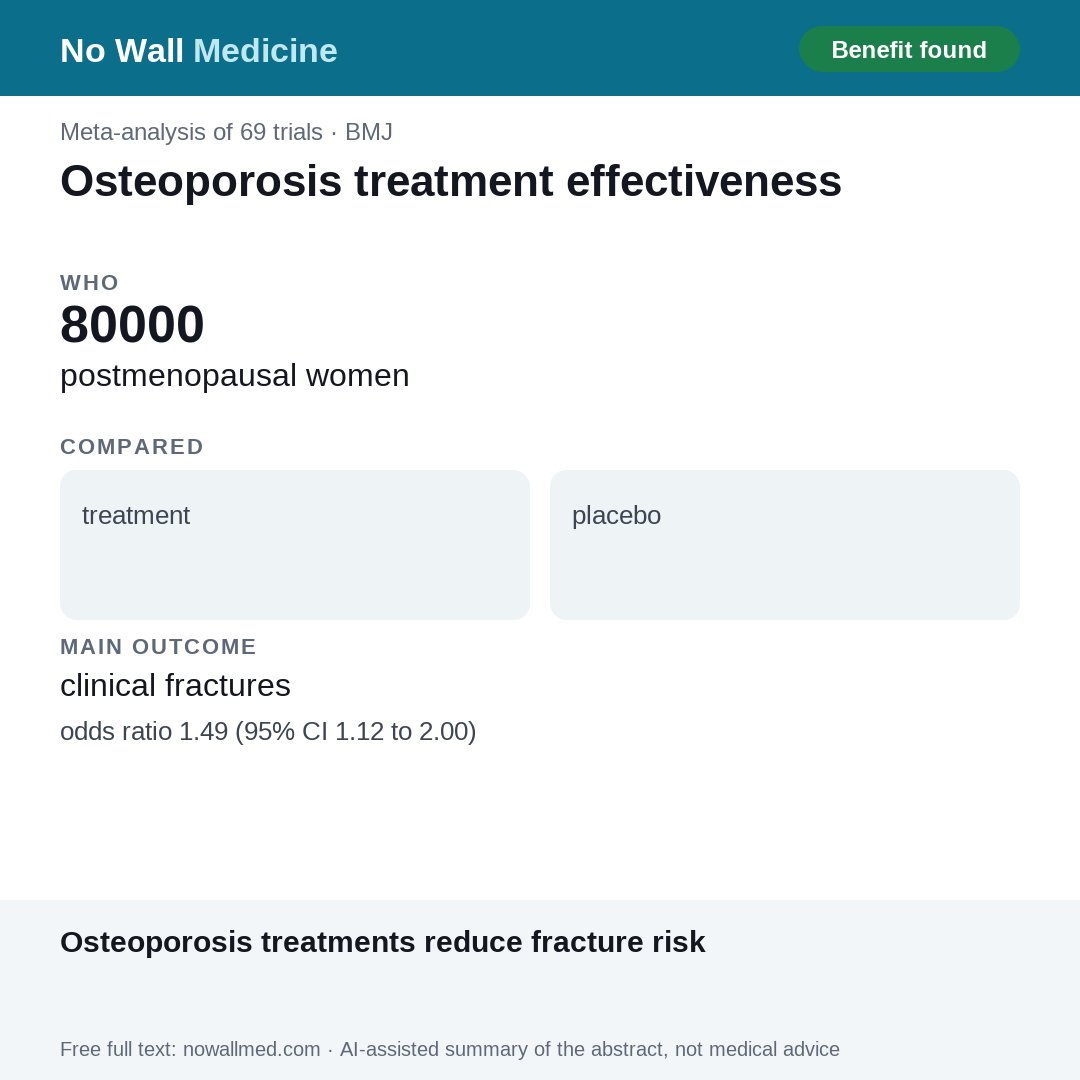
Osteoporosis treatment effectiveness
Who
80000
postmenopausal women
Compared
treatment
placebo
Main outcome
clinical fractures
Result: odds ratio 1.49 (95% CI 1.12 to 2.00)
Bottom line: Osteoporosis treatments reduce fracture risk
Limitation: serious risk of bias and imprecision
BMJ · 2023-05-02Download image
Key points
- Researchers analyzed 69 randomized clinical trials involving over 80,000 non-Asian postmenopausal women to compare various osteoporosis treatments.
- Compared to parathyroid hormone receptor agonists, bisphosphonates had an odds ratio of 1.49 for clinical fractures, while denosumab was less effective than romosozumab with an odds ratio of 1.56.
- All studied treatments showed an effect on vertebral fractures compared to placebo, and no harm outcomes were observed.
Limitation the authors note: The certainty of effect estimates was moderate to low due to reporting limitations, which indicated a serious risk of bias and imprecision.
Headline and key points written with AI from the paper’s abstract, with every number checked against it. Read the paper before relying on them.
Was this summary helpful?
Abstract
Objective
To review the comparative effectiveness of osteoporosis treatments, including the bone anabolic agents, abaloparatide and romosozumab, on reducing the risk of fractures in postmenopausal women, and to characterise the effect of antiosteoporosis drug treatments on the risk of fractures according to baseline risk factors. Design
Systematic review, network meta-analysis, and meta-regression analysis of randomised clinical trials. Data sources
Medline, Embase, and Cochrane Library to identify randomised controlled trials published between 1 January 1996 and 24 November 2021 that examined the effect of bisphosphonates, denosumab, selective oestrogen receptor modulators, parathyroid hormone receptor agonists, and romosozumab compared with placebo or active comparator. Eligibility criteria for selecting studies
Randomised controlled trials that included non-Asian postmenopausal women with no restriction on age, when interventions looked at bone quality in a broad perspective. The primary outcome was clinical fractures. Secondary outcomes were vertebral, non-vertebral, hip, and major osteoporotic fractures, all cause mortality, adverse events, and serious cardiovascular adverse events. Results
The results were based on 69 trials (>80 000 patients). For clinical fractures, synthesis of the results showed a protective effect of bisphosphonates, parathyroid hormone receptor agonists, and romosozumab compared with placebo. Compared with parathyroid hormone receptor agonists, bisphosphonates were less effective in reducing clinical fractures (odds ratio 1.49, 95% confidence interval 1.12 to 2.00). Compared with parathyroid hormone receptor agonists and romosozumab, denosumab was less effective in reducing clinical fractures (odds ratio 1.85, 1.18 to 2.92 for denosumab v parathyroid hormone receptor agonists and 1.56, 1.02 to 2.39 for denosumab v romosozumab). An effect of all treatments on vertebral fractures compared with placebo was found. In the active treatment comparisons, denosumab, parathyroid hormone receptor agonists, and romosozumab were more effective than oral bisphosphonates in preventing vertebral fractures. The effect of all treatments was unaffected by baseline risk indicators, except for antiresorptive treatments that showed a greater reduction of clinical fractures compared with placebo with increasing mean age (number of studies=17; β=0.98, 95% confidence interval 0.96 to 0.99). No harm outcomes were seen. The certainty in the effect estimates was moderate to low for all individual outcomes, mainly because of limitations in reporting, nominally indicating a serious risk of bias and imprecision. Conclusions
The evidence indicated a benefit of a range of treatments for osteoporosis in postmenopausal women for clinical and vertebral fractures. Bone anabolic treatments were more effective than bisphosphonates in the prevention of clinical and vertebral fractures, irrespective of baseline risk indicators. Hence this analysis provided no clinical evidence for restricting the use of anabolic treatment to patients with a very high risk of fractures. Systematic review registration
PROSPERO CRD42019128391.
Abstract reproduced under the article’s CC BY NC licence.
Subject terms
Cite this article
Händel MN, Cardoso I, von Bülow C, Rohde JF, Ussing A, Nielsen SM. Fracture risk reduction and safety by osteoporosis treatment compared with placebo or active comparator in postmenopausal women: systematic review, network meta-analysis, and meta-regression analysis of randomised clinical trials. BMJ. 2023. doi:10.1136/bmj-2021-068033
Spotted a mistake? Suggest a correction
Top studies every Monday
The week’s key trials and guidelines in your specialties, plus any topics you follow. By email, free.
Get the weekly digest