Direct oral anticoagulants were associated with lower fracture risks than warfarin in patients with atrial fibrillation
Fracture risks in patients with atrial fibrillation treated with different oral anticoagulants: a meta-analysis and systematic review
Meta-analysis of six observational studiesBenefit found
Do direct oral anticoagulants increase fracture risk compared to warfarin in atrial fibrillation patients?
Who
351,208
Patients with atrial fibrillation
Compared
Direct oral anticoagulants
Warfarin
Main outcome
Risk of any fracture
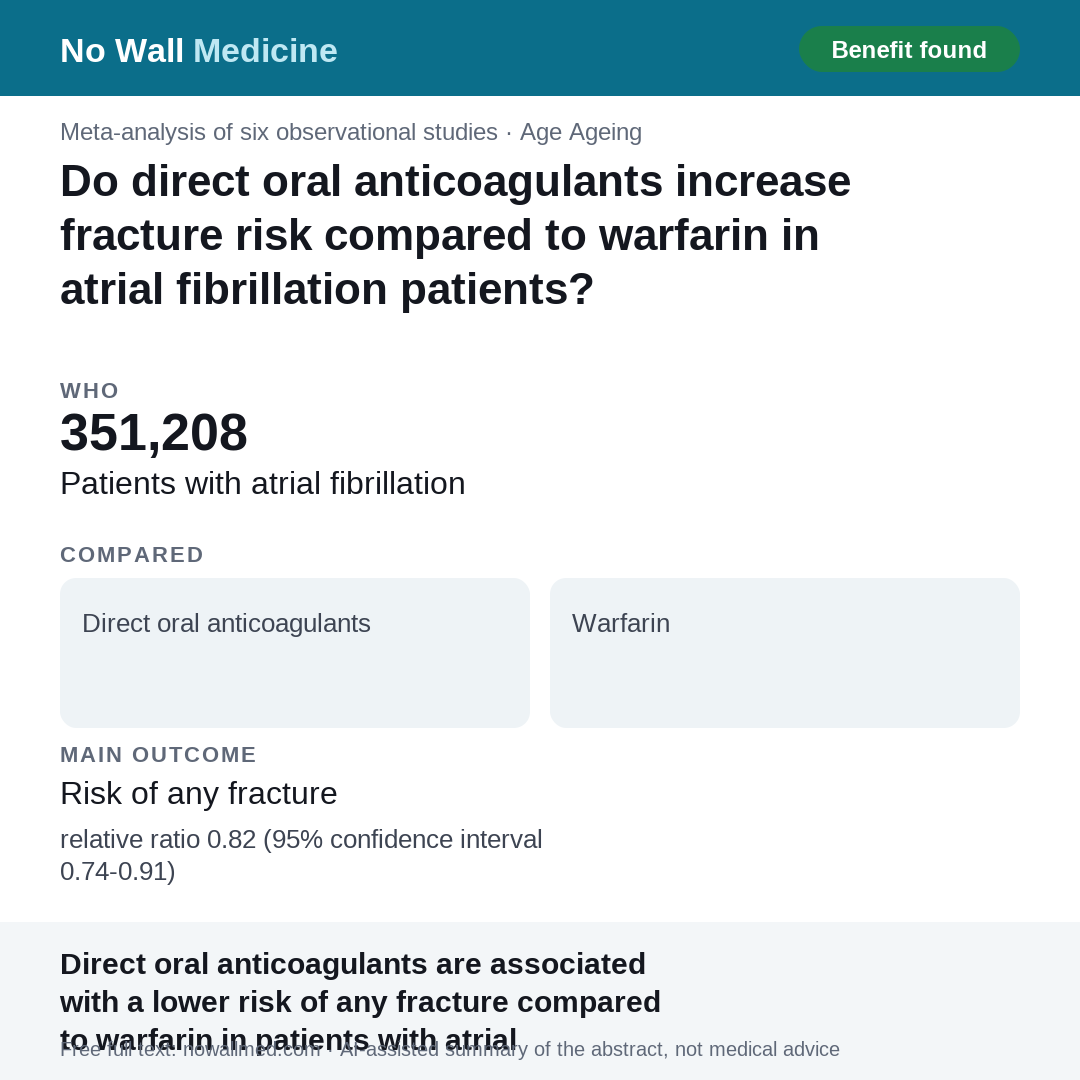
Result: relative ratio 0.82 (95% confidence interval 0.74-0.91)
Bottom line: Direct oral anticoagulants are associated with a lower risk of any fracture compared to warfarin in patients with atrial fibrillation.
Age Ageing · 2022-01-25Download image
Clinical question: Do direct oral anticoagulants increase fracture risk compared to warfarin in atrial fibrillation patients?
Why it matters: Evidence regarding the difference in fracture risks for patients with atrial fibrillation receiving direct oral anticoagulants versus warfarin remains controversial.
Key points
- Researchers analyzed six observational studies involving 351,208 patients and 9,424 fractures to compare fracture risks between direct oral anticoagulants and warfarin.
- Patients using direct oral anticoagulants had a lower risk of any fracture compared to those on warfarin with a relative ratio of 0.82 (95% CI: 0.74-0.91).
- Sub-analyses showed apixaban and rivaroxaban were associated with lower risks of any fracture compared to warfarin with hazard ratios of 0.75 (95% CI: 0.60-0.92) and 0.79 (95% CI: 0.71-0.88).
Headline and key points written with AI from the paper’s abstract, with every number checked against it. Read the paper before relying on them.
Was this summary helpful?
Subject terms
Cite this article
Xie X, Liu Y, Li J, Gu F, Zhang K, Sui Z. Fracture risks in patients with atrial fibrillation treated with different oral anticoagulants: a meta-analysis and systematic review. Age Ageing. 2022. doi:10.1093/ageing/afab264
Spotted a mistake? Suggest a correction
Top studies every Monday
The week’s key trials and guidelines in your specialties, plus any topics you follow. By email, free.
Get the weekly digest