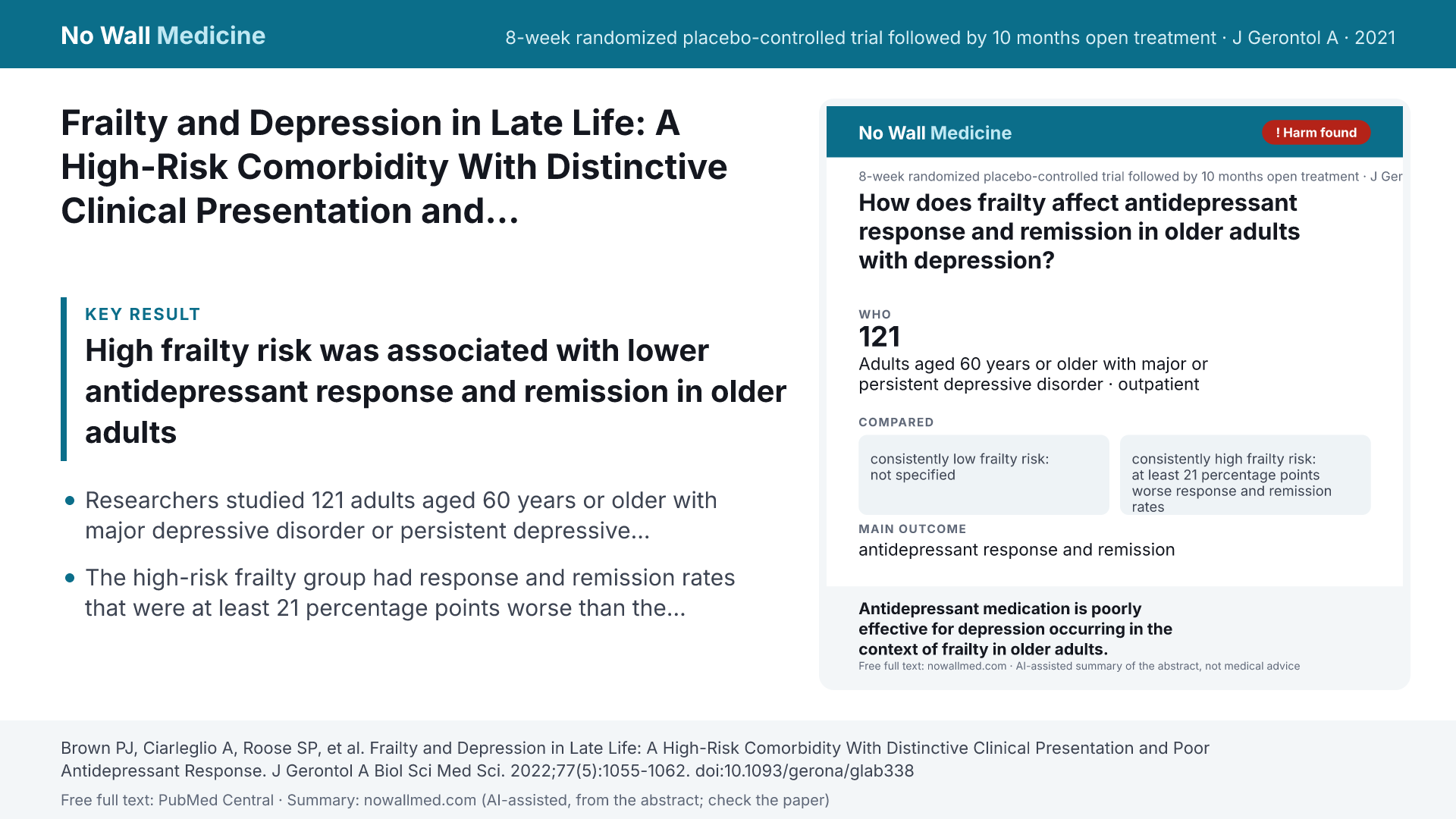
High frailty risk was associated with lower antidepressant response and remission in older adults
Frailty and Depression in Late Life: A High-Risk Comorbidity With Distinctive Clinical Presentation and Poor Antidepressant Response
8-week randomized placebo-controlled trial followed by 10 months open treatmentHarm found
How does frailty affect antidepressant response and remission in older adults with depression?
Who
121
Adults aged 60 years or older with major or persistent depressive disorder · outpatient research clinic
Compared
consistently low frailty risk: not specified
consistently high frailty risk: at least 21 percentage points worse response and remission rates
Main outcome
antidepressant response and remission
Bottom line: Antidepressant medication is poorly effective for depression occurring in the context of frailty in older adults.
J Gerontol A · 2021-11-11Download image
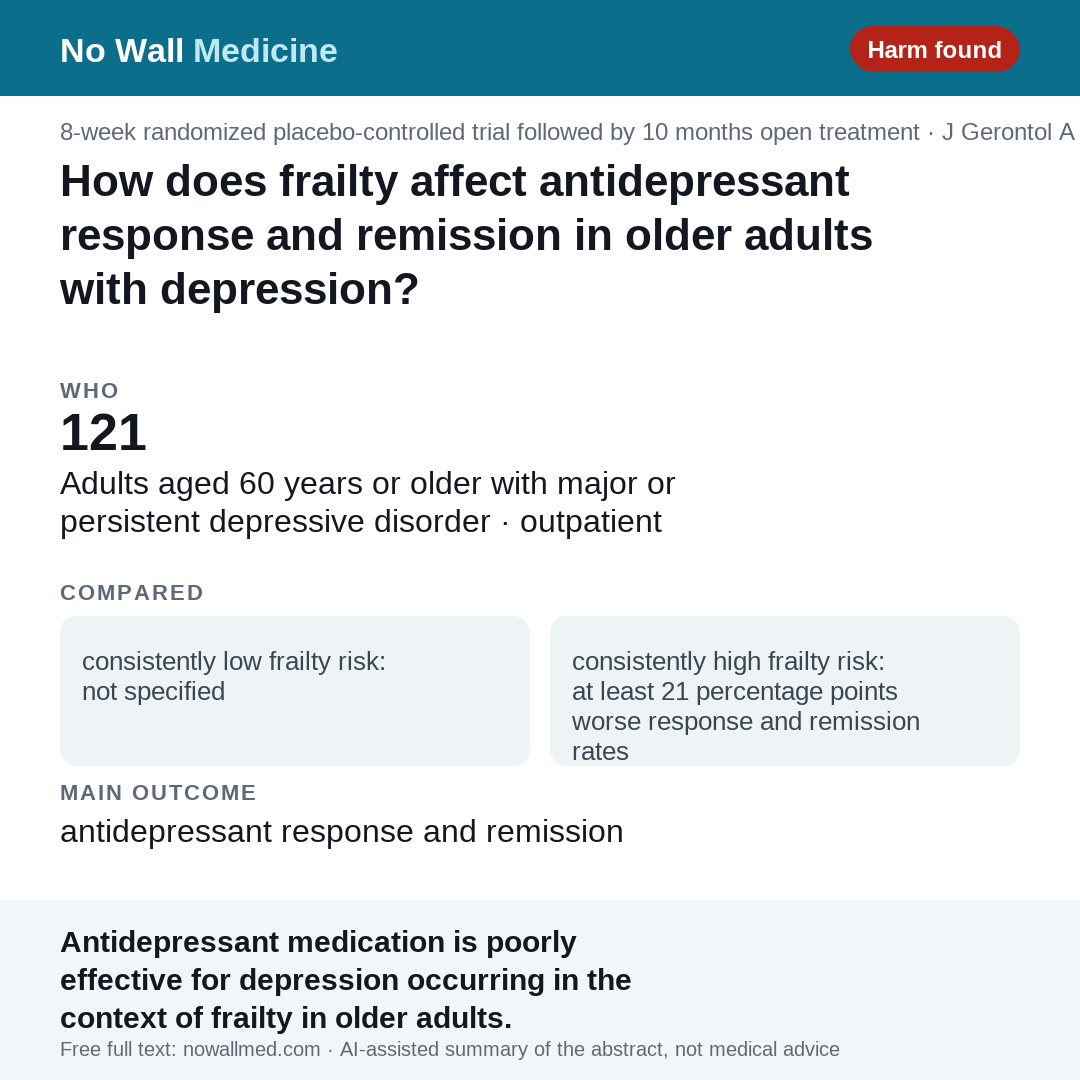
Clinical question: How does frailty affect antidepressant response and remission in older adults with depression?
Key points
- Researchers studied 121 adults aged 60 years or older with major depressive disorder or persistent depressive disorder over 12 months.
- The high-risk frailty group had response and remission rates that were at least 21 percentage points worse than the low-risk group.
- Subsequent frailty was associated with previous frailty, but previous response or remission was not linked to subsequent frailty.
Headline and key points written with AI from the paper’s abstract, with every number checked against it. Read the paper before relying on them.
Was this summary helpful?
Subject terms
Cite this article
Brown PJ, Ciarleglio A, Roose SP, et al. Frailty and Depression in Late Life: A High-Risk Comorbidity With Distinctive Clinical Presentation and Poor Antidepressant Response. J Gerontol A. 2021. doi:10.1093/gerona/glab338
Spotted a mistake? Suggest a correction