Aerobic exercise training shows different benefits for frail and non-frail patients with heart failure
Frailty Status Modifies the Efficacy of Exercise Training Among Patients With Chronic Heart Failure and Reduced Ejection Fraction: An Analysis From the HF-ACTION Trial
Randomized trial analysisBenefit found
Does baseline frailty modify the efficacy of aerobic exercise training in heart failure patients?
Who
2130
Stable outpatients with heart failure and reduced ejection fraction
Compared
Frail participants: hazard ratio 0.83 (95% CI, 0.72-0.95)
Nonfrail participants: hazard ratio 1.04 (95% CI, 0.87-1.25)
Main outcome
all-cause hospitalization or mortality
Result: hazard ratio 0.83 (95% CI, 0.72-0.95) in frail participants
Bottom line: Aerobic exercise training reduces the risk of all-cause hospitalization in frail patients with heart failure and reduced ejection fraction.
Circulation · 2022-05-26Download image
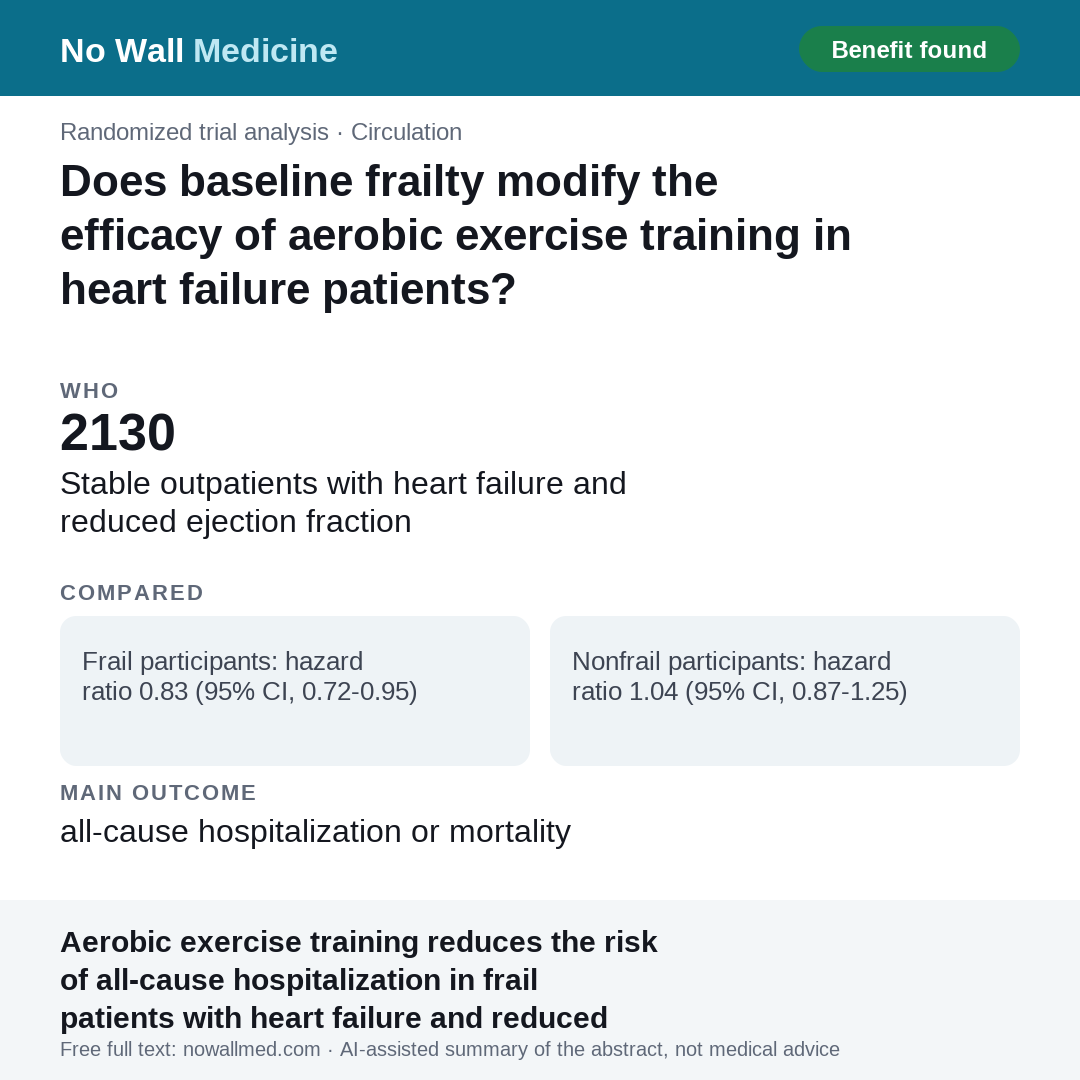
Clinical question: Does baseline frailty modify the efficacy of aerobic exercise training in heart failure patients?
Why it matters: It was unknown if baseline frailty, a state of increased vulnerability, changes how well aerobic exercise training works for patients with heart failure.
Key points
- Researchers analyzed 2130 stable outpatients with heart failure and reduced ejection fraction who were randomized to aerobic exercise training or usual care.
- In frail patients, aerobic exercise training was associated with a lower risk of the primary composite endpoint of all-cause hospitalization or mortality (hazard ratio, 0.83 [95% CI, 0.72-0.95]).
- The benefit for frail patients was driven by a lower risk of all-cause hospitalization (hazard ratio, 0.84 [95% CI, 0.72-0.99]), but no difference was found for mortality or other secondary endpoints.
Headline and key points written with AI from the paper’s abstract, with every number checked against it. Read the paper before relying on them.
Topics
Cite this article
Pandey A, Segar MW, Singh S, Reeves GR, O'Connor C, Piña I. Frailty Status Modifies the Efficacy of Exercise Training Among Patients With Chronic Heart Failure and Reduced Ejection Fraction: An Analysis From the HF-ACTION Trial. Circulation. 2022. doi:10.1161/CIRCULATIONAHA.122.059983
Spotted a mistake? Suggest a correction
Top studies every Monday
The week’s key trials and guidelines in your specialties, plus any topics you follow. By email, free.
Get the weekly digest