Free functional muscle transfer after oncologic extremity reconstruction: A systematic review
Systematic reviewBenefit found
What are the outcomes of free functional muscle transfer after oncologic extremity resection?
Who
82
Patients undergoing free functional muscle transfer after oncologic extremity resection
Compared
100%Flap survival (77/77)
26.67%Complication rate (16/60)
Main outcome
flap survival and functional strength recovery
Bottom line: Free functional muscle transfer shows high flap reliability and meaningful strength recovery after oncologic extremity resection.
Limitation: Small heterogeneous series and incomplete outcome reporting.
JPRAS Open · 2026-04-30Download image
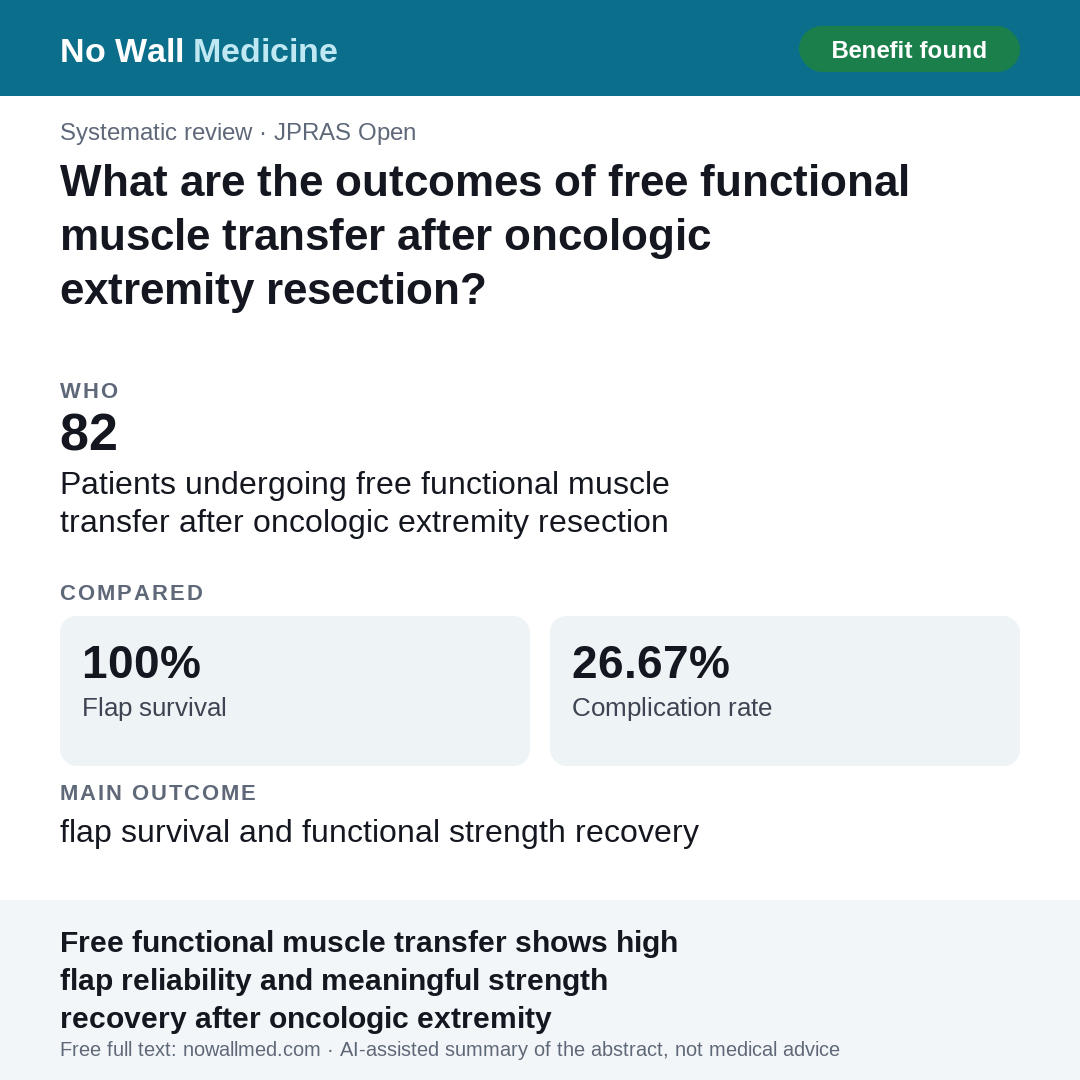
Clinical question: What are the outcomes of free functional muscle transfer after oncologic extremity resection?
Abstract
Background
Limb-salvage surgery for extremity sarcoma increasingly prioritizes preservation of meaningful motor function, yet oncologic resections often require removal of major musculotendinous units, resulting in severe disability despite limb preservation. Free functional muscle transfer (FFMT) offers a reconstructive option capable of restoring active motion through microvascular transfer and reinnervation of a donor muscle. Methods
A PRISMA-guided, OSF-registered systematic review was performed to evaluate outcomes of FFMT following oncologic extremity resection. Primary endpoints were flap survival and functional strength recovery (MRC/MMT), with secondary outcomes including complications and tumor recurrence. Outcomes were synthesized descriptively using pooled proportions with Wilson 95% confidence intervals. Results
Twenty-two studies comprising 82 cases met inclusion criteria. Flap survival was reported in 77 cases, with 100% survival (77/77; 95% CI 95.3-100.0). Complication outcomes were available in 60 cases, with a pooled complication rate of 26.67% (16/60; 95% CI 17.1-39.0%), most commonly involving wound-related events. Strength outcomes were most frequently in the MRC/MMT >3 to ≤4 range (36/82; 43.9%), while 15.9% achieved >4 to ≤5 strength. Mean strength varied by donor muscle, with vastus lateralis (4.21) and rectus femoris (4.17) demonstrating higher averages than latissimus dorsi (3.55) and gracilis (3.60), though subgroup sample sizes were small. Tumor recurrence was uncommon among reported cases. Conclusions
FFMT demonstrates high flap reliability and frequently meaningful strength recovery following oncologic extremity resection, supporting its role as a cornerstone technique for functional limb salvage. However, the evidence base remains limited by small heterogeneous series and incomplete outcome reporting, underscoring the need for standardized functional endpoints and prospective multicenter data collection.
Cite this article
Blank L, Khorsandi J, Kim H, Adkins S, Buttenberg K, Franzoni D. Free functional muscle transfer after oncologic extremity reconstruction: A systematic review. JPRAS Open. 2026. doi:10.1016/j.jpra.2026.04.022
Spotted a mistake? Suggest a correction