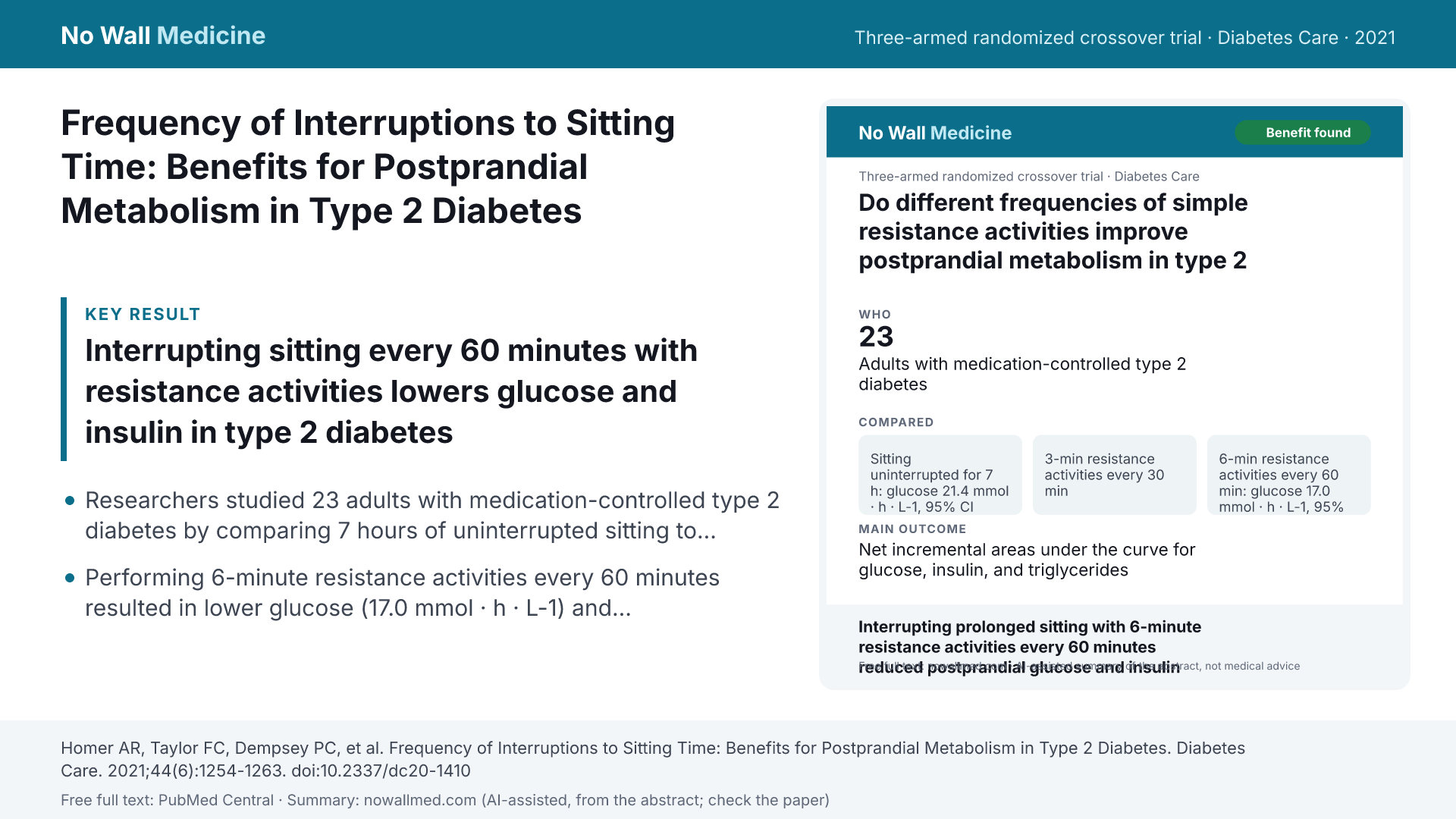
Interrupting sitting every 60 minutes with resistance activities lowers glucose and insulin in type 2 diabetes
Frequency of Interruptions to Sitting Time: Benefits for Postprandial Metabolism in Type 2 Diabetes
Three-armed randomized crossover trialBenefit found
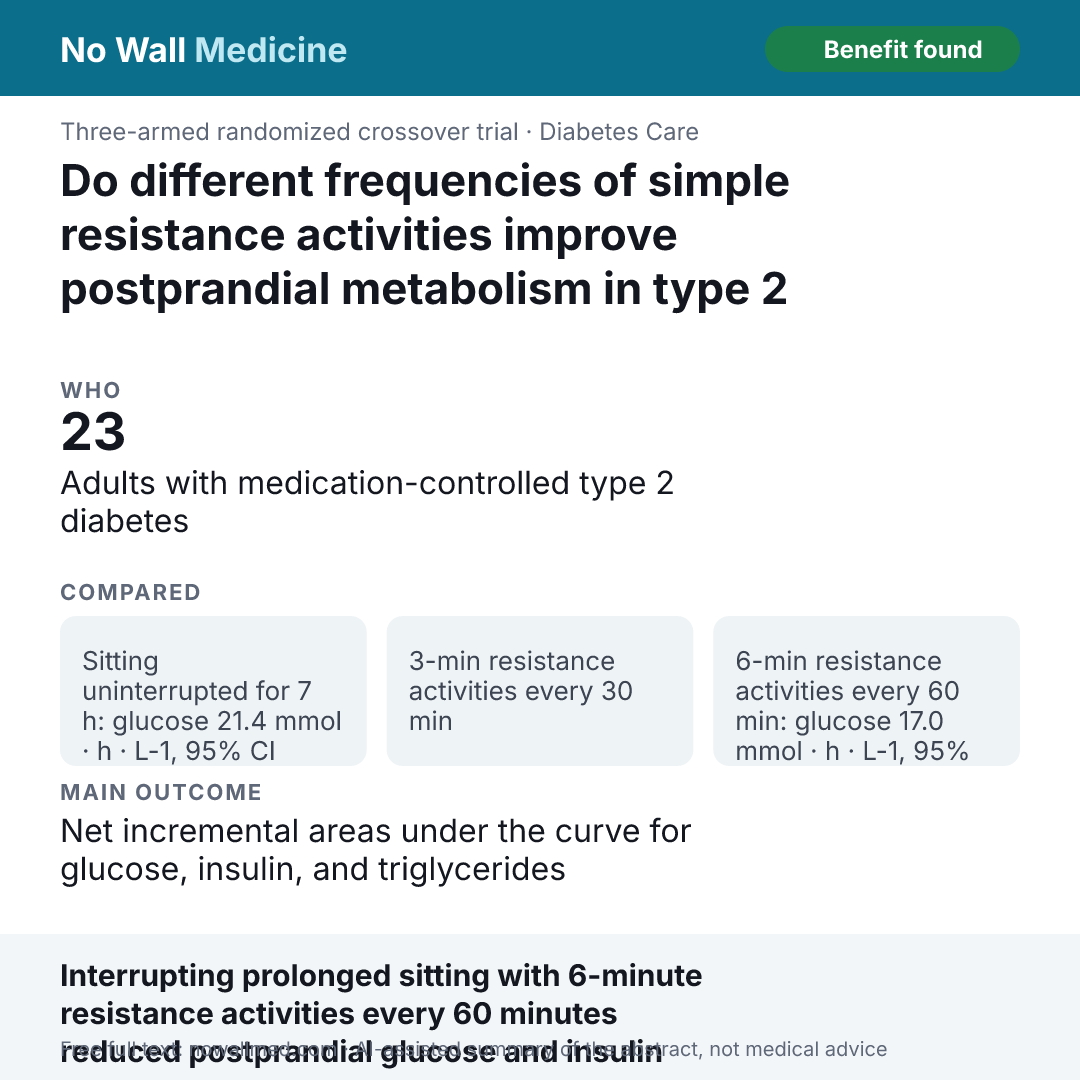
Do different frequencies of simple resistance activities improve postprandial metabolism in type 2 diabetes?
Who
23
Adults with medication-controlled type 2 diabetes
Compared
Sitting uninterrupted for 7 h: glucose 21.4 mmol · h · L-1, 95% CI 16.9, 25.8
3-min resistance activities every 30 min
6-min resistance activities every 60 min: glucose 17.0 mmol · h · L-1, 95% CI 12.5, 21.4
Main outcome
Net incremental areas under the curve for glucose, insulin, and triglycerides
Bottom line: Interrupting prolonged sitting with 6-minute resistance activities every 60 minutes reduced postprandial glucose and insulin responses.
Diabetes Care · 2021-04-26 · Save PNG
Clinical question: Do different frequencies of simple resistance activities improve postprandial metabolism in type 2 diabetes?
Key points
- Researchers studied 23 adults with medication-controlled type 2 diabetes by comparing 7 hours of uninterrupted sitting to two different schedules of brief resistance activities.
- Performing 6-minute resistance activities every 60 minutes resulted in lower glucose (17.0 mmol · h · L-1) and insulin (1,229 pmol · h · L-1) levels compared to uninterrupted sitting.
- The 6-minute resistance activity every 60 minutes also showed lower glucose levels than the 3-minute resistance activity every 30 minutes, but no significant difference was found for triglycerides.
Headline and key points written with AI from the paper’s abstract, with every number checked against it. Read the paper before relying on them.
Was this summary helpful?
Subject terms
Headline, design, result, key points, caveat and citation as plain text.
Cite this article
Homer AR, Taylor FC, Dempsey PC, et al. Frequency of Interruptions to Sitting Time: Benefits for Postprandial Metabolism in Type 2 Diabetes. Diabetes Care. 2021;44(6):1254-1263. doi:10.2337/dc20-1410
Spotted a mistake? Suggest a correction