Capivasertib plus fulvestrant improved survival in women with advanced hormone receptor-positive breast cancer
Fulvestrant plus capivasertib versus placebo after relapse or progression on an aromatase inhibitor in metastatic, oestrogen receptor-positive, HER2-negative breast cancer (FAKTION): overall survival, updated progression-free survival, and expanded biomarker analysis from a randomised, phase 2 trial
Randomised, double-blind, placebo-controlled, phase 2 trialBenefit found
Does capivasertib plus fulvestrant improve survival in aromatase inhibitor-resistant breast cancer?
Who
140
Postmenopausal women with estrogen receptor-positive, HER2-negative, metastatic or locally advanced breast cancer · 19 hospitals in the UK
Compared
10.3 monthsFulvestrant plus capivasertib
4.8 monthsFulvestrant plus placebo
Main outcome
Progression-free survival
Result: adjusted hazard ratio 0.56 (95% CI 0.38 to 0.81)
Bottom line: Capivasertib plus fulvestrant significantly improved progression-free survival and overall survival compared to placebo in this population.
Lancet Oncol · 2022-06-04Download image
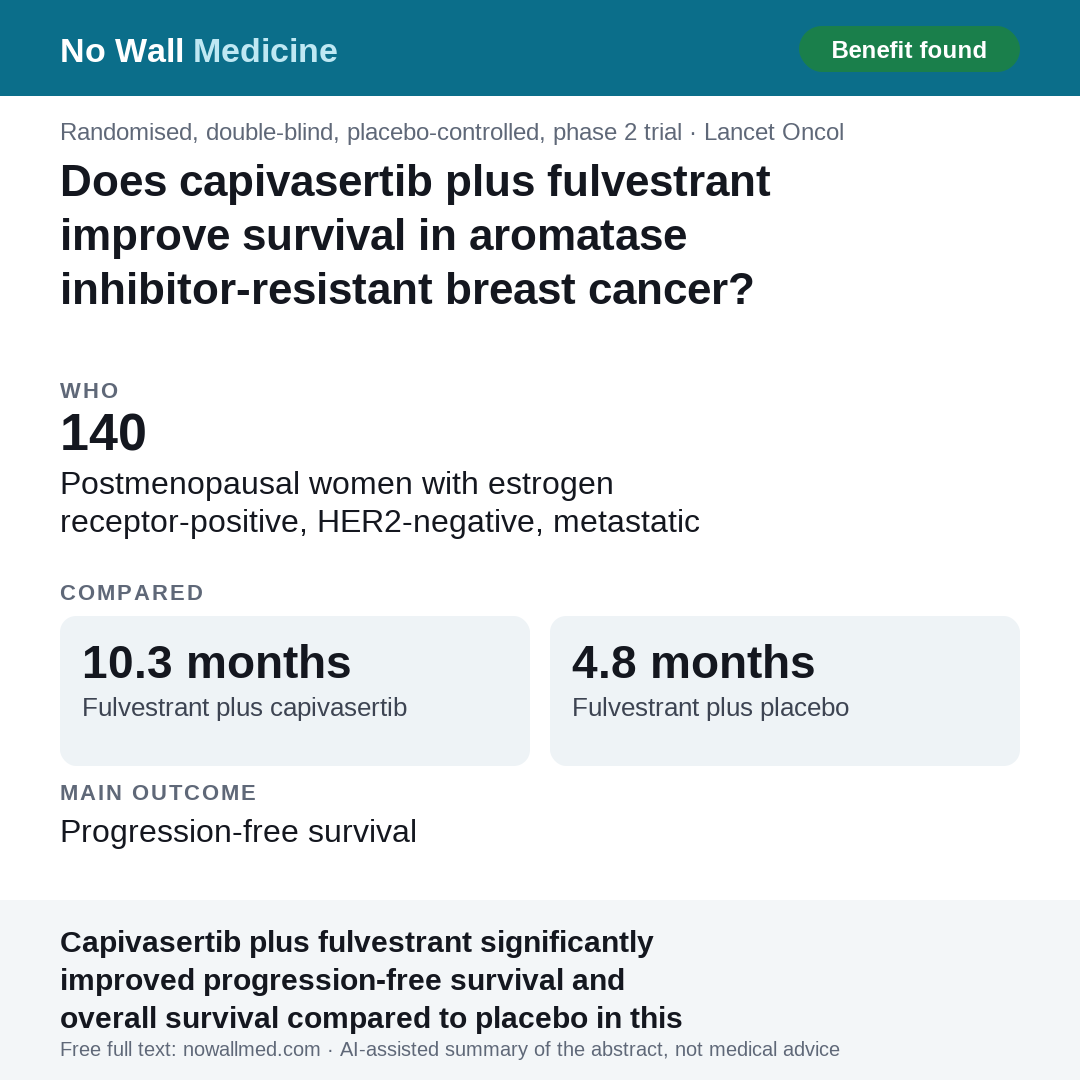
Clinical question: Does capivasertib plus fulvestrant improve survival in aromatase inhibitor-resistant breast cancer?
Why it matters: It was unknown if the benefits of capivasertib, an AKT inhibitor, were linked to specific genetic alterations in the PI3K/AKT/PTEN pathway.
Key points
- In this phase 2 trial, 140 women with hormone receptor-positive, HER2-negative breast cancer were assigned to receive fulvestrant plus capivasertib or fulvestrant plus a placebo.
- The capivasertib group had a median progression-free survival of 10.3 months compared to 4.8 months in the placebo group (adjusted hazard ratio 0.56).
- Median overall survival was 29.3 months for the capivasertib group versus 23.4 months for the placebo group (adjusted hazard ratio 0.66).
Headline and key points written with AI from the paper’s abstract, with every number checked against it. Read the paper before relying on them.
Was this summary helpful?
Abstract
Background
Capivasertib, an AKT inhibitor, added to fulvestrant, was previously reported to improve progression-free survival in women with aromatase inhibitor-resistant oestrogen receptor (ER)-positive, HER2-negative advanced breast cancer. The benefit appeared to be independent of the phosphoinositide 3-kinase (PI3K)/AKT/phosphatase and tensin homologue (PTEN) pathway alteration status of tumours, as ascertained using assays available at the time. Here, we report updated progression-free survival and overall survival results, and a prespecified examination of the effect of PI3K/AKT/PTEN pathway alterations identified by an expanded genetic testing panel on treatment outcomes. Methods
This randomised, multicentre, double-blind, placebo-controlled, phase 2 trial recruited postmenopausal adult women aged at least 18 years with ER-positive, HER2-negative, metastatic or locally advanced inoperable breast cancer and an Eastern Cooperative Oncology Group performance status of 0-2, who had relapsed or progressed on an aromatase inhibitor, from across 19 hospitals in the UK. Participants were randomly assigned (1:1) to receive intramuscular fulvestrant 500 mg (day 1) every 28 days (plus a 500 mg loading dose on day 15 of cycle 1) with either capivasertib 400 mg or matching placebo, orally twice daily on an intermittent weekly schedule of 4 days on and 3 days off, starting on cycle 1 day 15. Treatment continued until disease progression, unacceptable toxicity, loss to follow-up, or withdrawal of consent. Treatment was allocated by an interactive web-response system using a minimisation method (with a 20% random element) and the following minimisation factors: measurable or non-measurable disease, primary or secondary aromatase inhibitor resistance, PIK3CA status, and PTEN status. The primary endpoint was progression-free survival in the intention-to-treat population. Secondary endpoints shown in this Article were overall survival and safety in the intention-to-treat population, and the effect of tumour PI3K/AKT/PTEN pathway status identified by an expanded testing panel that included next-generation sequencing assays. Recruitment is complete. The trial is registered with ClinicalTrials.gov, number NCT01992952. Findings
Between March 16, 2015, and March 6, 2018, 183 participants were screened for eligibility and 140 (77%) were randomly assigned to receive fulvestrant plus capivasertib (n=69) or fulvestrant plus placebo (n=71). Median follow-up at the data cut-off of Nov 25, 2021, was 58·5 months (IQR 45·9-64·1) for participants treated with fulvestrant plus capivasertib and 62·3 months (IQR 62·1-70·3) for fulvestrant plus placebo. Updated median progression-free survival was 10·3 months (95% CI 5·0-13·4) in the group receiving fulvestrant plus capivasertib compared with 4·8 months (3·1-7·9) for fulvestrant plus placebo (adjusted hazard ratio [HR] 0·56 [95% CI 0·38-0·81]; two-sided p=0·0023). Median overall survival in the capivasertib versus placebo groups was 29·3 months (95% CI 23·7-39·0) versus 23·4 months (18·7-32·7; adjusted HR 0·66 [95% CI 0·45-0·97]; two-sided p=0·035). The expanded biomarker panel identified an expanded pathway-altered subgroup that contained 76 participants (54% of the intention-to-treat population). Median progression-free survival in the expanded pathway-altered subgroup for participants receiving capivasertib (n=39) was 12·8 months (95% CI 6·6-18·8) compared with 4·6 months (2·8-7·9) in the placebo group (n=37; adjusted HR 0·44 [95% CI 0·26-0·72]; two-sided p=0·0014). Median overall survival for the expanded pathway-altered subgroup receiving capivasertib was 38·9 months (95% CI 23·3-50·7) compared with 20·0 months (14·8-31·4) for those receiving placebo (adjusted HR 0·46 [95% CI 0·27-0·79]; two-sided p=0·0047). By contrast, there were no statistically significant differences in progression-free or overall survival in the expanded pathway non-altered subgroup treated with capivasertib (n=30) versus placebo (n=34). One additional serious adverse event (pneumonia) in the capivasertib group had occurred subsequent to the primary analysis. One death, due to atypical pulmonary infection, was assessed as possibly related to capivasertib treatment. Interpretation
Updated FAKTION data showed that capivasertib addition to fulvestrant extends the survival of participants with aromatase inhibitor-resistant ER-positive, HER2-negative advanced breast cancer. The expanded biomarker testing suggested that capivasertib predominantly benefits patients with PI3K/AKT/PTEN pathway-altered tumours. Phase 3 data are needed to substantiate the results, including in patients with previous CDK4/6 inhibitor exposure who were not included in the FAKTION trial. Funding
AstraZeneca and Cancer Research UK.
Abstract reproduced under the article’s CC BY licence.
Subject terms
Cite this article
Howell SJ, Casbard A, Carucci M, Ingarfield K, Butler R, Morgan S. Fulvestrant plus capivasertib versus placebo after relapse or progression on an aromatase inhibitor in metastatic, oestrogen receptor-positive, HER2-negative breast cancer (FAKTION): overall survival, updated progression-free survival, and expanded biomarker analysis from a randomised, phase 2 trial. Lancet Oncol. 2022. doi:10.1016/S1470-2045(22)00284-4
Spotted a mistake? Suggest a correction
Top studies every Monday
The week’s key trials and guidelines in your specialties, plus any topics you follow. By email, free.
Get the weekly digest