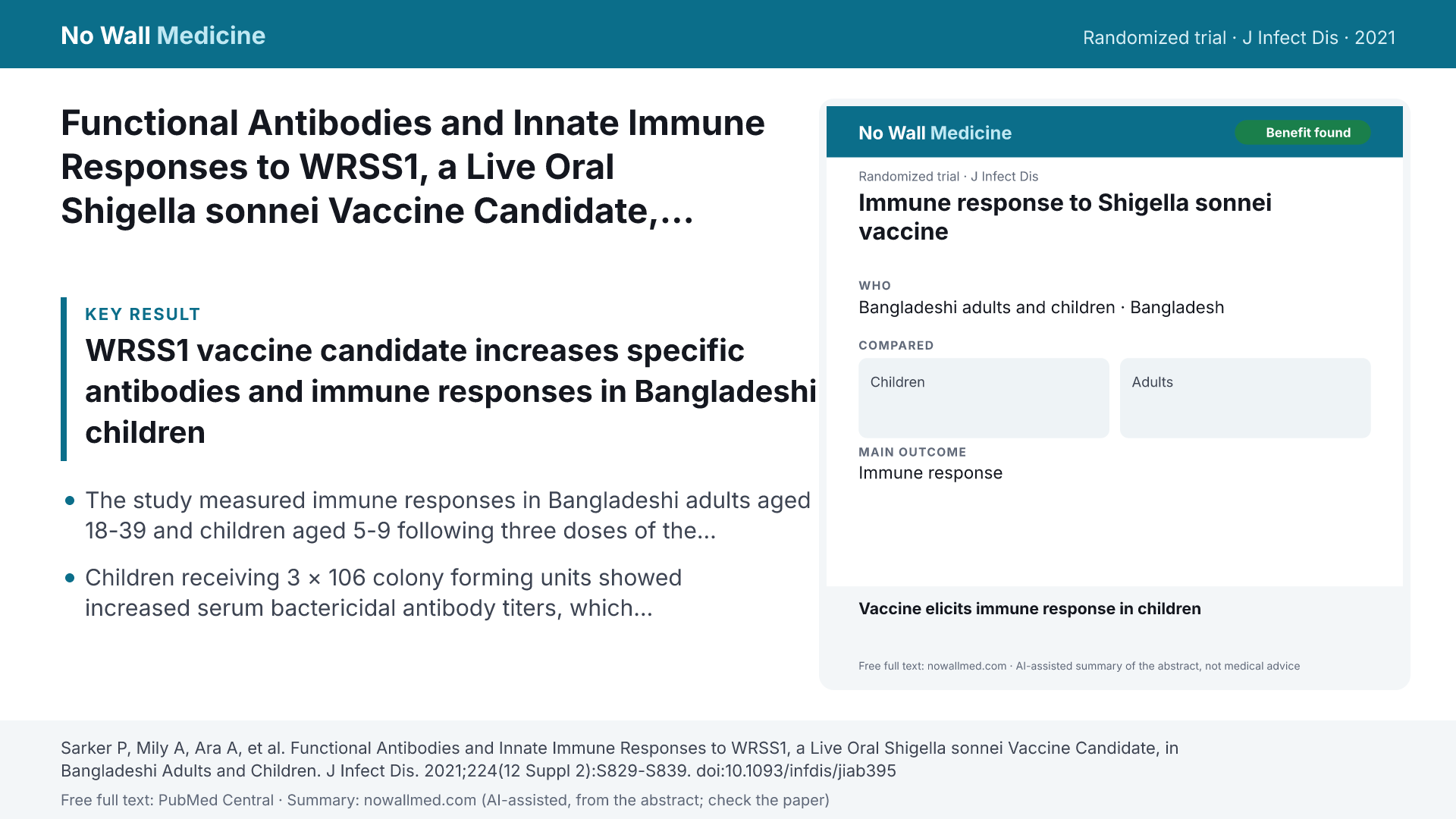
WRSS1 vaccine candidate increases specific antibodies and immune responses in Bangladeshi children
Functional Antibodies and Innate Immune Responses to WRSS1, a Live Oral Shigella sonnei Vaccine Candidate, in Bangladeshi Adults and Children
Randomized trialBenefit found
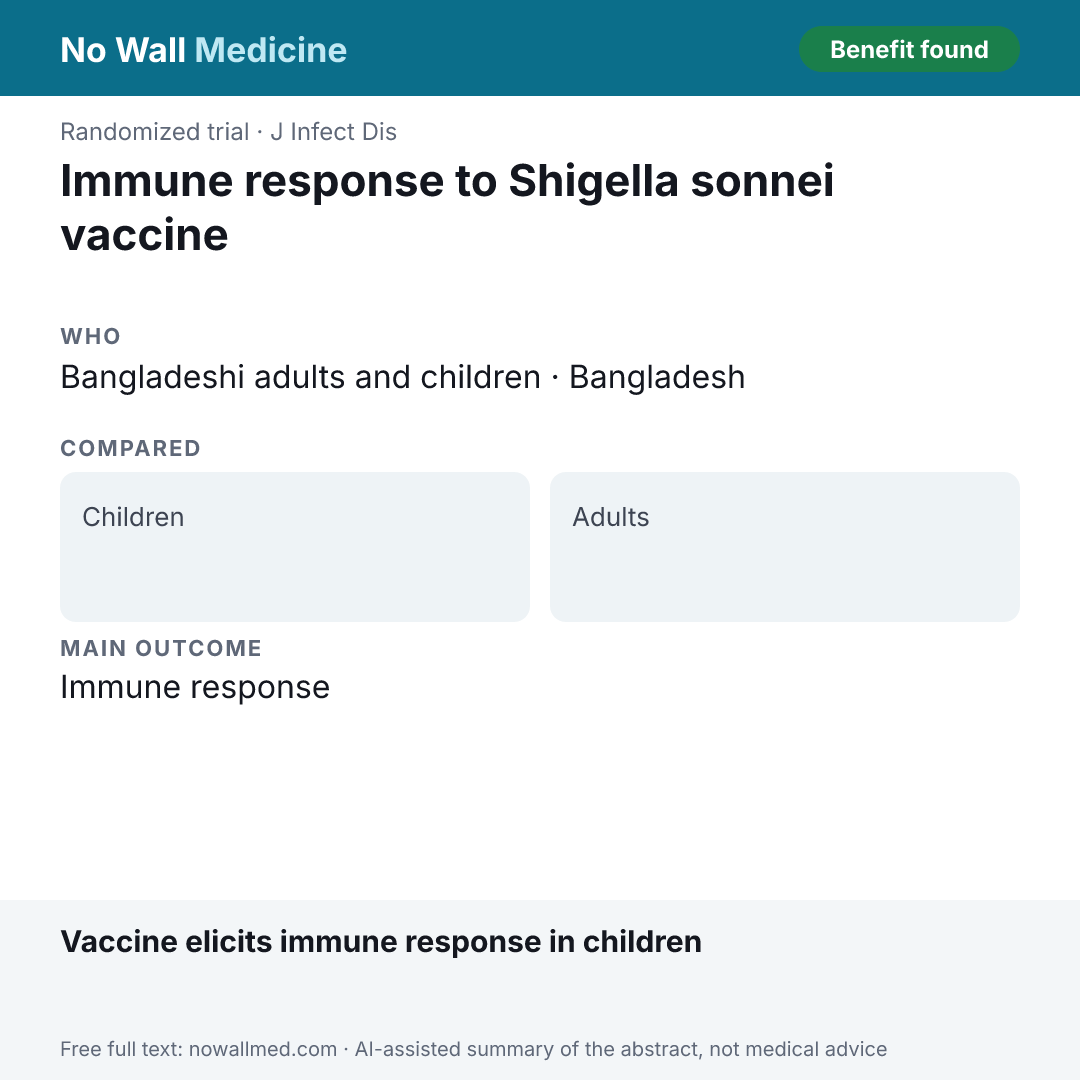
Immune response to Shigella sonnei vaccine
Who
Bangladeshi adults and children · Bangladesh
Compared
Children
Adults
Main outcome
Immune response
Bottom line: Vaccine elicits immune response in children
J Infect Dis · 2021-08-11 · Save PNG
Key points
- The study measured immune responses in Bangladeshi adults aged 18-39 and children aged 5-9 following three doses of the WRSS1 vaccine candidate.
- Children receiving 3 × 10⁶ colony forming units showed increased serum bactericidal antibody titers, which are antibodies that kill bacteria, after the third dose.
- Vaccination in children was associated with increases in Th-17 and proinflammatory cytokines and decreases in anti-inflammatory and Th2 cytokines.
Headline and key points written with AI from the paper’s abstract, with every number checked against it. Read the paper before relying on them.
Was this summary helpful?
Subject terms
Headline, design, result, key points, caveat and citation as plain text.
Cite this article
Sarker P, Mily A, Ara A, et al. Functional Antibodies and Innate Immune Responses to WRSS1, a Live Oral Shigella sonnei Vaccine Candidate, in Bangladeshi Adults and Children. J Infect Dis. 2021;224(12 Suppl 2):S829-S839. doi:10.1093/infdis/jiab395
Spotted a mistake? Suggest a correction