Stroke rehabilitation interventions show greater gait speed improvements in acute and subacute phases than chronic phases
Gait Speed Changes in Stroke Rehabilitation Motor Lower Extremity Randomized Controlled Trials by Intervention and Time Poststroke: A Meta-analysis
Meta-analysis of 106 randomized controlled trialsMixed results
How do lower extremity motor rehabilitation interventions affect gait speed after stroke?
Who
106
Adults with stroke
Compared
Interventions in acute/subacute phase: significant benefits
Interventions in chronic phase: none showed any significant benefit
Main outcome
Gait speed
Bottom line: Acute and subacute interventions show greater gait speed improvements than interventions in the chronic phase.
Arch Phys Med Rehabil · 2026-09-03Download image
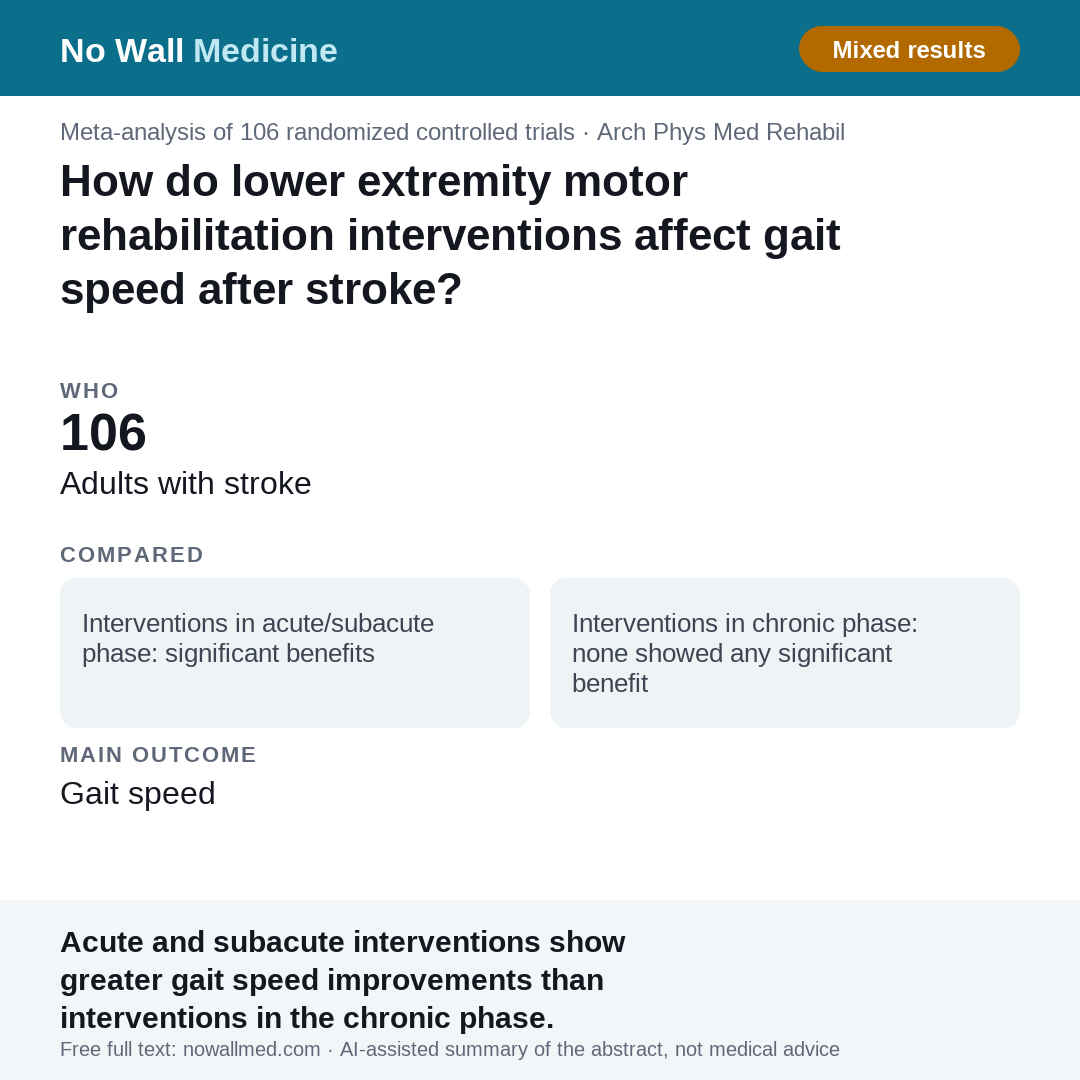
Clinical question: How do lower extremity motor rehabilitation interventions affect gait speed after stroke?
Why it matters: Researchers sought to understand how different lower-extremity rehabilitation interventions affect walking speed at various time points after a stroke.
Key points
- Researchers analyzed 106 randomized controlled trials comparing lower-extremity motor rehabilitation to conventional care or sham controls in adults after a stroke.
- Treadmill training, body weight-supported treadmill training, and exoskeleton training showed significant benefits in the acute or subacute phase, but none showed significant benefits in the chronic phase.
- Interventions studied during the acute or subacute phase poststroke demonstrated a significantly greater magnitude of improvement in walking speed than those studied in the chronic phase.
Headline and key points written with AI from the paper’s abstract, with every number checked against it. Read the paper before relying on them.
Spotted a mistake? Suggest a correction