Wearable powered robot shows no significant difference in walking speed compared to conventional training
Gait training with a wearable powered robot during stroke rehabilitation: a randomized parallel-group trial
Randomized parallel-group trialNo clear difference
Does a wearable powered robot improve gait training in stroke patients?
Who
35
Stroke patients
Compared
Group A (wearable robot)
Group B (conventional therapist-assisted)
Main outcome
Improvement rates of 10-m walking time and 6-minute walking distance
Bottom line: There was no significant difference in main gait outcomes between the wearable robot and conventional gait training.
J Neuroeng Rehabil · 2023-04-28Download image
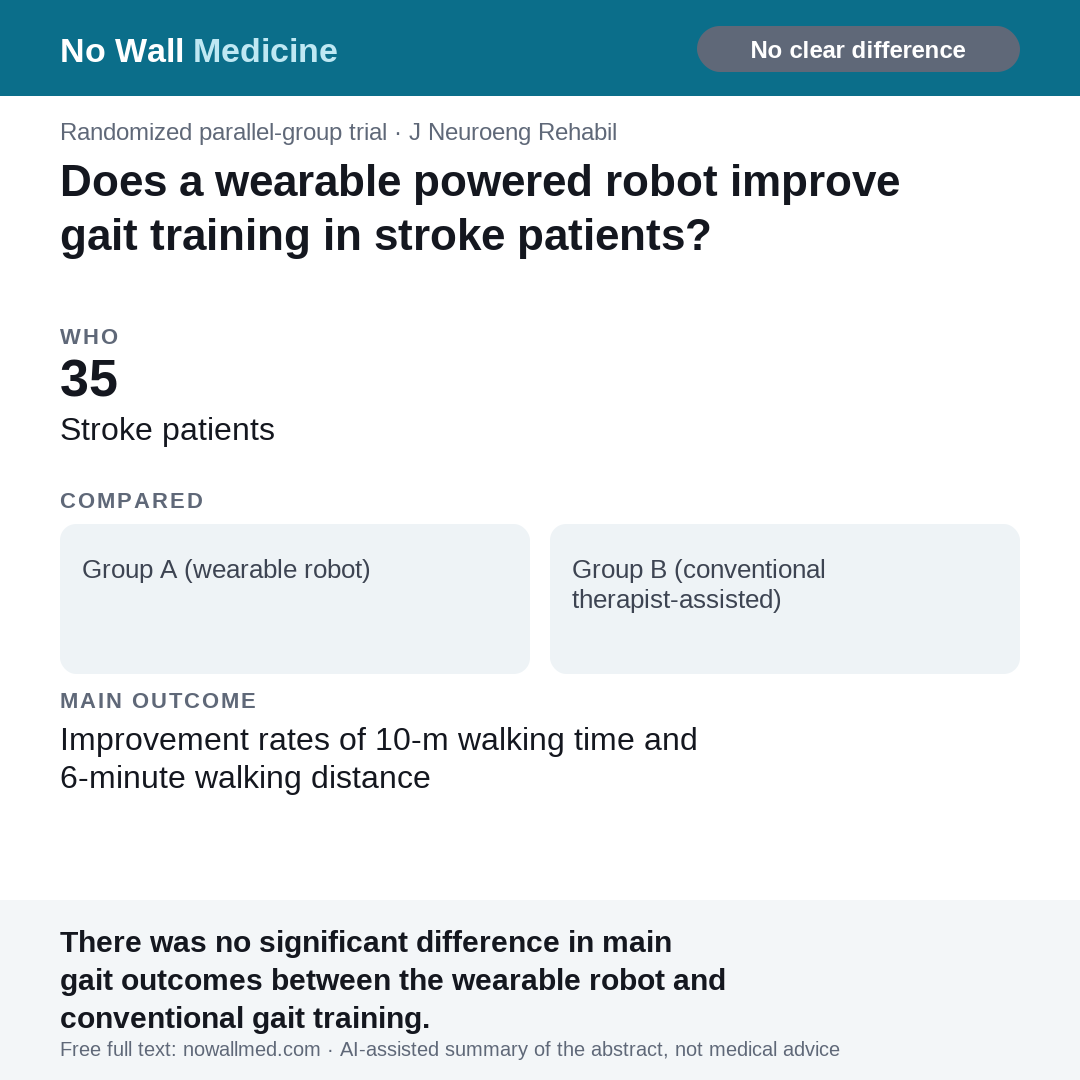
Clinical question: Does a wearable powered robot improve gait training in stroke patients?
Why it matters: The rehabilitative effect of the curara wearable powered robot on gait training in stroke patients has not been clarified.
Key points
- Researchers studied 35 stroke patients randomized to receive either robot-assisted gait training or conventional therapist-assisted gait training over 15 days.
- There was no significant difference between the two groups for the main outcomes of 10-meter walking time and 6-minute walking distance.
- In both groups, gait speed, stride length, stride duration, and cadence improved significantly between day 0 and day 14.
Headline and key points written with AI from the paper’s abstract, with every number checked against it. Read the paper before relying on them.
Was this summary helpful?
Subject terms
Cite this article
Miyagawa D, Matsushima A, Maruyama Y, Mizukami N, Tetsuya M, Hashimoto M. Gait training with a wearable powered robot during stroke rehabilitation: a randomized parallel-group trial. J Neuroeng Rehabil. 2023. doi:10.1186/s12984-023-01168-x
Spotted a mistake? Suggest a correction
Top studies every Monday
The week’s key trials and guidelines in your specialties, plus any topics you follow. By email, free.
Get the weekly digest