Randomized trialThe Lancet Infectious Diseases · Nov 6, 2026
Ganaplacide plus lumefantrine was non-inferior to artemether-lumefantrine for malaria
Ganaplacide plus lumefantrine solid dispersion formulation for children with uncomplicated Plasmodium falciparum malaria (KALUMI): an open-label, multicentre, randomised, controlled, adaptive, phase 2, non-inferiority trial
Fofana B, Zoleko-Manego R, Mombo-Ngoma G, Offianan AT, Kilowele M, Togo AH, et al
Background
Ganaplacide plus lumefantrine solid dispersion formulation (SDF) is a novel antimalarial combination shown to be effective and well tolerated in adults, adolescents, and children with uncomplicated Plasmodium falciparum malaria. Here, we aimed to assess food effects on drug exposure and non-inferiority of ganaplacide plus lumefantrine SDF to artemether-lumefantrine. Methods
This open-label, multicentre, randomised, controlled, adaptive, phase 2, non-inferiority trial was conducted at ten clinics and hospitals in Burkina Faso, Mali, Côte d'Ivoire, Gabon, and DR Congo. Eligible patients had microscopically confirmed uncomplicated P falciparum malaria. In run-in cohorts 1 and 2, patients (aged 12 years to Findings
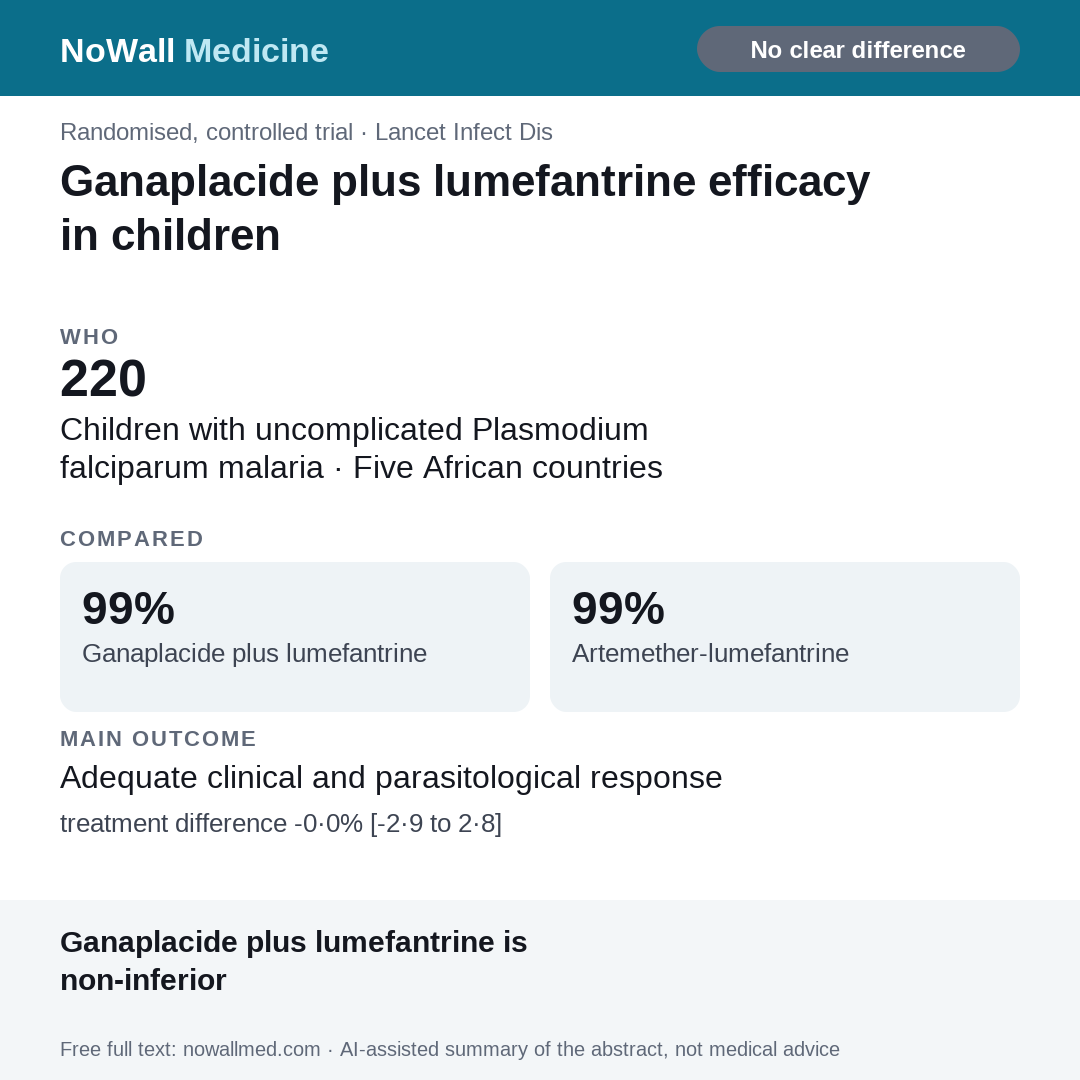
Between Feb 16, 2021, and July 14, 2024, 577 patients were screened and 282 were ineligible. 51 patients were enrolled in run-in cohort 1, 24 in run-in cohort 2, and 220 in the main part (110 each assigned to ganaplacide plus lumefantrine SDF or artemether-lumefantrine). Two (4%) patients discontinued early in run-in cohort 1 and all 24 in run-in cohort 2 completed the study. Across run-in cohorts 1 and 2, the food effect on ganaplacide was small (mean fed:fasted ratios from 0·98 to 1·41), but a significant food effect was observed for lumefantrine (mean ratios ranging from 1·48 to 2·87). Ganaplacide 400 mg plus lumefantrine SDF 480 mg given once per day for 3 days with a light meal (100-300 calories, with 5-10 g of fat) was selected as the full dose and 206 (94%) of 220 patients completed the main part. For PCR-corrected adequate clinical and parasitological response on day 29, response rates were 97 (99% [95% CI 94 to 100]) of 98 in the ganaplacide plus lumefantrine SDF group and 98 (99% [95 to 100]) of 99 in the artemether-lumefantrine group (treatment difference -0·0% [-2·9 to 2·8]), with the lower limit of 95% CI above -10%. The most common adverse events were vomiting (32 [29%] of 110 in the ganaplacide plus lumefantrine SDF group vs 12 [11%] of 110 in the artemether-lumefantrine group) and hypokalaemia (27 [25%] vs 16 [15%]). Interpretation
Ganaplacide 400 mg plus lumefantrine SDF 480 mg once per day for 3 days with a light meal was non-inferior to artemether-lumefantrine for patients with uncomplicated P falciparum malaria. This regimen was further evaluated in a phase 3 trial (NCT05842954). Funding
Novartis and Medicines for Malaria Venture (Gates Foundation; EDCTP2 programme, the EU), the Deutsches Zentrum für Luft- und Raumfahrt, the Swedish International Development Cooperation Agency, and the UK Department of Health and Social Care.
Abstract reproduced under the article’s CC BY licence.