Evidence remains uncertain regarding the effects of hormone therapy for individuals under 26 years old
Gender affirming hormone therapy for individuals with gender dysphoria aged <26 years: a systematic review and meta-analysis
Systematic review and meta-analysisUnclear result
What are the effects of gender affirming hormone therapy in individuals under 26?
Who
Individuals with gender dysphoria aged less than 26 years
Compared
Gender affirming hormone therapy
No gender affirming hormone therapy
Main outcome
Psychological and physical effects
Result: odds ratio 0.73 (95% CI 0.61 to 0.88)
Bottom line: There is considerable uncertainty about the effects of gender affirming hormone therapy and benefit or harm cannot be excluded.
Limitation: Evidence provided was mostly very low certainty and methodologically rigorous prospective studies are needed.
Arch Dis Child · 2025-05-16Download image
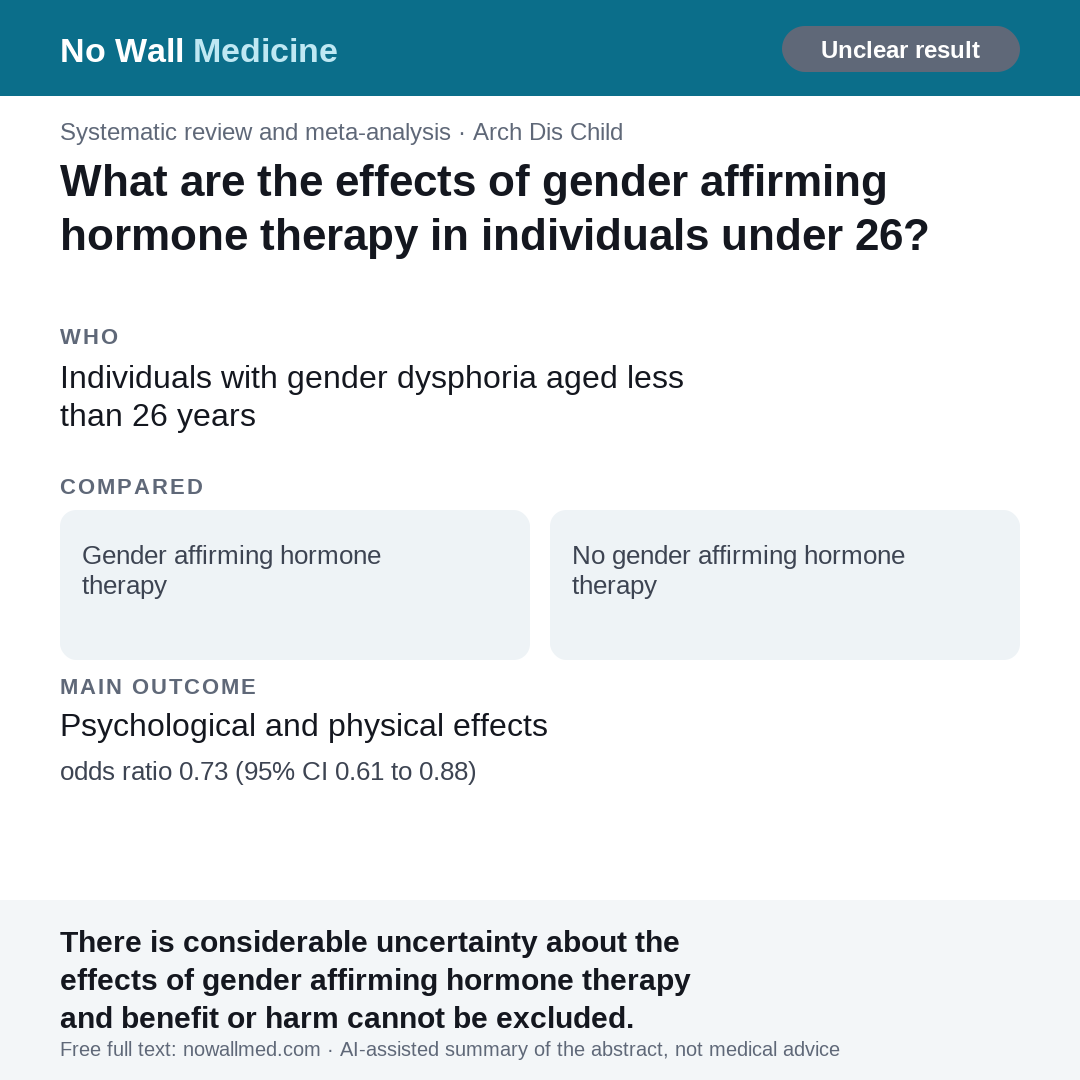
Clinical question: What are the effects of gender affirming hormone therapy in individuals under 26?
Why it matters: The certainty of evidence regarding the psychological and physical effects of hormone therapy for younger individuals with gender dysphoria is currently low.
Key points
- Researchers analyzed 24 studies to assess the psychological and physical effects of gender affirming hormone therapy in people under 26 years of age with gender dysphoria.
- One observational study reported that the odds of depression may be lower with a reported odds ratio of 0.73 (95% CI 0.61 to 0.88).
- A case series study found the proportion of individuals experiencing cardiovascular events 7-109 months after starting hormone therapy was 0.04 (95% CI 0.03 to 0.05).
Limitation the authors note: The authors state that there is considerable uncertainty and a need for methodologically rigorous prospective studies to produce higher certainty evidence.
Headline and key points written with AI from the paper’s abstract, with every number checked against it. Read the paper before relying on them.
Was this summary helpful?
Abstract
Objective
In this systematic review and meta-analysis, we assessed and summarised the certainty of the evidence about the effects of gender affirming hormone therapy (GAHT) in individuals with gender dysphoria (GD). Methods
We searched Medline, Embase, PsychINFO, Social Sciences Abstracts, LGBTQ+ Source and Sociological Abstracts from inception to September 2023. We included studies comparing GAHT with no GAHT in individuals aged <26 years with GD. Outcomes of interest included psychological and physical effects. Pairs of reviewers independently screened articles, abstracted data and assessed the risk of bias in the included studies. We performed meta-analyses and assessed the certainty of the evidence using the grading of recommendations assessment, development and evaluation (GRADE) approach. Results
We included 24 studies. Comparative observational studies (n=9) provided mostly very low certainty evidence regarding GD, global function and depression. One comparative observational study reported that the odds of depression may be lower (OR 0.73 (95% CI 0.61 to 0.88), n (number of studies)=1, low certainty) in individuals who received GAHT compared with those who did not. Before-after studies (n=13) provided very low certainty evidence about GD, global function, depression and bone mineral density. Case series studies (n=2) provided high certainty evidence that the proportion of individuals with cardiovascular events 7-109 months after receiving GAHT was 0.04 (95% CI 0.03 to 0.05, n=1, high certainty). Conclusion
There is considerable uncertainty about the effects of GAHT and we cannot exclude the possibility of benefit or harm. Methodologically rigorous prospective studies are needed to produce higher certainty evidence. Trial registration number
PROSPERO CRD42023452171.
Abstract reproduced under the article’s CC BY NC licence.
Subject terms
Cite this article
Miroshnychenko A, Ibrahim S, Roldan Y, Kulatunga-Moruzi C, Montante S, Couban R. Gender affirming hormone therapy for individuals with gender dysphoria aged <26 years: a systematic review and meta-analysis. Arch Dis Child. 2025. doi:10.1136/archdischild-2024-327921
Spotted a mistake? Suggest a correction
Top studies every Monday
The week’s key trials and guidelines in your specialties, plus any topics you follow. By email, free.
Get the weekly digest