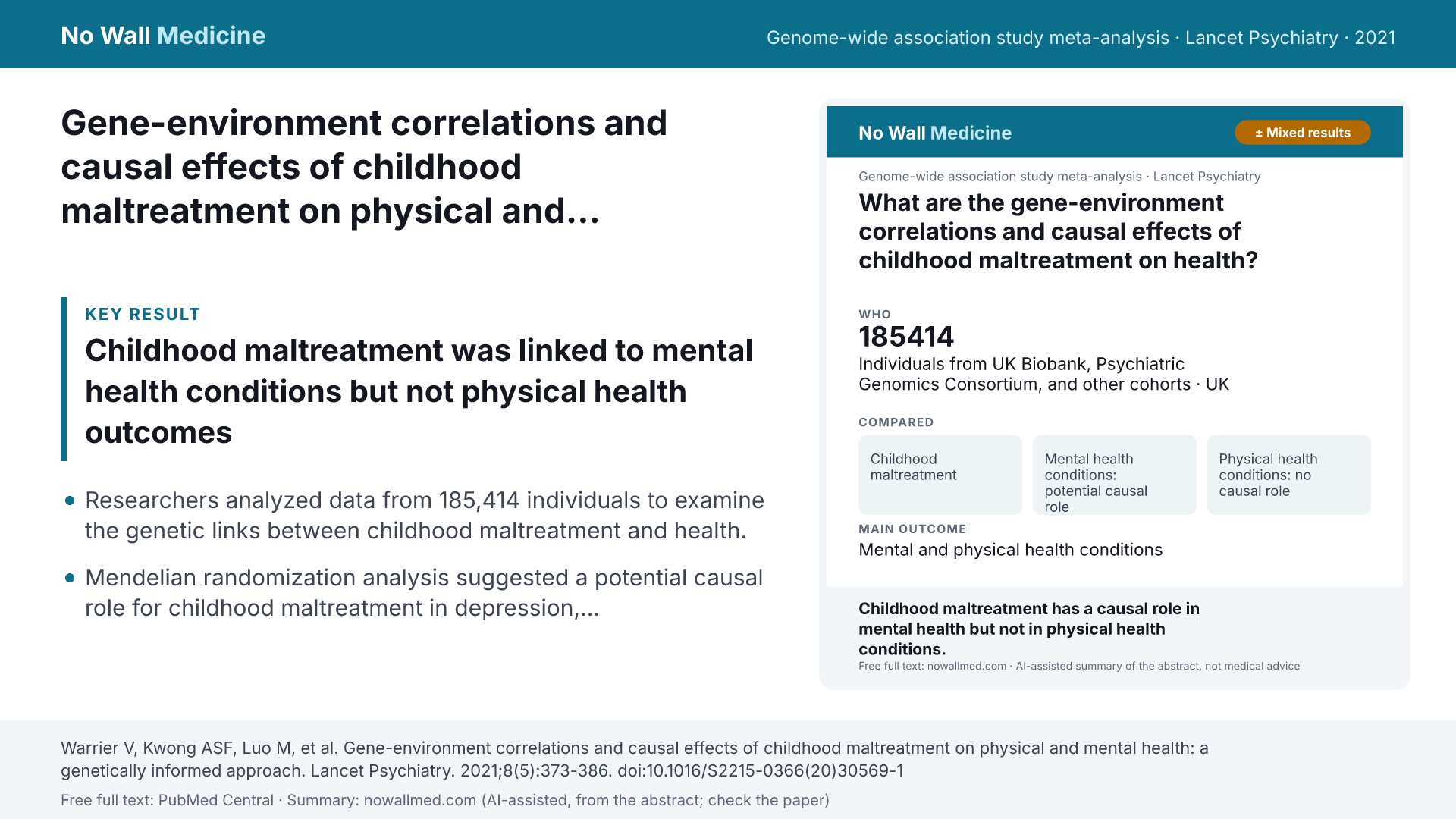
Childhood maltreatment was linked to mental health conditions but not physical health outcomes
Gene-environment correlations and causal effects of childhood maltreatment on physical and mental health: a genetically informed approach
Genome-wide association study meta-analysisMixed results
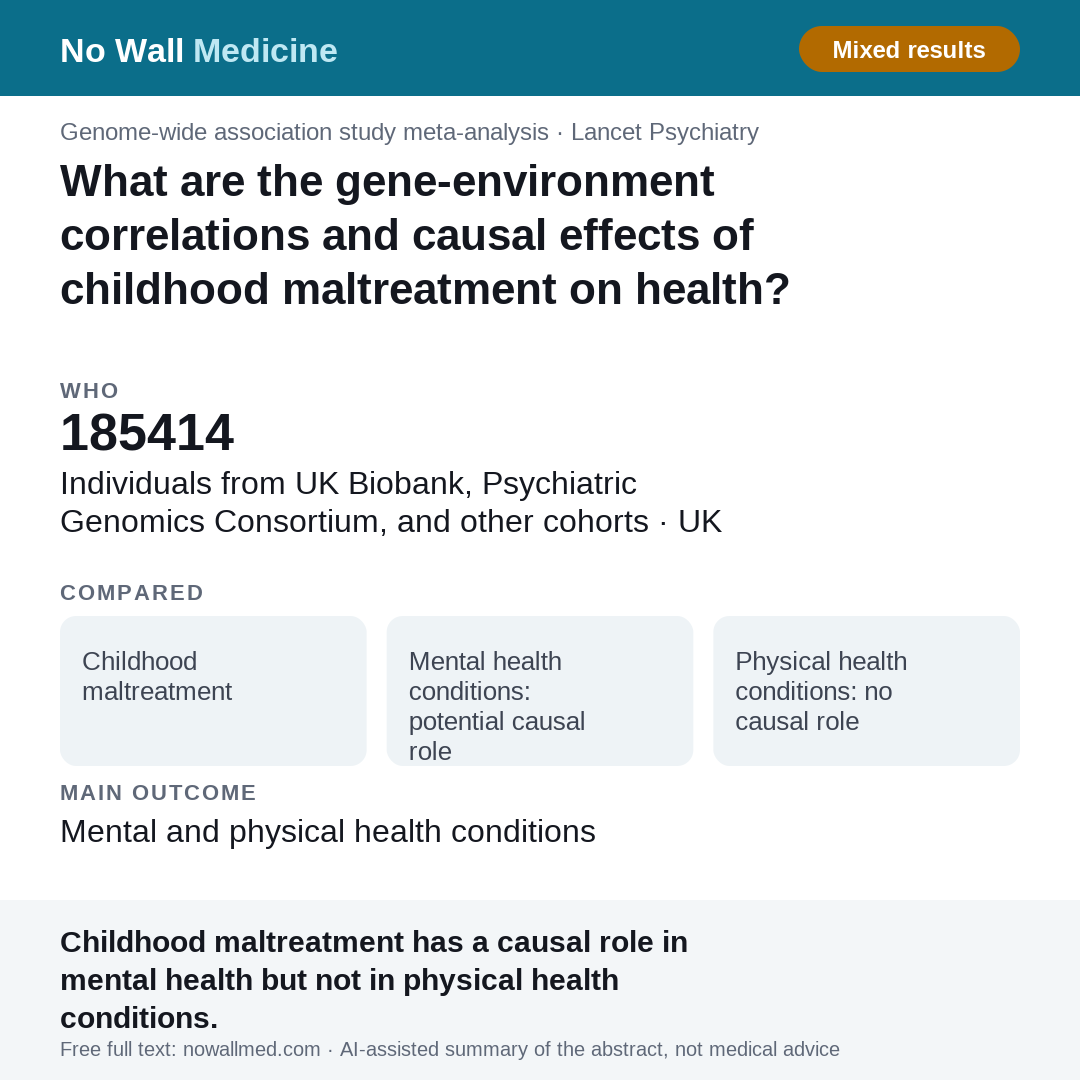
What are the gene-environment correlations and causal effects of childhood maltreatment on health?
Who
185414
Individuals from UK Biobank, Psychiatric Genomics Consortium, and other cohorts · UK and international cohorts
Compared
Childhood maltreatment
Mental health conditions: potential causal role
Physical health conditions: no causal role
Main outcome
Mental and physical health conditions
Bottom line: Childhood maltreatment has a causal role in mental health but not in physical health conditions.
Funded by: Wellcome Trust, UK Medical Research Council, Horizon 2020, NIMH, NIHR
Lancet Psychiatry · 2021-03-16Download image
Clinical question: What are the gene-environment correlations and causal effects of childhood maltreatment on health?
Key points
- Researchers analyzed data from 185,414 individuals to examine the genetic links between childhood maltreatment and health.
- Mendelian randomization analysis suggested a potential causal role for childhood maltreatment in depression, schizophrenia, and attention-deficit/hyperactivity disorder.
- Childhood maltreatment was not linked to physical health conditions like coronary artery disease, type 2 diabetes, or inflammation.
Headline and key points written with AI from the paper’s abstract, with every number checked against it. Read the paper before relying on them.
Was this summary helpful?
Abstract
Background
Childhood maltreatment is associated with poor mental and physical health. However, the mechanisms of gene-environment correlations and the potential causal effects of childhood maltreatment on health are unknown. Using genetics, we aimed to delineate the sources of gene-environment correlation for childhood maltreatment and the causal relationship between childhood maltreatment and health. Methods
We did a genome-wide association study meta-analysis of childhood maltreatment using data from the UK Biobank (n=143 473), Psychiatric Genomics Consortium (n=26 290), Avon Longitudinal Study of Parents and Children (n=8346), Adolescent Brain Cognitive Development Study (n=5400), and Generation R (n=1905). We included individuals who had phenotypic and genetic data available. We investigated single nucleotide polymorphism heritability and genetic correlations among different subtypes, operationalisations, and reports of childhood maltreatment. Family-based and population-based polygenic score analyses were done to elucidate gene-environment correlation mechanisms. We used genetic correlation and Mendelian randomisation analyses to identify shared genetics and test causal relationships between childhood maltreatment and mental and physical health conditions. Findings
Our meta-analysis of genome-wide association studies (N=185 414) identified 14 independent loci associated with childhood maltreatment (13 novel). We identified high genetic overlap (genetic correlations 0·24-1·00) among different maltreatment operationalisations, subtypes, and reporting methods. Within-family analyses provided some support for active and reactive gene-environment correlation but did not show the absence of passive gene-environment correlation. Robust Mendelian randomisation suggested a potential causal role of childhood maltreatment in depression (unidirectional), as well as both schizophrenia and ADHD (bidirectional), but not in physical health conditions (coronary artery disease, type 2 diabetes) or inflammation (C-reactive protein concentration). Interpretation
Childhood maltreatment has a heritable component, with substantial genetic correlations among different operationalisations, subtypes, and retrospective and prospective reports of childhood maltreatment. Family-based analyses point to a role of active and reactive gene-environment correlation, with equivocal support for passive correlation. Mendelian randomisation supports a (primarily bidirectional) causal role of childhood maltreatment on mental health, but not on physical health conditions. Our study identifies research avenues to inform the prevention of childhood maltreatment and its long-term effects. Funding
Wellcome Trust, UK Medical Research Council, Horizon 2020, National Institute of Mental Health, and National Institute for Health Research Biomedical Research Centre.
Abstract reproduced under the article’s CC BY licence.
Subject terms
Cite this article
Warrier V, Kwong ASF, Luo M, et al. Gene-environment correlations and causal effects of childhood maltreatment on physical and mental health: a genetically informed approach. Lancet Psychiatry. 2021;8(5):373-386. doi:10.1016/S2215-0366(20)30569-1
Spotted a mistake? Suggest a correction