General practitioners report uncertainty and time constraints regarding their role in clinical genetic services
General practitioners' (GPs) experience, attitudes and needs on clinical genetic services: a systematic review
Systematic reviewUnclear result
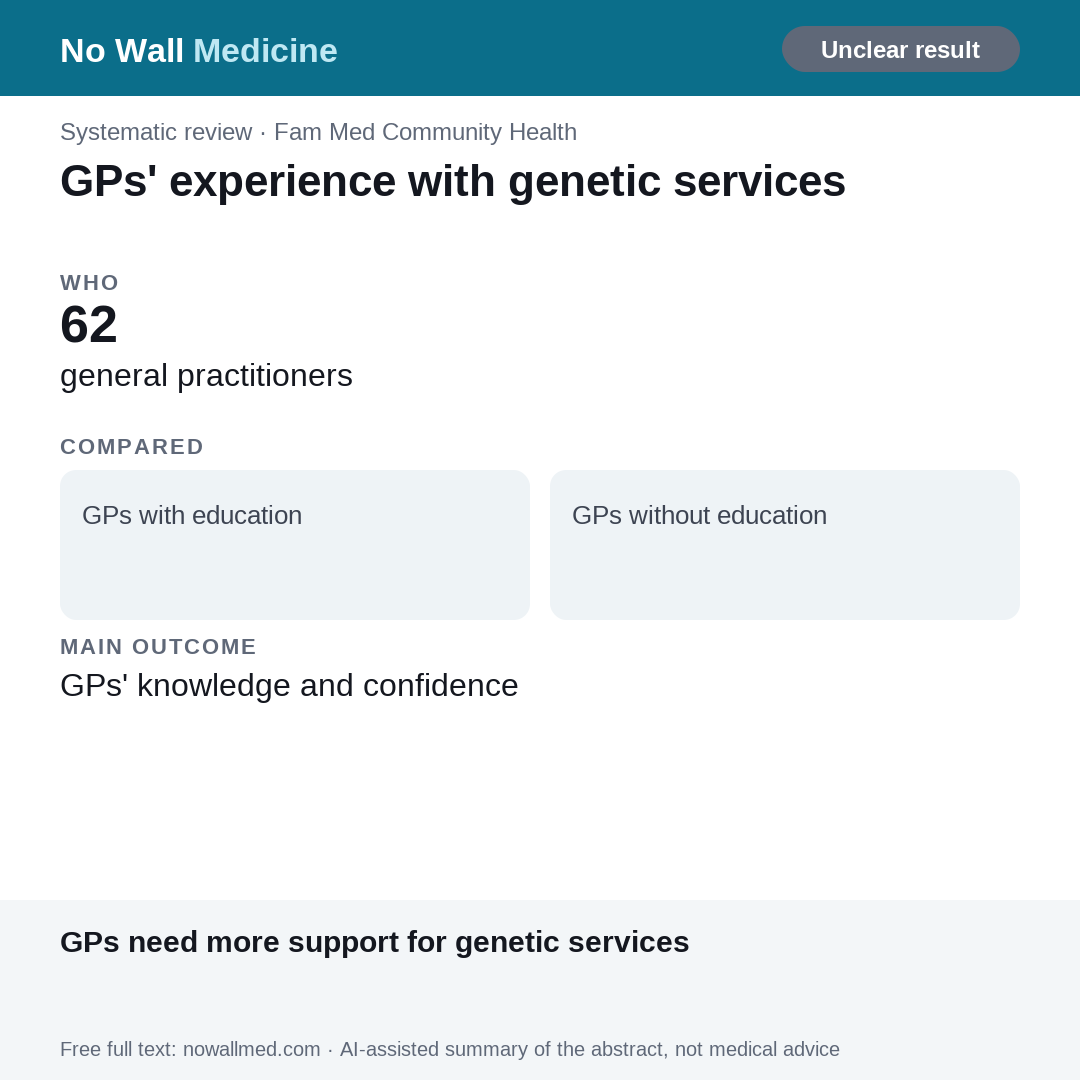
GPs' experience with genetic services
Who
62
general practitioners
Compared
GPs with education
GPs without education
Main outcome
GPs' knowledge and confidence
Bottom line: GPs need more support for genetic services
Fam Med Community Health · 2022-11-30Download image
Why it matters: It is unknown how general practitioners' experiences, attitudes, and needs influence the adoption of clinical genetic services in medical practice.
Key points
- Researchers conducted a systematic review of 62 peer-reviewed articles published between 2010 and 2022 regarding general practitioners' views on genetic testing.
- A lack of confidence, time constraints, and the rarity of cases were associated with uncertainty regarding the role of general practitioners in providing genetic services.
- Educational interventions were associated with increased knowledge and confidence, but varied interests and preferences for shared care models resulted in minimal clinical adoption.
Headline and key points written with AI from the paper’s abstract, with every number checked against it. Read the paper before relying on them.
Was this summary helpful?
Abstract
Objective
The proliferation and growing demands of genetic testing are anticipated to revolutionise medical practice. As gatekeepers of healthcare systems, general practitioners (GPs) are expected to play a critical role in the provision of clinical genetic services. This paper aims to review existing literature on GPs' experience, attitudes and needs towards clinical genetic services. Design
A systematic mixed studies review of papers published between 2010 and 2022. Eligibility criteria
The inclusion criterion was peer-reviewed articles in English and related to GPs' experience, views and needs on any genetic testing. Information sources
The PubMed, PsycINFO, Cochrane, EMBASE databases were searched using Mesh terms, Boolean and wildcards combinations to identify peer-reviewed articles published from 2010 to 2022. Study quality was assessed using Mixed Methods Appraisal Tool. Only articles that fulfilled the inclusion criteria were selected. A thematic meta-synthesis was conducted on the final sample of selected articles to identify key themes. Results
A total of 62 articles were included in the review. Uncertainty over GPs' role in providing genetic services were attributed by the lack of confidence and time constraints and rarity of cases may further exacerbate their reluctance to shoulder an expanded role in clinical genetics. Although educational interventions were found to increasing GPs' knowledge and confidence to carry out genetic tasks, varied interest on genetic testing and preference for a shared care model with other genetic health professionals have resulted in minimal translation to clinical adoption. Conclusion
This review highlights the need for deeper exploration of GPs' varied experience and attitudes towards clinical genetic services to better facilitate targeted intervention in the adoption of clinical genetics.
Abstract reproduced under the article’s CC BY NC licence.
Subject terms
Cite this article
Ong CSB, Fok RW, Tan RCA, Fung SM, Sun S, Ngeow JYY. General practitioners' (GPs) experience, attitudes and needs on clinical genetic services: a systematic review. Fam Med Community Health. 2022. doi:10.1136/fmch-2021-001515
Spotted a mistake? Suggest a correction
Top studies every Monday
The week’s key trials and guidelines in your specialties, plus any topics you follow. By email, free.
Get the weekly digest