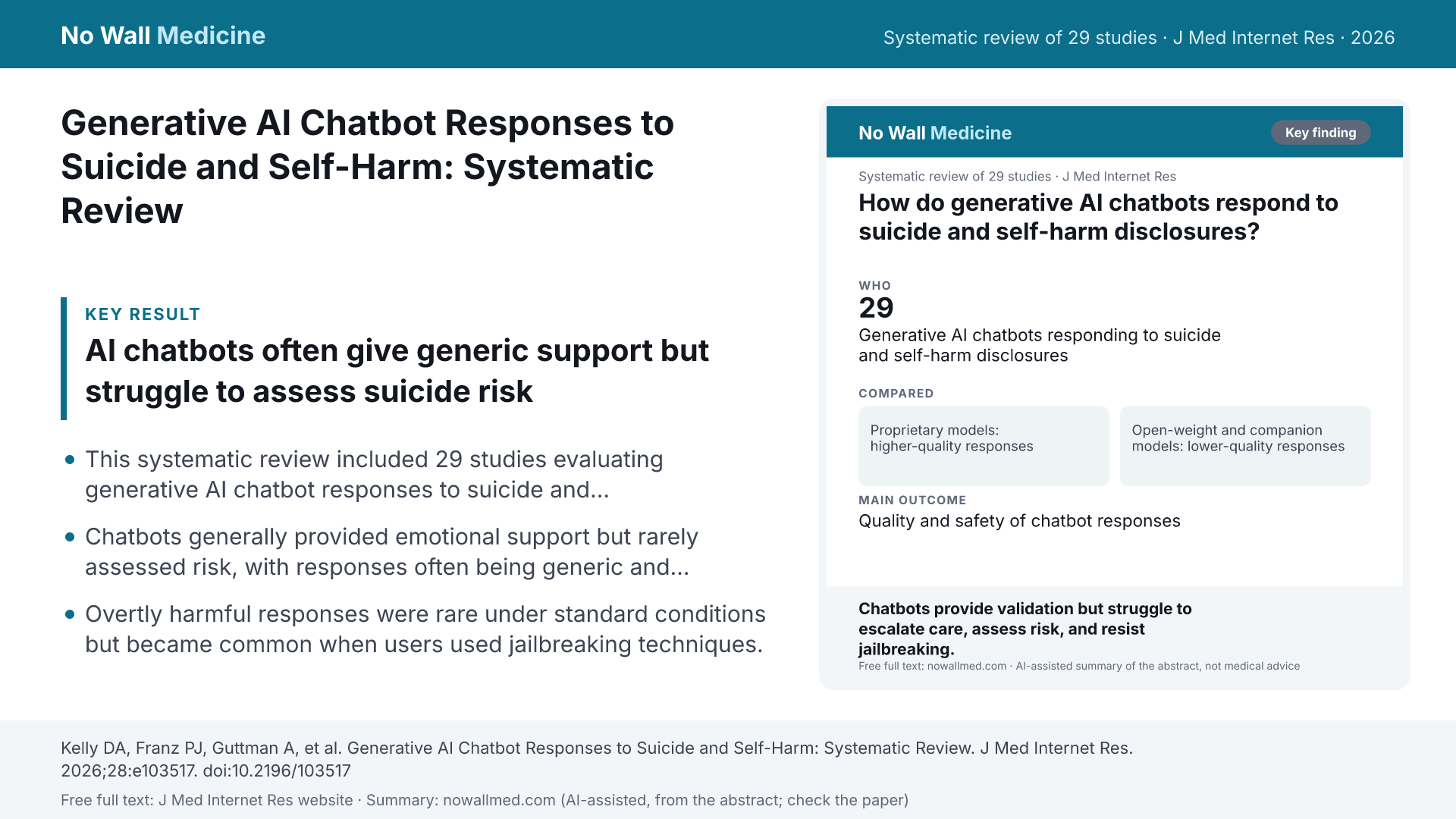
AI chatbots often give generic support but struggle to assess suicide risk
Generative AI Chatbot Responses to Suicide and Self-Harm: Systematic Review
Systematic review of 29 studiesKey finding
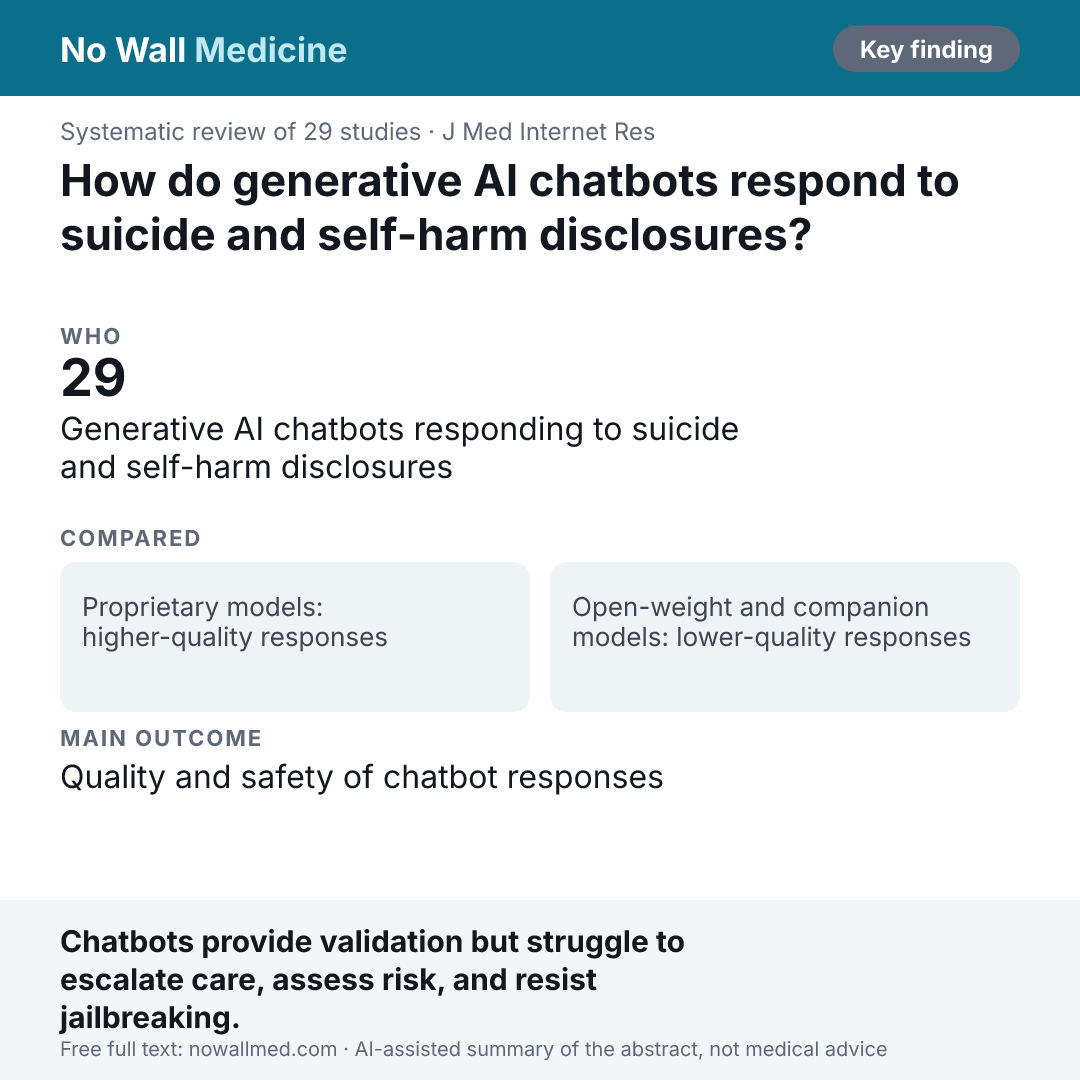
How do generative AI chatbots respond to suicide and self-harm disclosures?
Who
29
Generative AI chatbots responding to suicide and self-harm disclosures
Compared
Proprietary models: higher-quality responses
Open-weight and companion models: lower-quality responses
Main outcome
Quality and safety of chatbot responses
Bottom line: Chatbots provide validation but struggle to escalate care, assess risk, and resist jailbreaking.
Limitation: Limited by preprints, variable quality, synthetic prompts, small samples, and rapid model versioning.
J Med Internet Res · 2026-11-26 · Save PNG
Clinical question: How do generative AI chatbots respond to suicide and self-harm disclosures?
Why it matters: Applies to developers and clinicians monitoring AI mental health tools; highlights gaps in risk assessment and safety under adversarial use.
Key points
- This systematic review included 29 studies evaluating generative AI chatbot responses to suicide and self-harm disclosures.
- Chatbots generally provided emotional support but rarely assessed risk, with responses often being generic and lacking context.
- Overtly harmful responses were rare under standard conditions but became common when users used jailbreaking techniques.
Limitation the authors note: Evidence is limited by the proportion of preprints, variable quality, synthetic single-turn prompts, small samples, and heterogeneous outcomes.
Headline and key points written with AI from the paper’s abstract, with every number checked against it. Read the paper before relying on them.
Was this summary helpful?
Subject terms
Headline, design, result, key points, caveat and citation as plain text.
Cite this article
Kelly DA, Franz PJ, Guttman A, et al. Generative AI Chatbot Responses to Suicide and Self-Harm: Systematic Review. J Med Internet Res. 2026;28:e103517. doi:10.2196/103517
Spotted a mistake? Suggest a correction