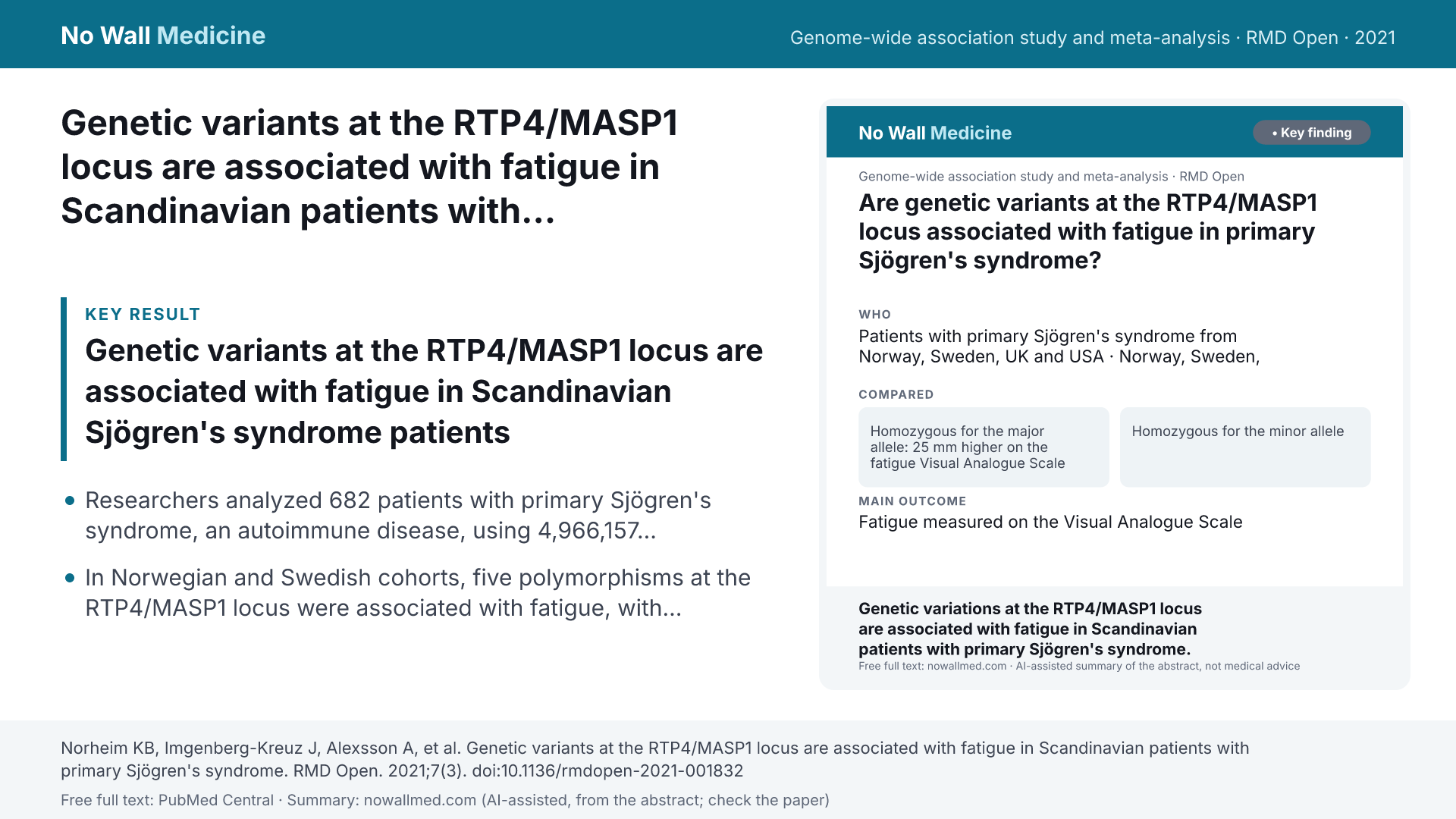
Genetic variants at the RTP4/MASP1 locus are associated with fatigue in Scandinavian Sjögren's syndrome patients
Genetic variants at the RTP4/MASP1 locus are associated with fatigue in Scandinavian patients with primary Sjögren's syndrome
Genome-wide association study and meta-analysisKey finding
Are genetic variants at the RTP4/MASP1 locus associated with fatigue in primary Sjögren's syndrome?
Who
Patients with primary Sjögren's syndrome from Norway, Sweden, UK and USA · Norway, Sweden, United Kingdom and United States
Compared
Homozygous for the major allele: 25 mm higher on the fatigue Visual Analogue Scale
Homozygous for the minor allele
Main outcome
Fatigue measured on the Visual Analogue Scale
Bottom line: Genetic variations at the RTP4/MASP1 locus are associated with fatigue in Scandinavian patients with primary Sjögren's syndrome.
RMD Open · 2021-12-15 · Save PNG
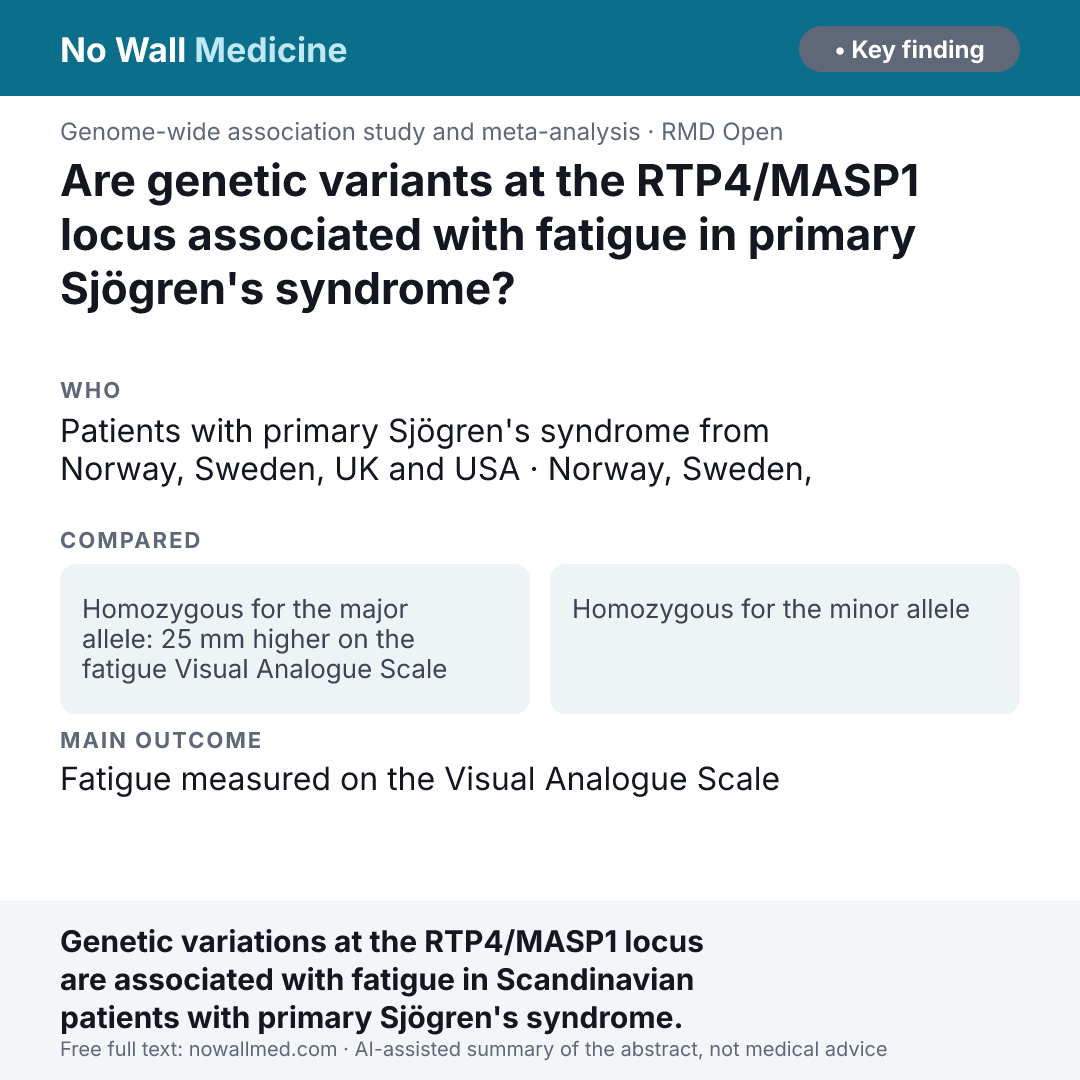
Clinical question: Are genetic variants at the RTP4/MASP1 locus associated with fatigue in primary Sjögren's syndrome?
Key points
- Researchers analyzed 682 patients with primary Sjögren's syndrome, an autoimmune disease, using 4,966,157 genetic markers.
- In Norwegian and Swedish cohorts, five polymorphisms at the RTP4/MASP1 locus were associated with fatigue, with patients homozygous for the major allele scoring 25 mm higher on the fatigue Visual Analogue Scale.
- No variants reached genome-wide significance in the US/UK cohorts or when all four cohorts were analyzed together.
Headline and key points written with AI from the paper’s abstract, with every number checked against it. Read the paper before relying on them.
Was this summary helpful?
Abstract
Objectives
Fatigue is common and severe in primary Sjögren's syndrome (pSS). The aim of this study was to identify genetic determinants of fatigue in pSS through a genome-wide association study. Methods
Patients with pSS from Norway, Sweden, UK and USA with fatigue and genotype data available were included. After genotype imputation and quality control, 682 patients and 4 966 157 genetic markers were available. Association analysis in each cohort using linear regression with fatigue as a continuous variable and meta-analyses between the cohorts were performed. Results
Meta-analysis of the Norwegian and Swedish cohorts identified five polymorphisms within the same linkage disequilibrium block at the receptor transporter protein 4 (RTP4)/MASP1 locus associated with fatigue with genome-wide significance (GWS) (p<5×10⁻⁸). Patients homozygous for the major allele scored 25 mm higher on the fatigue Visual Analogue Scale than patients homozygous for the minor allele. There were no variants associated with fatigue with GWS in meta-analyses of the US/UK cohorts, or all four cohorts. RTP4 expression in pSS B cells was upregulated and positively correlated with the type I interferon score. Expression quantitative trait loci effects in whole blood for fatigue-associated variants at RTP4/MASP1 and levels of RTP4 and MASP1 expression were identified. Conclusion
Genetic variations at RTP4/MASP1 are associated with fatigue in Scandinavian pSS patients. RTP4 encodes a Golgi chaperone that influences opioid pain receptor function and MASP1 is involved in complement activation. These results add evidence for genetic influence over fatigue in pSS.
Abstract reproduced under the article’s CC BY NC licence.
Subject terms
Headline, design, result, key points, caveat and citation as plain text.
Cite this article
Norheim KB, Imgenberg-Kreuz J, Alexsson A, et al. Genetic variants at the RTP4/MASP1 locus are associated with fatigue in Scandinavian patients with primary Sjögren's syndrome. RMD Open. 2021;7(3). doi:10.1136/rmdopen-2021-001832
Spotted a mistake? Suggest a correction