Genetic analysis links specific DNA variations and deletions to treatment-resistant depression risk
Genome-wide association meta-analysis and rare copy number variant analysis of treatment-resistant depression
Genome-wide association meta-analysis and rare copy number variant analysisBenefit found
What are the genetic associations and heritability of treatment-resistant depression?
Who
Individuals with treatment-resistant depression, healthy controls, and non-treatment-resistant major depressive disorder · Three Nordic countries
Compared
Treatment-resistant depression: 2 062
Healthy controls: 441 037
Non-treatment-resistant major depressive disorder: 38 544
Main outcome
Genetic risk and rare copy number variant burden
Result: SNP-based heritability for treatment-resistant depression risk at 26% (SE = 5%)
Bottom line: Treatment-resistant depression has a 26% SNP-based heritability and higher rare copy number variant deletion burdens.
Mol Psychiatry · 2025-06-26Download image
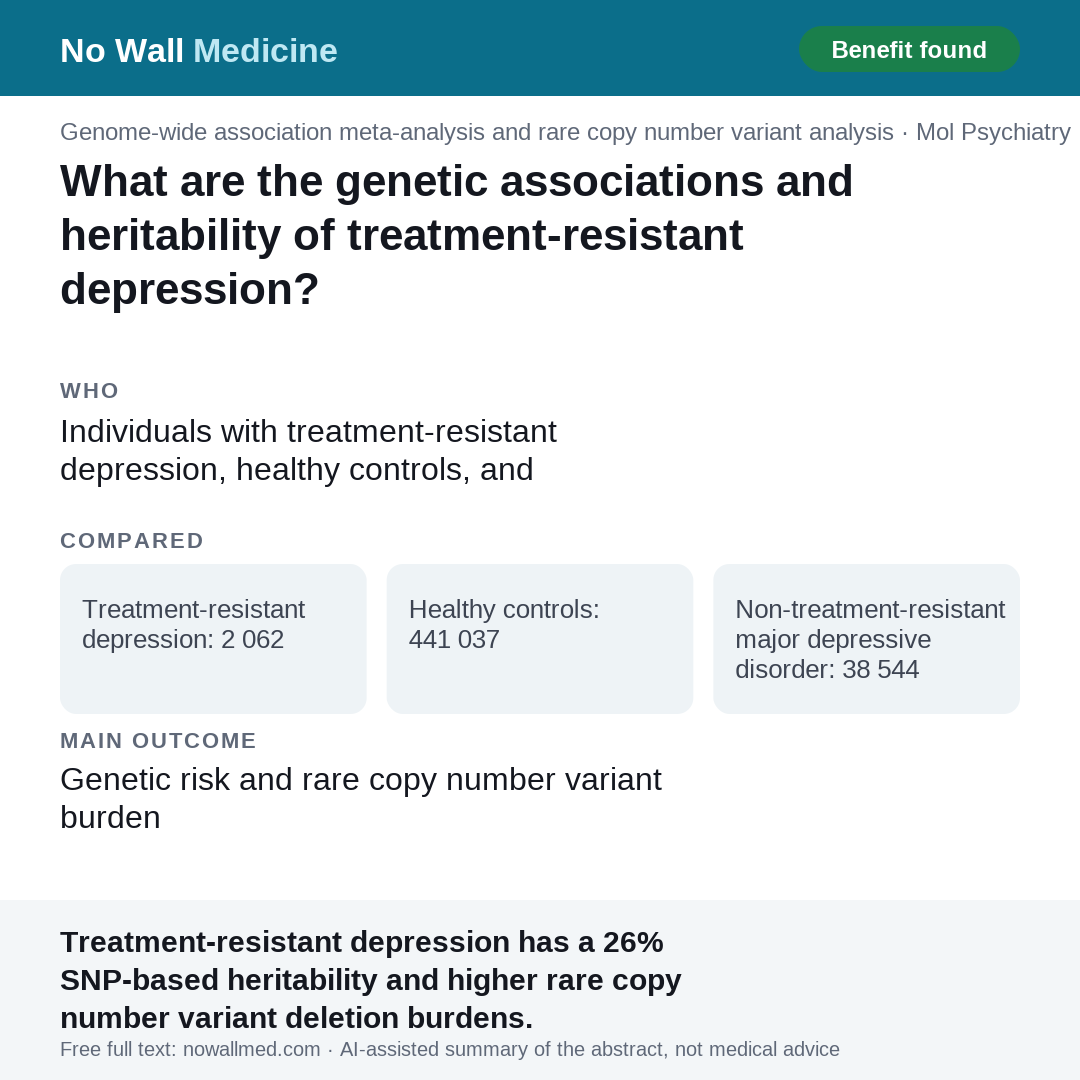
Clinical question: What are the genetic associations and heritability of treatment-resistant depression?
Why it matters: Identifying the genetic components of treatment-resistant depression is challenging because the condition is difficult to define and study.
Key points
- Researchers compared 2,062 people with treatment-resistant depression to 441,037 healthy controls and 38,544 people with major depressive disorder who responded to treatment.
- The study found a genetic heritability for treatment-resistant depression risk of 26% and identified one specific genetic location on chromosome 3 associated with this risk.
- Treatment-resistant depression was associated with a higher burden of rare copy number variants, which are missing pieces of DNA, with odds ratios between 1.74-2.86.
Headline and key points written with AI from the paper’s abstract, with every number checked against it. Read the paper before relying on them.
Was this summary helpful?
Subject terms
Cite this article
Xiong Y, Krebs K, Jermy B, Karlsson R, Pasman JA, Nguyen TD. Genome-wide association meta-analysis and rare copy number variant analysis of treatment-resistant depression. Mol Psychiatry. 2025. doi:10.1038/s41380-025-03084-z
Spotted a mistake? Suggest a correction
Top studies every Monday
The week’s key trials and guidelines in your specialties, plus any topics you follow. By email, free.
Get the weekly digest