Genetic study identifies 10 risk loci for central serous chorioretinopathy
Genome-Wide Association Study Meta-Analysis of Central Serous Chorioretinopathy
Meta-analysis of 5 cohortsBenefit found
Genetic architecture of central serous chorioretinopathy
Who
2584
Patients with central serous chorioretinopathy of European ancestry · European biobanks
Compared
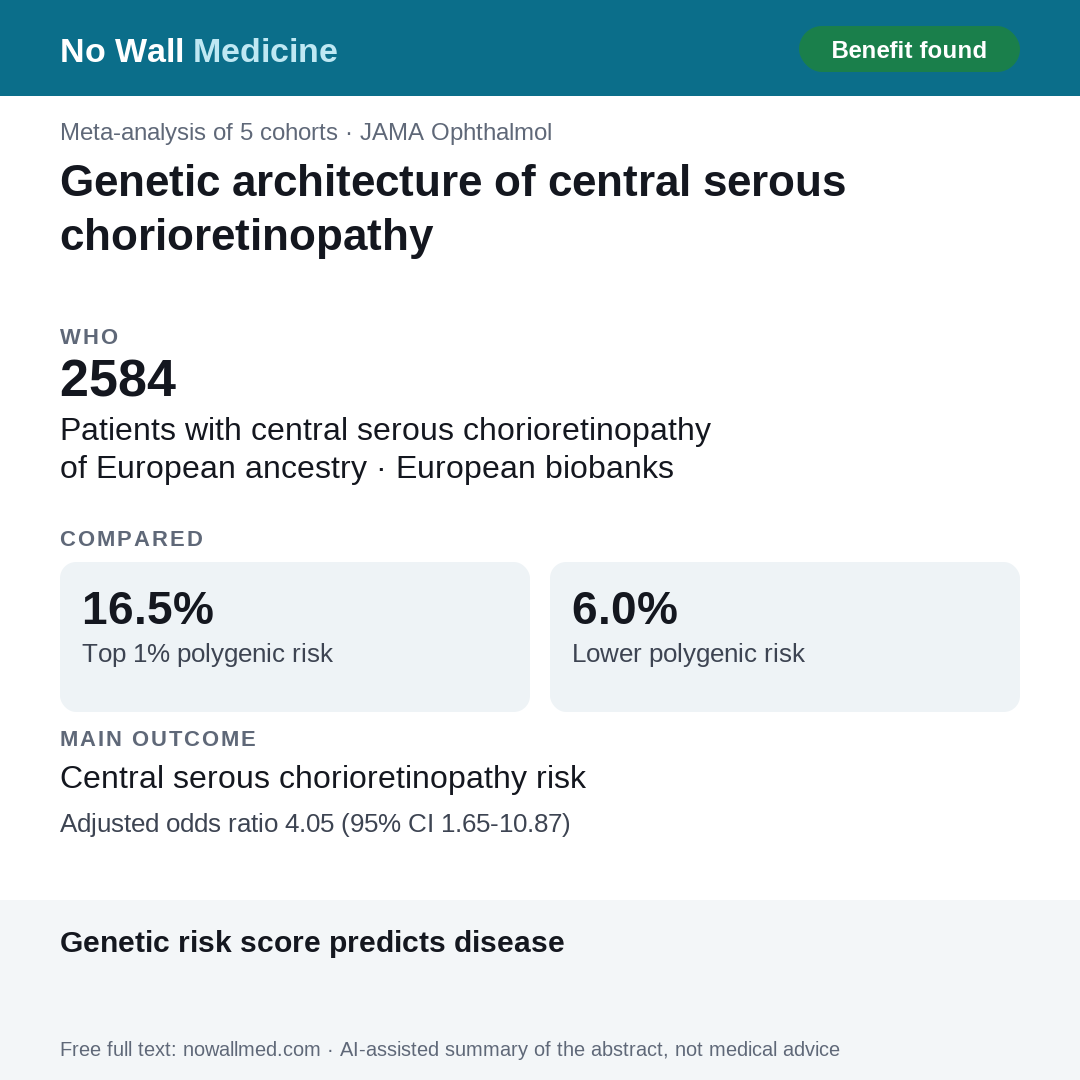
16.5%Top 1% polygenic risk (18/109)
6.0%Lower polygenic risk (8/134)
Main outcome
Central serous chorioretinopathy risk
Result: Adjusted odds ratio 4.05 (95% CI 1.65-10.87)
Bottom line: Genetic risk score predicts disease
JAMA Ophthalmol · 2026-11-05Download image
Why it matters: The pathophysiology of central serous chorioretinopathy remains incompletely understood
Key points
- Researchers studied 2584 patients with central serous chorioretinopathy and 1,044,455 controls.
- The study identified 10 risk loci, including 3 novel loci, for the condition.
- A genetic risk score predicted abnormalities on macular optical coherence tomography in high-risk participants.
Headline and key points written with AI from the paper’s abstract, with every number checked against it. Read the paper before relying on them.
Cite this article
Chen L, Kim SHF, Truong B, Rämö JT, Gorman BR, van Dijk EHC. Genome-Wide Association Study Meta-Analysis of Central Serous Chorioretinopathy. JAMA Ophthalmol. 2026. doi:10.1001/jamaophthalmol.2026.4427
Spotted a mistake? Suggest a correction