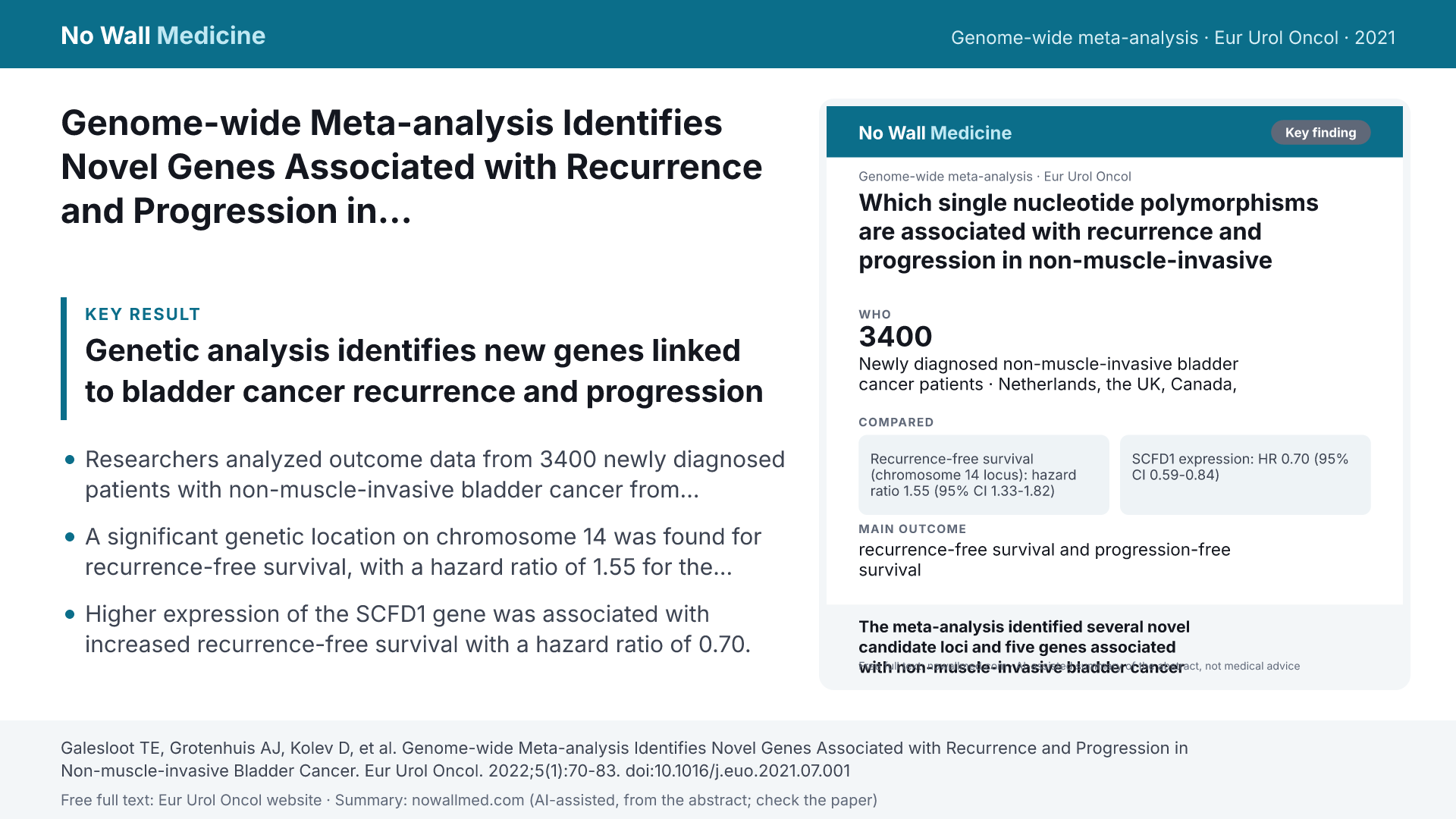
Genetic analysis identifies new genes linked to bladder cancer recurrence and progression
Genome-wide Meta-analysis Identifies Novel Genes Associated with Recurrence and Progression in Non-muscle-invasive Bladder Cancer
Genome-wide meta-analysisBenefit found
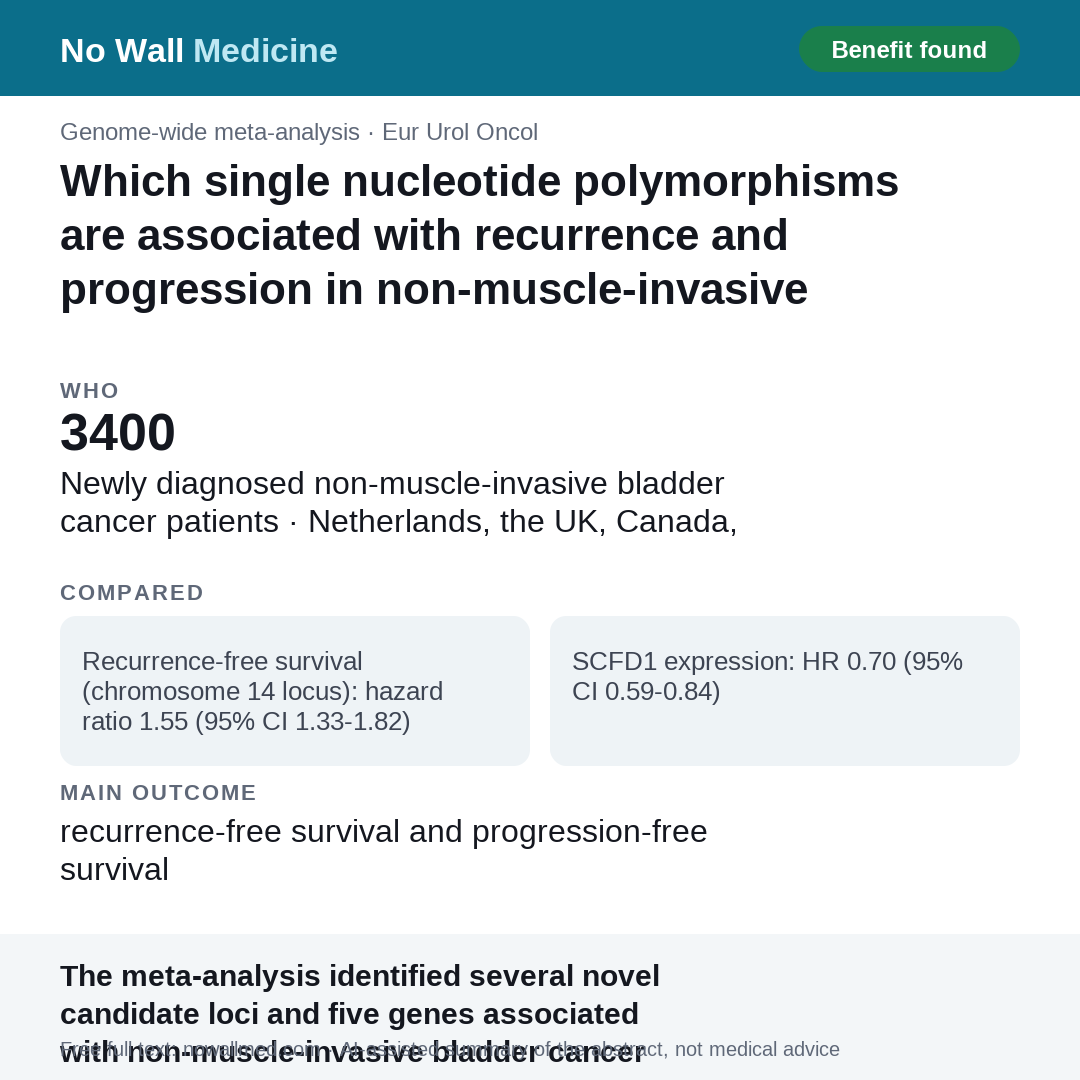
Which single nucleotide polymorphisms are associated with recurrence and progression in non-muscle-invasive bladder cancer?
Who
3400
Newly diagnosed non-muscle-invasive bladder cancer patients · Netherlands, the UK, Canada, and Spain
Compared
Recurrence-free survival (chromosome 14 locus): hazard ratio 1.55 (95% CI 1.33-1.82)
SCFD1 expression: HR 0.70 (95% CI 0.59-0.84)
Main outcome
recurrence-free survival and progression-free survival
Result: hazard ratio 1.55 (95% CI 1.33-1.82)
Bottom line: The meta-analysis identified several novel candidate loci and five genes associated with non-muscle-invasive bladder cancer recurrence or progression.
Limitation: The roles and mechanisms of these genes should be investigated in future studies.
Eur Urol Oncol · 2021-08-02Download image
Clinical question: Which single nucleotide polymorphisms are associated with recurrence and progression in non-muscle-invasive bladder cancer?
Why it matters: The biological mechanisms behind why non-muscle-invasive bladder cancer frequently recurs or progresses in stage and grade are not fully understood.
Key points
- Researchers analyzed outcome data from 3400 newly diagnosed patients with non-muscle-invasive bladder cancer from the Netherlands, the UK, Canada, and Spain.
- A significant genetic location on chromosome 14 was found for recurrence-free survival, with a hazard ratio of 1.55 for the C versus T allele.
- Higher expression of the SCFD1 gene was associated with increased recurrence-free survival with a hazard ratio of 0.70.
Headline and key points written with AI from the paper’s abstract, with every number checked against it. Read the paper before relying on them.
Was this summary helpful?
Subject terms
Cite this article
Galesloot TE, Grotenhuis AJ, Kolev D, et al. Genome-wide Meta-analysis Identifies Novel Genes Associated with Recurrence and Progression in Non-muscle-invasive Bladder Cancer. Eur Urol Oncol. 2021. doi:10.1016/j.euo.2021.07.001
Spotted a mistake? Suggest a correction