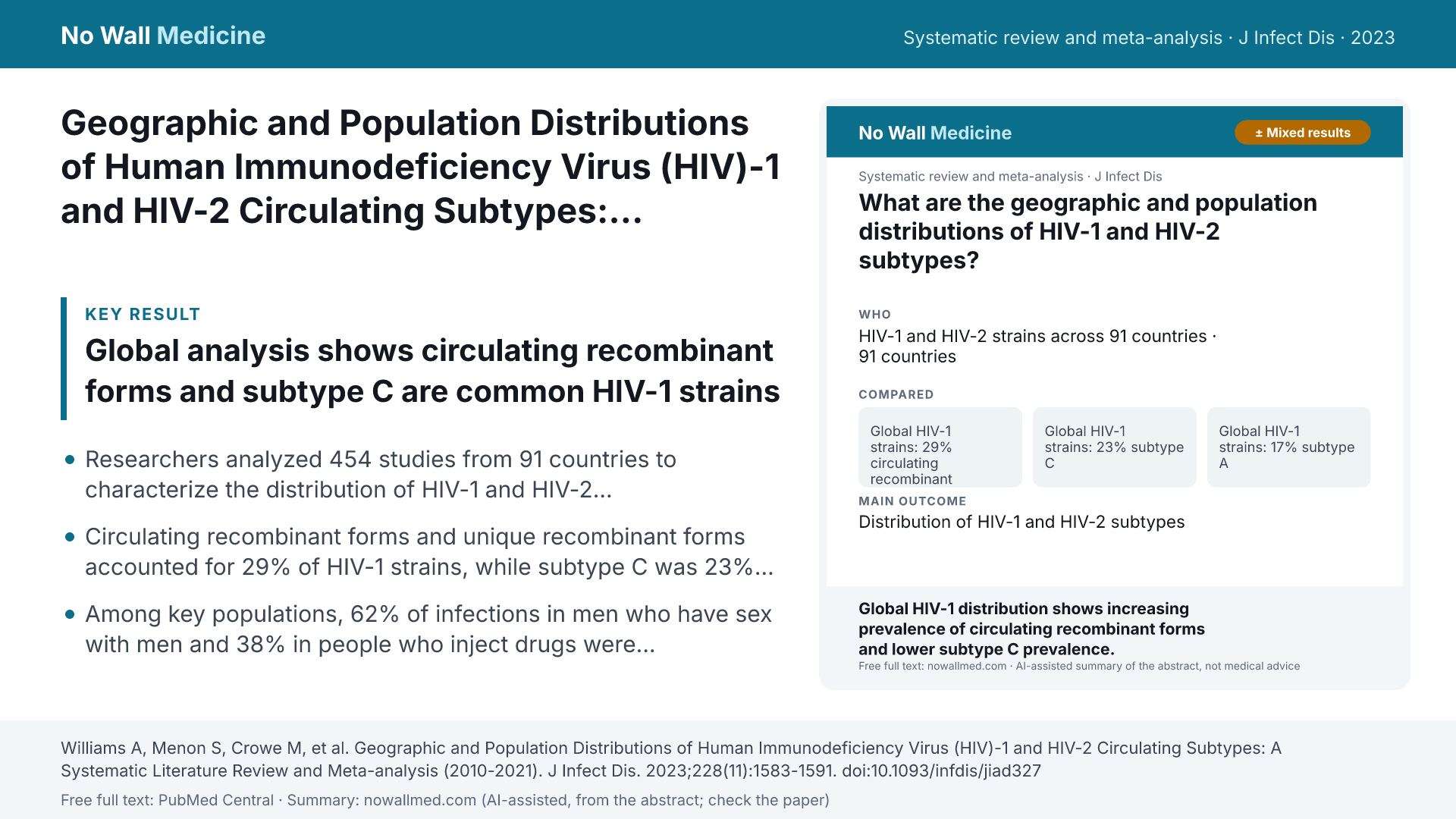
Global analysis shows circulating recombinant forms and subtype C are common HIV-1 strains
Geographic and Population Distributions of Human Immunodeficiency Virus (HIV)-1 and HIV-2 Circulating Subtypes: A Systematic Literature Review and Meta-analysis (2010-2021)
Systematic review and meta-analysisMixed results
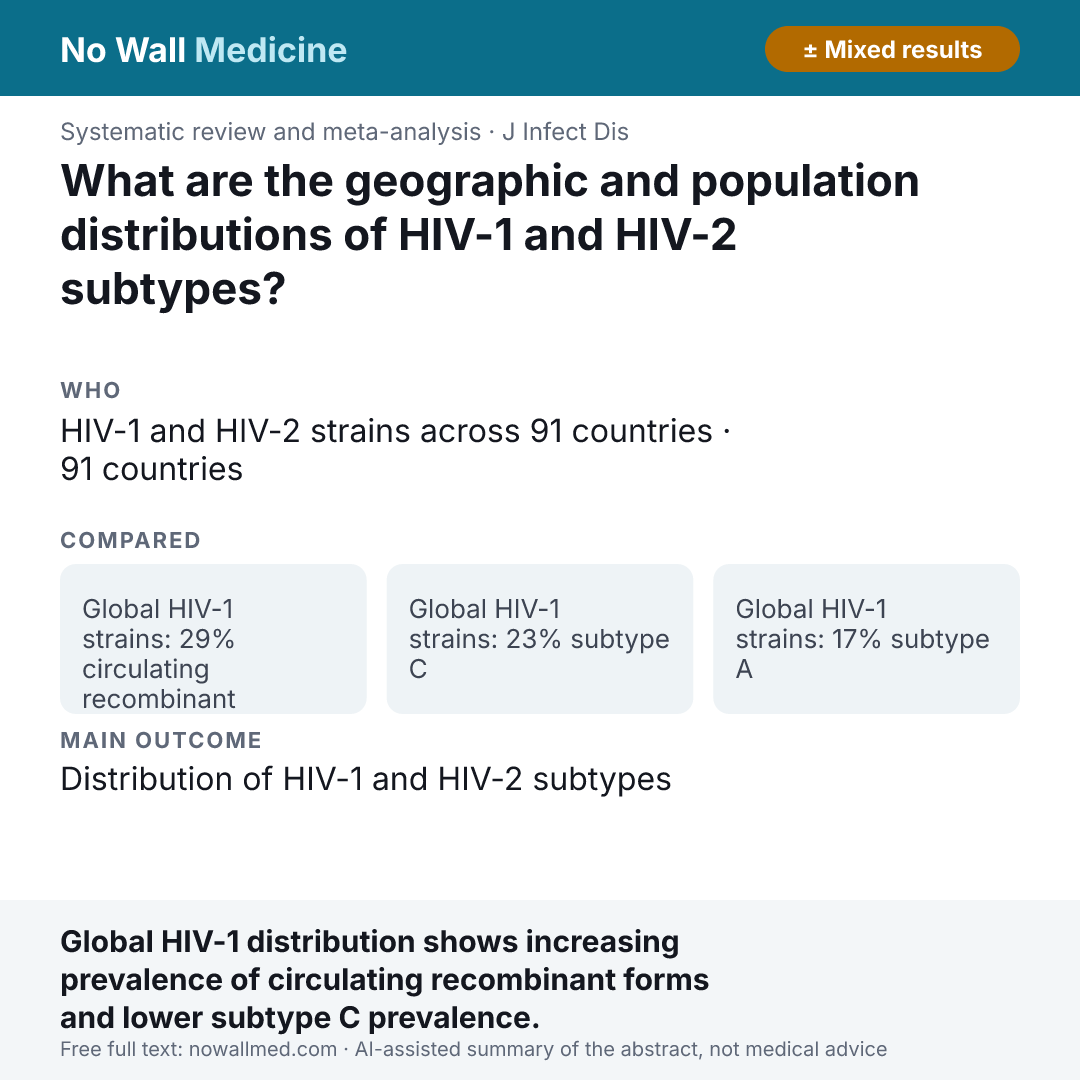
What are the geographic and population distributions of HIV-1 and HIV-2 subtypes?
Who
HIV-1 and HIV-2 strains across 91 countries · 91 countries
Compared
Global HIV-1 strains: 29% circulating recombinant forms/unique recombinant forms
Global HIV-1 strains: 23% subtype C
Global HIV-1 strains: 17% subtype A
Main outcome
Distribution of HIV-1 and HIV-2 subtypes
Bottom line: Global HIV-1 distribution shows increasing prevalence of circulating recombinant forms and lower subtype C prevalence.
Limitation: Data on HIV-2 were limited.
J Infect Dis · 2023-08-18 · Save PNG
Clinical question: What are the geographic and population distributions of HIV-1 and HIV-2 subtypes?
Why it matters: The high genetic mutation and recombination rates of HIV pose challenges for vaccine development that requires targeting various subtypes.
Key points
- Researchers analyzed 454 studies from 91 countries to characterize the distribution of HIV-1 and HIV-2 subtypes between 2010 and 2021.
- Circulating recombinant forms and unique recombinant forms accounted for 29% of HIV-1 strains, while subtype C was 23% and subtype A was 17%.
- Among key populations, 62% of infections in men who have sex with men and 38% in people who inject drugs were recombinant forms.
Limitation the authors note: Data were limited regarding HIV-2.
Headline and key points written with AI from the paper’s abstract, with every number checked against it. Read the paper before relying on them.
Was this summary helpful?
Subject terms
Headline, design, result, key points, caveat and citation as plain text.
Cite this article
Williams A, Menon S, Crowe M, et al. Geographic and Population Distributions of Human Immunodeficiency Virus (HIV)-1 and HIV-2 Circulating Subtypes: A Systematic Literature Review and Meta-analysis (2010-2021). J Infect Dis. 2023;228(11):1583-1591. doi:10.1093/infdis/jiad327
Spotted a mistake? Suggest a correction